
Semrush vs Moz 2026: Is Moz Pro Still Relevant for SEO Teams?
If you’re choosing between an SEO platform in 2026, the Semrush vs Moz debate is less about which tool offers more features
Both can address the basics, but the discussion turns to what happens once your SEO operations grow in scale and complexity.
A solo marketer can work effectively in one tool, but the requirements for a five-person team juggling multiple sites, markets, and content programs are considerably more involved.
The same applies to technical SEO: The needs of an in-house team are different from an agency’s, and both are distinct from an enterprise-level operation.
These differences are even more apparent in 2026, as Google’s search environment grows increasingly reliant on AI, and alternative discovery channels like ChatGPT, Gemini, and Perplexity take an increasing role in the customer journey. Semrush has responded to these conditions by introducing the AI Visibility Toolkit, which tracks brand mentions and citations across AI search platforms.
So, is Moz Pro obsolete?
Not necessarily, but it’s no longer a default recommendation for most SEO teams.
I’ll explain what distinguishes Moz Pro from Semrush and provide guidance on which option is worth considering in your specific situation.
Semrush vs Moz 2026 SEO Tools: Quick Overview
Semrush is the preferred choice for scaling SEO teams, while Moz Pro remains useful as a lighter alternative for narrower SEO-focused tasks.
Moz Pro: Good for focused SEO operations with simple requirements like rank tracking, keyword research, and backlink analysis. Moz offers a simplified interface for fundamental SEO tasks, while its Domain Authority remains among the most reliable third-party metrics available for link evaluation.
Semrush: A better fit for complex SEO operations that require in-depth analysis of competitors, extensive keyword research, technical SEO audits, content creation assistance, and visibility tracking across multiple channels, including AI search.
Semrush vs Moz: The Core Difference
The easiest way to start the Semrush vs Moz comparison is to recognize that Moz Pro is primarily an SEO tool, whereas Semrush has evolved into a marketing intelligence platform that includes SEO as a pillar capability.
It’s not that Moz lacks the broader marketing features; it simply has them to a lesser extent, and they’re generally more narrowly focused.
Moz has long been known for its approachable SEO software, offering straightforward solutions for keyword research, rank tracking, crawling, and backlink analysis. In recent years, it has expanded into related areas like local SEO, social media analytics, and paid search, but they remain supplementary to its core competencies.
Semrush covers similar SEO areas, but it also addresses advertising, content, and social media with greater depth, along with emerging opportunities like AI-driven search.
Its current SEO Toolkit includes keyword research, position tracking, comprehensive website auditing, competitor research, reporting, and other SEO features. Semrush’s 2026 plans range from Pro, suitable for independent SEOs or small businesses, to Guru and Business, which offer more robust features and greater project limits.
In most cases, Semrush is the more comprehensive option, but it’s worth asking whether you need all the features a broad marketing intelligence platform offers.
Semrush vs Moz Pricing in 2026: Value vs Budget
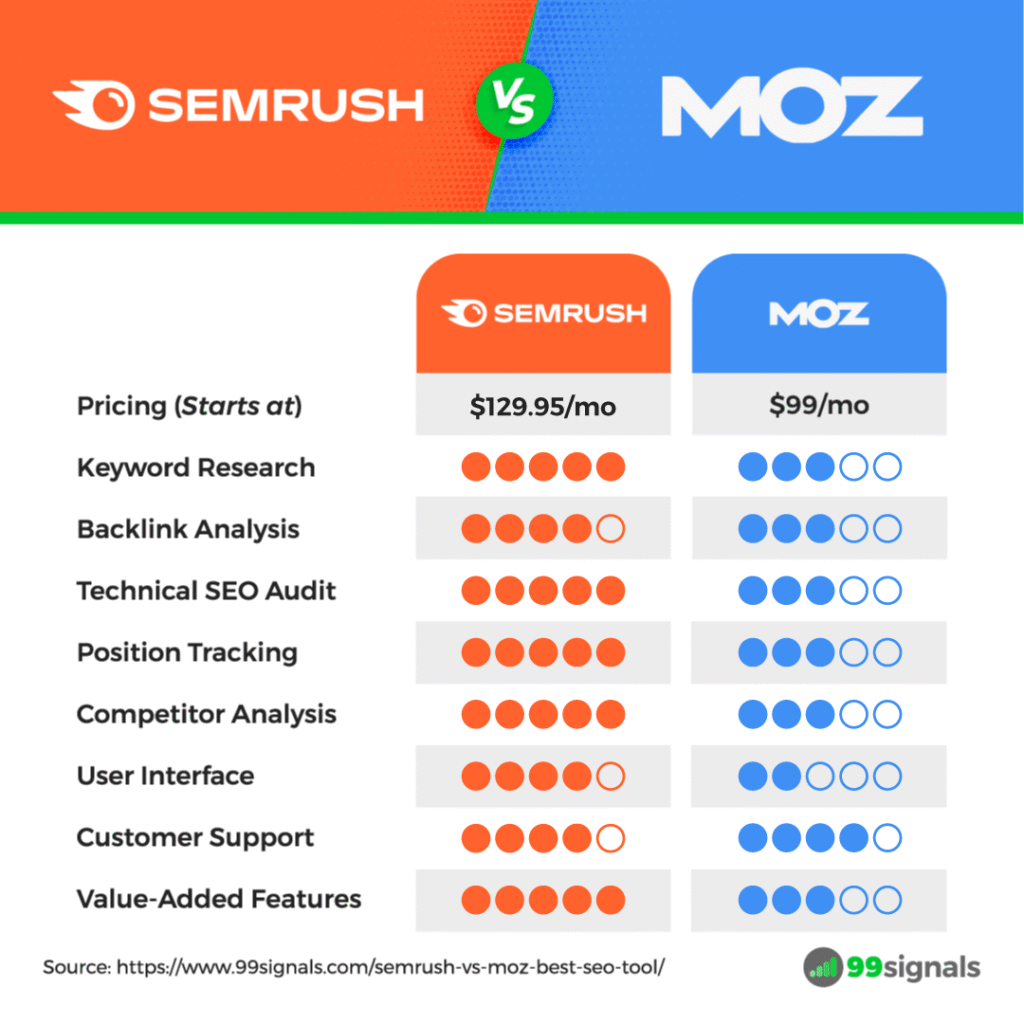
One of the most apparent differences between Semrush vs Moz is the price, which is why budget considerations often drive the selection process.
However, a frequently overlooked detail is that a cheaper option is not always more affordable.
To evaluate which solution offers better value for money, consider how much you’ll be able to accomplish with the selected plan.
Semrush’s current SEO Toolkit pricing in 2026 is as follows:
| Plan | Price ($/Month) | # of Websites | Tracked Keywords | Crawl Limit |
|---|---|---|---|---|
| Pro | $139.95 | 5 | 500 | 100,000 pages |
| Guru | $249.95 | 15 | 1,500 | 300,000 pages |
| Business | $499.95 | 40 | 5,000 | 1,000,000 pages |
Semrush also unlocks additional report templates, more keyword-level metrics, historical data access, multi-targeting, report customization in Looker Studio, API access, and share-of-voice analysis at higher plan levels.
An important development in 2026 is that Semrush’s AI Visibility Toolkit, which tracks brand mentions and cites across AI search platforms, has joined the pricing structure as an add-on. The base plan for AI visibility starts at $99 per month, per domain, billed annually.
It’s also worth noting that Semrush vs Moz Pro value calculations are not directly comparable in 2026. This is due to changes on both sides, including evolving plans and additional services. Always ensure you’re reviewing the most up-to-date figures when comparing Semrush vs Moz or any other SEO software.
For most small SEO teams, a larger platform with features they barely use is an expensive extravagance. At the same time, such teams may struggle to extract meaningful insights from an enterprise-level solution.
By contrast, an agency that manages multiple clients will benefit from the expanded capabilities and richer reporting Semrush offers, as it addresses more areas without requiring separate software for competing research, rank tracking, or link-building analysis.
Semrush vs Moz Pro: Keyword Research Comparison
The difference between Semrush vs Moz becomes most apparent when you examine the keyword research tools and options.
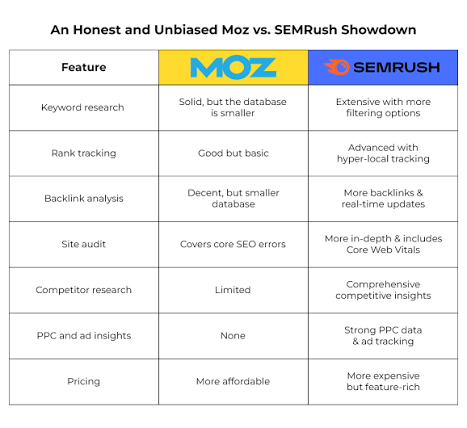
Moz offers a broad range of keyword research features, including volume estimates, difficulty scores, SERP snapshots, and related terms exploration. For many users, this is sufficient to support their content and product research needs.
However, if you’re managing a competitive space where keyword research is highly contested, these capabilities may not be enough. As you’re aware, the true value of keyword research lies in understanding which terms your competitors are targeting and which ones you can capitalize on.
This is where Semrush excels at the keyword research aspect of Semrush vs Moz competition.
It has more comprehensive tools for competitive analysis, including insights into competitors’ best-performing keywords, gaps in your keyword coverage, SERP feature analysis, and content opportunities. You’ll get more value out of Semrush if competitive research is a regular part of your SEO workflow.
The sheer volume of data is also noteworthy: Semrush holds 26.7 billion keywords in its library, compared to 1.25 billion on Moz, per the Semrush vs Moz comparison page. Of course, it’s wise to treat these figures with caution, as both companies tend to update them periodically.
For global companies with an interest in untapped niche markets, this discrepancy could be significant. At the same time, a local business with a limited set of potential keywords is unlikely to benefit substantially from the additional volume.
Verdict
Winner: Semrush for competitive analysis and extensive keyword library. Moz remains adequate for basic keyword research and recommendations.
Semrush vs Moz Competitor Analysis: Which is Better?
I’m going to say Semrush here, at least for professional SEO teams.
SEO is rarely an island these days, which means your competitors are constantly doing things you need to be aware of and, ideally, respond to. They’re publishing new content, acquiring backlinks, improving their websites, targeting new keywords, and exploring alternative promotion avenues, including AI search.
The same principles apply to local businesses and large corporations: In both cases, you need to keep track of what your competitors are doing to maintain a competitive edge.
That is where Semrush shines in the Semrush vs Moz debate, as it offers more extensive and nuanced competitive intelligence than Moz Pro.
A competitor analysis in Semrush can be as simple as identifying which domains are ranking for your target keywords, but the tool also helps you go deeper and analyze which SERP features your competitors are leveraging, what content upgrades they’re making, and how they’re allocating resources across different channels.
In 2026, Semrush introduced the AI Visibility Toolkit, which is set to change the nature of competitive analysis for years to come. In particular, the Semrush AI Visibility analysis feature highlights prompts where your competitors appear in AI search results while recommending your brand. This is invaluable insight, as it enables you to counter their presence in AI search directly.
That being said, traditional competitor research still serves a critical purpose, and Semrush continues to address it better than any other SEO tool.
You can use Semrush’s link analysis features to keep track of your competitors’ best-performing backlinks, evaluate their quality, and look for opportunities to attract similar links. The same applies to their content and technical SEO practices, with the ability to conduct gap analyses and prioritize high-value improvements.
Verdict
Winner: Semrush provides more comprehensive competitive analysis and research options for SEO.
Moz Pro vs Semrush: Backlink Analysis Tools
Semrush vs Moz Pro backlink analysis tools are arguably the closest in terms of breadth, depth, and practical application.
Moz has a considerable lead when it comes to link-building features, as they pioneered many of them. Their Domain Authority has become an industry standard, and similar metrics are often used as proxies for Google’s internal ranking factors.
With that said, it’s important to remember that there are no official metrics from Google, and domain authority scores are best used for comparative analysis.
When comparing Semrush vs Moz for backlinks, you should go beyond domain authority and look at individual link metrics. Pay close attention to referring domains, anchor text distribution, link quality, relevance, and other factors. Semrush and Moz offer similar lists of metrics, although the former frequently unlocks additional options at higher plan levels.
Another crucial consideration for Semrush vs Moz backlink analysis is the link-building research and competitive intelligence features.
Can you easily identify high-value opportunities, analyze your competitors’ backlink profiles, and determine which link-building tactics they’re using? Semrush offers powerful options in this regard, and an expanded competitive research ecosystem makes it easier to leverage this intelligence.
If your team only needs basic backlink-building analysis, Moz is a viable option. However, Semrush is more useful in competitive environments and when you need in-depth data about individual links and their characteristics.
Verdict
Close call, but I’m going to give this one to Semrush for its competitive research and comprehensive link-building analysis features.
Semrush vs Moz for Technical SEO Evaluation
There isn’t much to say about the Semrush vs Moz technical SEO audit tools, as both platforms offer a variety of crawler-based solutions to address common issues.
These include broken links, canonicalization errors, duplicate content, indexing problems, structured data errors, redirects, HTTPS malfunctions, internal linking, and more. Both Semrush vs Moz crawlers can detect most of these issues, but more comprehensive solutions are typically available in premium plan levels.
The main consideration for technical SEO crawlers in 2026 is your website’s scale. A small personal blog has vastly different requirements from an enterprise-level site with hundreds of thousands of pages.
Semrush’s current SEO Toolkit limits are particularly relevant for larger sites, as Pro, Guru, and Business plans allow you to crawl 100,000, 300,000, and 1,000,000 pages per month, respectively.
That said, no single crawler, including Semrush, is entirely reliable, which is why it’s crucial to perform a technical SEO audit using additional tools and validation methods. Relying on a third-party crawler is only an option when you lack the internal capacity to address all issues identified during the audit.
Google Search Console and Analytics can help you confirm the accuracy of a technical SEO audit.
Verdict
Semrush has an edge for larger-scale operations, but both platforms are otherwise similar.
Semrush vs Moz Rank Tracking: Similar, But Different Enough
A feature-rich rank tracking system is the cornerstone of any SEO effort, and Semrush vs Moz Pro both offer competitive options.
In most cases, though, rank tracking is only part of the equation, as you need to interpret these results in the context of your overall SEO strategy.
A good starting point for comparing Semrush vs Moz rank tracking is to look at the metrics you’ll be able to analyze.
Are you only interested in first-page keywords, or do you also want to track second and third positions? Do you want to segment your results by country or device type to spot differences in local and desktop/mobile performance?
For larger organizations, long-tail keyword tracking is typically much more valuable than first-page visibility. Semrush vs Moz both offer this capability, but Semrush provides more flexibility and depth, particularly at higher plan levels.
I find position tracking most useful when it’s combined with additional insights, such as SERP feature analysis, competitor intelligence, and trends data.
Semrush has more competitive intelligence features built into its rank tracking, but both Semrush vs Moz options are useful in different situations. Your exact requirements will dictate which solution is more valuable for you.
Verdict
Both Semrush vs Moz rank tracking systems are excellent, but Semrush offers more options and customization at higher plan levels.
Semrush vs Moz SEO Tools for Teams
At this point, I think it’s worth addressing the Semrush vs Moz comparison from another angle. So far, I’ve focused on individual capabilities, but a more productive discussion is about what makes more sense for your team.
A solo marketing generalist
If you’re a solo marketer, it’s worth reconsidering the Semrush vs Moz decision, as a heavy marketing intelligence platform may offer too many features for your needs. It’s unlikely you’ll use Moz or Semrush to their absolute capacity if you only have a few sites, keywords, and competitors to track.
In this situation, Moz is preferable due to its simplicity, but you should always take your specific requirements into account.
A small in-house SEO team
If you’re managing a small team, Semrush vs Moz evaluation considerations are different from those applicable to larger organizations. I’m going to assume your capacity is approximately three people: one technical SEO specialist, one content strategist, and one SEO manager. If that’s the case, Moz may no longer be the best option due to its limited feature set.
Semrush, by contrast, starts to look much more compelling, at least in theory. You can use the same platform to address multiple aspects of your SEO operations, including competitive research, content creation, and technical maintenance.
Which SEO Tool to Choose For an SEO agency
If you’re with an agency, I’m almost certain Semrush is the right option for you. Agencies operate differently from in-house teams, as they typically have multiple clients with diverse requirements. This is where the Semrush vs Moz differences are relevant, as you’re likely to need more comprehensive solutions.
I’m not suggesting Moz can’t support an agency; it can and does, but only in specific circumstances. Semrush has an advantage due to its broader range of features, including marketing intelligence, content creation assistance, competitive research, and visibility tracking.
This is particularly beneficial when dealing with multiple clients since you can rely on a consistent set of features rather than having to use several different platforms.
Verdict
Moz is suitable for solo workers due to its lightweight nature, and small in-house teams can use either option depending on their requirements. Larger in-house teams and agencies should consider Semrush due to its more extensive capabilities.
Is Moz Still Worth Using in 2026?
Yes, but not by default. The same applies to Semrush, which continues to evolve and introduce new features every year.
Moz is worth buying if your team prioritizes focused SEO operations over general marketing intelligence. Moz Pro offers a streamlined experience with useful features like keyword research, rank tracking, and backlink analysis. It’s more intuitive than most alternatives and better suited for teams that only need fundamental SEO solutions.
Moz Pro is insufficient if your team needs extensive competitive analysis, comprehensive marketing intelligence, or advanced content creation assistance.
Verdict
Moz is still relevant but only for specific use cases.
The AI Search Question in Semrush vs Moz
One of the reasons Semrush has overtaken Moz in the broader SEO discussion is its response to the rise of AI search. Traditional SEO practices are no longer sufficient in the age of chatbots, and brands need to rethink their online visibility strategies.
In 2026, Semrush addressed this challenge by introducing the AI Visibility Toolkit, which highlights prompts where your brand appears in AI search results.
This is an essential feature, as it empowers marketers to take direct action and appear in the same prompts where their competitors are visible. Semrush, in turn, provides options to address these opportunities, including link acquisition, content creation, brand mentions, and citations.
That being said, nothing about traditional SEO has changed, which means you should continue to follow established practices. Search engines like Google remain critical to your SEO performance, and a comprehensive strategy will continue to involve multiple channels and formats.
If you’re looking at Semrush vs Moz to determine which is better at addressing AI search, the answer is Semrush, at least for now. You’ll need to use additional tools to fully benefit from AI Visibility, including link-building and content creation solutions.
Verdict
Semrush has taken the lead over Moz in addressing the opportunities presented by AI search.
Five Questions to Ask Before Selecting an SEO Platform
Instead of comparing Semrush vs Moz, it’s more productive to formulate questions that will help you identify the best SEO tool for your specific needs. Here are five important considerations.
1. Is your SEO operation simple or complex?
If you only need basic tools to manage one website and a handful of keywords, Moz is likely the right choice. Semrush is more appropriate for complex multi-site, multi-market operations with extensive competitive research needs.
2. Is competitive research a priority?
If so, select the option that offers the most comprehensive competitive analysis features.
3. Do you need to address multiple marketing channels?
Choose a platform that includes SEO, PPC, content, and social media to maximize efficiency.
4. Are you looking to track AI visibility?
If yes, find out which tool has the most relevant features for this purpose.
5. Will you be using advanced features?
This is a frequently overlooked consideration, as an expensive platform with complex interfaces can fail to deliver if you only need a few basic features. Use the tools you actually need, not the ones you think you should be using.
Semrush vs Moz: Which SEO Tool is Better? Use Case Comparison
| Use Case | Better Fit |
|---|---|
| Beginner SEO | Moz |
| Solo SEO specialist | Moz or Semrush |
| Small local business | Moz |
| Small SEO team | Moz or Semrush |
| Growing in-house SEO team | Semrush |
| SEO agency | Semrush |
| Large website | Semrush |
| Technical SEO-heavy operation | Semrush |
| Competitor intelligence | Semrush |
| SEO + PPC research | Semrush |
| Simple rank tracking | Moz |
| Focused link analysis | Moz |
| Large-scale keyword research | Semrush |
| AI visibility strategy | Semrush |
| Multi-market SEO | Semrush |
| Teams that prioritize simplicity | Moz |
This is not an exhaustive list, but these are the typical considerations for the Semrush vs Moz debate.
Common Errors in SEO Platform Selection
I’ve spent the better part of this article discussing the differences between Semrush vs Moz, but it’s also worth mentioning the common mistakes to avoid.
Error 1: Getting caught in the brand snare
A marketing platform’s brand image rarely has any bearing on its actual usefulness. I’ve seen too many people get talked into buying a more expensive product simply because it has a nicer name.
Error 2: Getting overwhelmed by the number of features
Additional features do not matter if they’re unnecessary for your operations. In many cases, a smaller product with a more straightforward interface is more useful than a comprehensive but overly complex solution.
Error 3: Only considering the subscription price
Always analyze the value you get for the price. I’ve witnessed too many teams wasting money on underused enterprise-level plans when a more affordable alternative would have been significantly more appropriate for their needs.
Error 4: Mistaking authority metrics for Google metrics
Both Semrush Authority Score and Moz Domain Authority are useful, but they’re only comparative metrics. In other words, these scores are meant to help you understand how one domain performs relative to another, rather than indicate Google’s internal ranking directly.
Error 5: Disregarding first-party data
Supplement your SEO platform with Google Search Console and Analytics rather than relying on one or the other exclusively.
Error 6: Overlooking the impact of AI search
Always evaluate how relevant an SEO tool is for modern discoverability needs.
Error 7: Failing to define your requirements
Always start with your specific requirements rather than the other way around.
What SEO Metrics Should You Track in 2026?
The most effective SEO organizations are shifting toward a more holistic approach, which typically involves tracking five types of metrics. The traditional focus on traffic is no longer sufficient, as there are more important things to measure.
1. Visibility
This refers to your general presence in search results.
2. Rankings
You need to track which keywords and SERP features contribute to your visibility.
3. Traffic
Rankings are only meaningful when they translate into actual visits.
4. Business outcomes
It’s critical to measure how your traffic affects your bottom line, whether it’s leads, trials, customers, or revenue.
5. AI visibility
This is an essential addition to the traditional SEO metrics, as it indicates how your brand shows up in AI search results.
Semrush’s AI Visibility Toolkit is currently the best option for monitoring this trend, as it provides valuable insights into mentions, citations, audience, and visibility at scale for multiple large language models (LLMs).
I’m going to assume that these are the minimum metrics to track, but you should always supplement them with additional data depending on your industry and specific requirements.
What I Would Say to Various Types of Businesses
If I’m advising a small business on SEO, I would not immediately suggest they use Semrush. Moz can be a perfectly acceptable solution if the company doesn’t have extensive requirements.
By contrast, an in-house team supporting a SaaS company has a much stronger case for adopting Semrush. I would highlight the value of a comprehensive platform, including its extended competitive research opportunities, content creation assistance, and visibility tracking features. This is even more relevant for international expansion, as Semrush supports multiple markets.
I’m going to give the same recommendation to an agency, as they will benefit from the same opportunities available to an in-house team. Their ability to provide value to clients is directly tied to their capacity to leverage competitive insights across multiple areas and markets.
If a company is aggressively pursuing opportunities in AI search, I would bring up Semrush’s AI Visibility Toolkit. It’s a worthwhile addition for such teams, as it explicitly addresses this emerging area with relevant metrics and opportunities.
However, I would ask more questions before making any recommendation, as the SEO tool needs to serve the team’s actual requirements rather than the other way around.
The Bigger SEO Lesson
The Semrush vs Moz controversy is a symptom of a bigger shift in SEO.
SEO teams used to ask the question:
“How do we rank for X keyword?”
The modern SEO asks the question:
“Why is my competitor ranking for this topic?”
“What information is my audience missing?”
“Where is our content lacking?”
“Which markets are we failing to dominate?”
“Which posts are earning links and mentions?”
“What is the SERP rewarding?”
“Are AI systems discovering & recommending our brand?”
SEO software is no longer about the longest list of features.
It is now about the ability to answer these questions.
If you need assistance in tying together technical SEO, content, visibility, and your business objectives, Digehub SEO services can provide that much needed strategic layer on top of your software stack.
Because software can tell you what is happening.
You need a strategy to tell you what should happen.
Semrush vs Moz 2026: Final Verdict
So, is Moz Pro still a viable option for SEO teams in 2026?
Yes, but it depends on what your team needs.
Moz is still a viable option for companies that want to limit their exposure to the marketing stack and focus on SEO-specific features.
Semrush is a better fit for most SEO teams that want to leverage competitive research, SEO, technical SEO, content, and marketing data, including AI visibility.
My unbiased opinion is that you should go with Moz if you want something simple and dedicated to SEO.
Go with Semrush if you want a competitive edge and need to understand the bigger picture.
And if you are somewhere in the middle, stop looking at logos and think deeper about your use case and requirements.
List what your team does on a daily basis.
Now, look at what these platforms can help you do faster or better.
That is how you should evaluate the Semrush vs Moz 2026 debate.
Frequently Asked Questions
SEO teams should start by defining their actual workflow and business objectives. If the priority is simplicity, focused SEO research, and straightforward rank tracking, Moz Pro may be sufficient.
If the team needs competitive intelligence, large-scale keyword research, technical SEO, content insights, multi-market analysis, broader marketing data, and AI visibility monitoring, Semrush is generally the stronger choice. The right platform is the one that supports the team’s current maturity without creating unnecessary complexity.
No. Both platforms should be treated as research and analysis systems rather than complete sources of truth.
SEO teams should combine third-party SEO data with first-party information from tools such as Google Search Console, Google Analytics, website analytics, conversion data, and actual business performance. The best SEO decisions come from combining these sources rather than relying on a single platform’s metrics.
Semrush is generally the stronger option for international SEO because larger organizations often need broader keyword research, competitor analysis, market-level visibility, rank tracking, and reporting capabilities. Moz Pro can still support international SEO, particularly for smaller operations, but Semrush becomes more useful when multiple countries, languages, competitors, and websites are involved.
Teams should compare the platforms based on the amount of useful work each one enables them to complete.
This includes keyword coverage, competitor intelligence, technical SEO capabilities, rank tracking, backlink research, reporting, project limits, crawl capacity, AI visibility capabilities, and the amount of manual work required outside the platform. A cheaper subscription can become more expensive if the team needs several additional tools to fill capability gaps.
A switch can make sense when a company’s SEO requirements outgrow Moz Pro’s capabilities. Common triggers include managing multiple websites, expanding internationally, conducting deeper competitor research, increasing content production, requiring more advanced reporting, or wanting to monitor AI search visibility.
The decision should be based on workflow requirements rather than simply choosing the platform with more features.
It can be. A small business managing one website and needing basic keyword research, rank tracking, backlink analysis, and technical SEO may not need the broader capabilities of Semrush. In that situation, Moz Pro can provide a more focused SEO workflow without requiring the business to manage a much larger marketing intelligence platform.
Semrush is generally the stronger choice for agencies managing multiple clients because its broader research, reporting, competitive intelligence, and project capabilities can support more complex client workflows. However, an agency serving a small number of clients with straightforward SEO requirements may find Moz Pro sufficient.
Semrush has a stronger position for teams that want to combine traditional SEO with AI visibility monitoring. Its AI Visibility Toolkit is designed to track how brands appear across AI search experiences and identify competitive opportunities. Moz Pro remains more focused on traditional SEO workflows, so teams prioritizing AI search visibility may need additional tools alongside Moz.
Yes. Moz Pro remains capable of identifying many common technical SEO issues, including broken links, duplicate content, redirects, canonicalization problems, and other crawl-related issues. However, Semrush tends to provide a broader technical SEO workflow, particularly for larger websites where crawl limits, prioritization, reporting, and integration with other SEO research become more important.
Semrush is generally better suited to enterprise SEO teams because it provides broader competitive research, larger-scale keyword analysis, technical SEO capabilities, reporting, and multi-market workflows. Moz Pro can still work for teams with narrower SEO requirements, but Semrush becomes more valuable as the number of websites, markets, competitors, and stakeholders increases.
The Bottom Line
Semrush vs Moz 2026 debate is not about which tool is better, but what teams need at this stage in their SEO maturity.
Moz Pro is still a valid option, but Semrush offers a more comprehensive solution for companies that need to track and report on a larger scale.
For most companies, Moz will be sufficient for a basic SEO workflow.
Semrush is better for companies that want to take their SEO to the next level and work with external agencies.
At the end of the day, the right platform will empower your teams by providing the information they need to make better choices, without getting caught up in the noise.
And in 2026, that means asking a slightly different question than you were asked ten years ago:
“How am I visible beyond the search results?”
Because the next big shift in SEO is going to be about how your brand asset fits in with the wider ecosystem, including the visibility in AI.
