
Moz Pro Review 2026: Best SEO Tool for Beginners?
Moz Pro Review 2026: Best SEO Software for Beginners? Best to Buy? Report by TechRadar Editors
If we were to summarize this Moz Pro review in one sentence, we would say that Moz Pro is one of the most beginner-friendly all-in-one SEO platforms but with caution that it might not be the best SEO tool for every beginner in 2026.
This nuance is, in fact, essential.
Moz has a reputable name, a decent backlink index and keyword research base, built-in rank tracking, extended site auditing and SERP analysis, metrics like DA, and is generally more accessible compared to many other SEO software products that flooded the market in recent years. TechRadar staff recently described Moz Pro as an intuitive SEO platform with keyword research, site audit, backlink analysis, rank tracking, page optimization, and AI features.
However, when evaluating SEO software for value, we move beyond the simplistic binary of what features does it offer versus what I need. The most critical question, especially when considering this Moz Pro review, is whether we can extract value from the software in terms of SEO performance that would otherwise be unavailable to us without spending the money.
That is the real reason why we put together this Moz Pro review.
The way we see it, anyone who considers Moz Pro for individual use as a beginner, freelance SEO manager or blogger, wants to know the true extent of its utility and limitations. What can we achieve with Moz Pro, what are the time-saving opportunities that the software offers us, and when should we spend our time and money elsewhere? As you can see, there is rarely a definite answer since it is always a matter of priorities.
Moz Pro Review 2026: Our Honest Thoughts About Buying Moz Pro
Is Moz Pro really worth the money in 2026?
Yes, for the right person.
Moz Pro makes sense as an all-in-one SEO platform that covers keyword research, competitive analysis, backlink monitoring, technical SEO, rank tracking, and on-page optimization tools. It makes even more sense if you are drawn to an intuitive interface.
However, at the same time, we do not recommend Moz Pro to someone with a tiny website footprint who barely has enough budget to pay for the SEO software, needs in-depth competitive analysis and content marketing features, or requires heavy AI-powered search analysis from a single platform.
We have to recognize that the SEO software market is becoming more competitive than when Moz initially positioned itself as an all-in-one solution. TechRadar’s 2026 SEO tool comparison ranked Semrush highest for overall value, Ahrefs as the best backlink analysis tool, and Moz Pro as an intuitive SEO platform in general.
This speaks volumes about the strengths and weaknesses of Moz Pro.
Moz Pro is great if you want to simplify your work with SEO, but it lacks certain critical features that other solutions offer.
Who should use Moz Pro according to our Moz Pro review?
We would recommend Moz Pro if:
- You are new to professional SEO;
- You have a small or medium-sized website;
- You need SEO services for a small business;
- You are a freelance SEO manager working with only a handful of clients;
- You run an affiliate website or want to launch a content-driven blog;
- You need to learn SEO basics, specifically keyword research and competitive analysis;
- You want to utilize an established SEO platform that does not require you to learn a steep learning curve;
- You prioritize core SEO features and do not need an extended marketing ecosystem;
You should consider other SEO software options if:
- You need extensive competitive analysis at scale;
- You want to design large-scale content marketing campaigns;
- You seek heavy PPC research opportunities;
- You need to implement sophisticated keyword clustering techniques;
- You want to automate high volumes of agency operations;
- You need to monitor AI visibility at scale;
- You want to utilize the most comprehensive marketing platform available;
- You have aggressive SEO research goals across multiple domains;
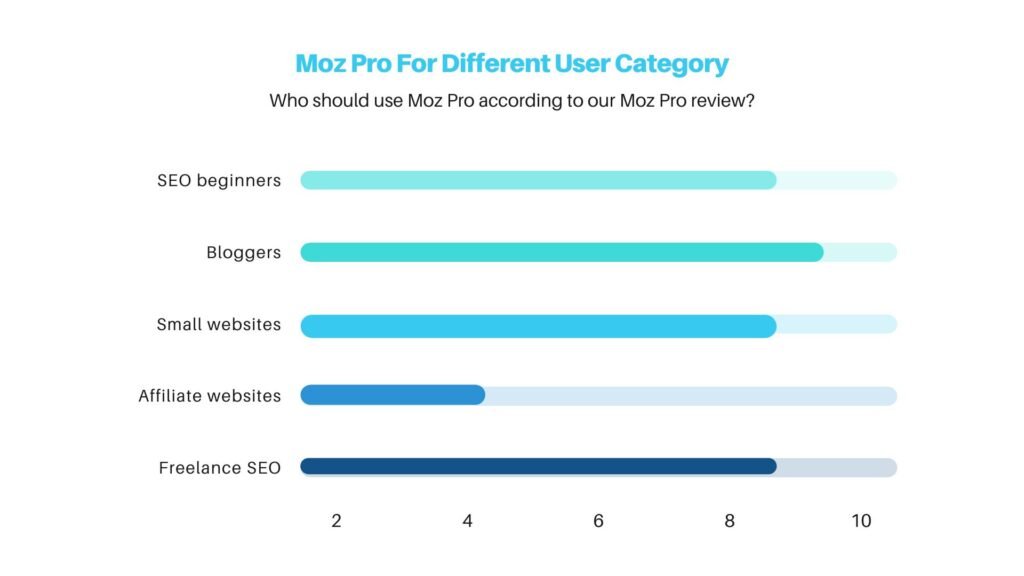
This is not to undermine the value that Moz Pro provides. The point is to understand that different types of businesses need to prioritize different features. With that being said, here is our Moz Pro review for beginner SEOs, bloggers, individuals, and agencies in the form of a rating:
| Users | Our rating | Reasoning |
|---|---|---|
| SEO beginners | 8.5/10 | Accessible core SEO workflow |
| Bloggers | 8.5/10 | Strong keyword and content opportunity research |
| Small websites | 8/10 | Useful, but need to consider the costs |
| Affiliate websites | 8.5/10 | Keyword, SERP and competitor research are valuable |
| Freelance SEO | 8.5/10 | Good core workflow and reporting potential |
| Small businesses | 8/10 | Solid fundamental SEO features |
| Agencies | 7.5/10 | Less competitive alternatives offer more comprehensive workflows |
| Enterprise SEO | 7/10 | Specialized platforms are usually better suited for large-scale operations |
The one thing our marketing team would say before buying Moz Pro
We would not start with a feature list when considering Moz Pro. Instead, we would evaluate how much of the Moz Pro feature set we would need on a monthly basis.
If we only need light SEO services, such as researching 20 – 50 keywords, optimizing several pages, tracking a couple of SERPs rankings, and analyzing a handful of backlinks, we would rather spend our budget elsewhere. However, the situation would change dramatically if we operated a full-scale SEO campaign with dozens of domains under management every month.
You see, the wrong question to ask when deciding whether Moz Pro is worth the money in 2026 is “what does it offer?” The right question is “how much of that do I need?”
What Is Moz Pro and What Does It Actually Do?
Moz Pro review and description in simple words
Moz Pro is an SEO-software that helps us to learn the performance of a website in organic search and get recommendations about what to optimize.
Practically, this means answering the questions about:
- what keywords to target,
- who are our competitors in SERP,
- who are linking to our competitors,
- what pages have issues,
- where our rank is changing,
- how good is the domain authority, backlink profile, etc. of a certain site,
- what pages are fighting for the same keywords and much more.
So, Moz Pro is not a keyword database; it is an SEO decision-supporting platform.
What our marketing team can actually do with Moz Pro SEO tool
The actual SEO tasks that we can do with Moz Pro are grouped in the following areas:
- keyword research,
- SERP analysis,
- competitor analysis,
- backlink research,
- website crawling,
- on-page SEO,
- rank tracking,
- domain analysis,
- authority analysis,
- local SEO (through separate Moz products)
Moreover, Moz as a whole tends to position itself as an AI-company these days, although its main features are still connected to standard SEO tasks.
Moz Pro vs free Moz SEO tools
This is a very important point.
Moz Pro vs Free Moz SEO Tools
| Feature | Moz Pro | Free Moz SEO Tools |
|---|---|---|
| Keyword research | Advanced keyword research with broader data and filtering | Limited keyword research |
| Keyword suggestions | Extensive suggestions and related terms | Limited suggestions |
| Keyword difficulty | Available with more detailed research capabilities | Limited access |
| SERP analysis | Detailed SERP analysis | Limited |
| Rank tracking | Yes | No full rank-tracking workflow |
| Site auditing | Full site crawling and technical SEO analysis | Limited/free checks |
| On-page optimization | On-Page Grader and deeper recommendations | Limited |
| Backlink analysis | Full Link Explorer access and deeper analysis | Limited backlink data |
| Link Intersect | Yes | Limited or unavailable |
| Competitor research | Advanced competitor analysis | Basic/limited |
| Domain Authority | Full access to domain metrics and comparisons | Available for basic checks |
| Page Authority | Yes | Basic access |
| Spam Score | Yes | Basic access |
| Keyword Lists | Yes | No |
| Campaign management | Yes | No |
| Reporting | Advanced reporting capabilities | Limited |
| Historical data | More comprehensive access | Limited |
| Best for | Serious SEO, freelancers, agencies, growing websites | Beginners, quick checks, occasional research |
| Cost | Paid subscription | Free |
Moz offers a wide variety of free SEO-tools, and I would not recommend buying a subscription to Moz Pro just to learn the structure of their website. On the contrary, we can use all the free tools to check if Moz Pro is worth the money.
If our team wants to do serious research, perform any SEO projects, track rankings, crawl sites, create reports, etc., then Moz Pro makes sense.
Is Moz Pro really an all-in-one SEO tool?
It depends on what you need.
Moz Pro is not an all-in-one marketing platform; it is an end-to-end SEO-tool.
Moz covers all the traditional SEO areas; however, it does not include the whole marketing-vertical.
For instance, if we need to build an end-to-end growth model, we will need more than an SEO-tool. We will also need services related to content-marketing, paid media, social media, CRO, AI-visibility, and automation. In this case, Moz would be just one part of the larger marketing ecosystem.
We Tested Moz Pro for the SEO Tasks that Beginner Users Actually Need
A review shouldn’t be a list of features. We would structure the Moz Pro review around tasks a real user would perform on a daily basis.
Finding keywords our team has a realistic chance of ranking for
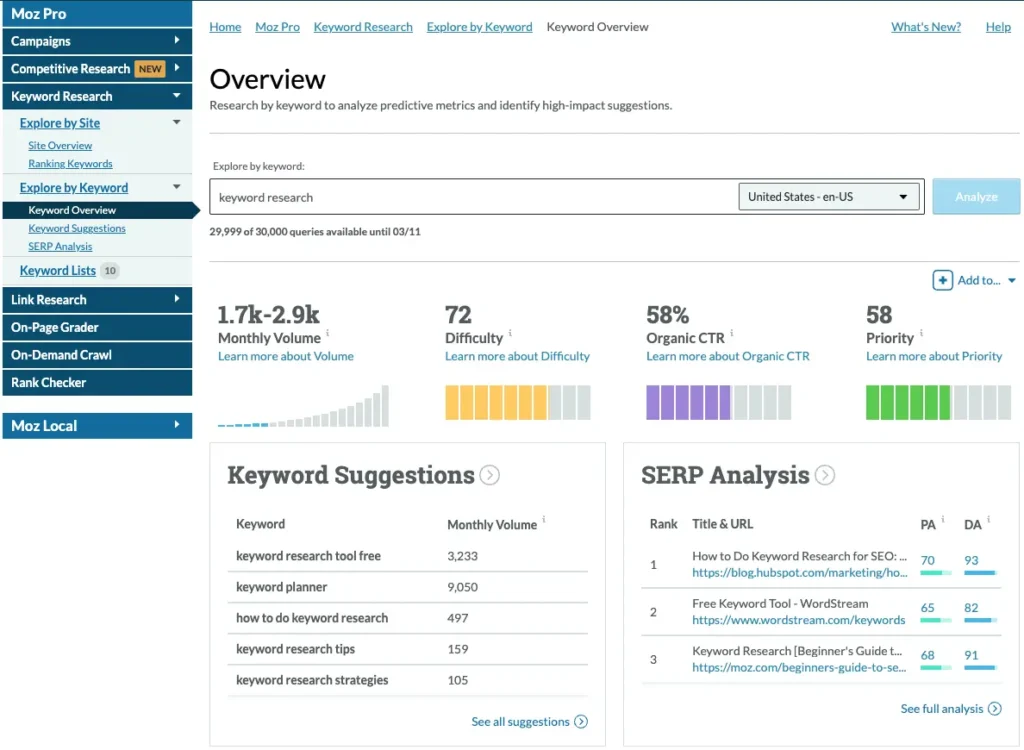
This is what makes Moz so great for a beginner SEO. A beginner doesn’t want 10,000 keyword suggestions from a keyword research tool. They want 20 keywords they can actually rank for. The Keyword Explorer can provide keyword suggestions, SERP analysis, difficulty scores, and related opportunities.
But the common mistake is to focus on the wrong metrics. You don’t want to target keywords based on their popularity. Instead, we need to focus on a combination of factors:
Relevance, intent, difficulty, SERP competition, and business value.
Checking why competitors rank higher in search results
SERP analysis is powerful because it helps shift the focus from “Why am I not ranking like them?” to “What are they doing better than us?” From there, the possibilities are endless
- Content depth,
- search intent,
- page authority,
- referring domains,
- ranking pages,
- SERP features,
- and
- keyword opportunities,
are some of the areas we would analyze with a SERP checker.
This is a much better way to approach competitor research than guessing based on assumptions.
Finding pages with SEO issues
Site crawling and on-page tools can help find issues that a beginner SEO may not be able to spot on their own.
This is especially important since many things in SEO can’t be discovered manually. A page might look fine when you visit it, but that doesn’t mean there aren’t any
- broken links,
- crawlability issues,
- meta description problems,
- indexing errors,
- on-page optimization opportunities,
- technical SEO issues.
Tracking if our position in search results has changed
Rank tracking allows us to see how our changes affected our position in search results. This is a very important part of SEO that isn’t utilized near enough. We want to focus on both an increase in quantity (more keywords ranked) and quality (improvement in position).
Finding backlink opportunities without overwhelming our team
Auditing a website for technical SEO problems
Turning Moz data into an actionable SEO plan
How useful is Moz for competitor research?
It is very useful, but we would always look at the SERP results for a keyword ourselves. Competitor identification in Moz has proven to be somewhat inconsistent in recent reviews. One of the recent 2026 reviews even cited instances where True Competitor failed to identify relevant competitor websites and recommended Semrush’s competitor research tools as being more reliable in some cases.
Our Moz authority metrics review: overall assessment
8/10
Very useful for comparative analysis, but potentially misleading if treated as an absolute value.
Moz Pro Competitor Research: Can It Find Our Real Competitors?
How True Competitor works
True Competitor attempts to identify sites competing with us based on overlapping organic search visibility. That is more useful than simply answering: “Who are the biggest companies in our industry?” Our actual SEO competitors may be completely different.
Finding websites competing for the same keywords
Our real SEO competitors are often:
The websites ranking where we want to rank.
They do not necessarily have to sell the same product.
Keyword overlap and competitor gaps
Keyword overlap helps us find shared opportunities
Content gaps
Competitor problems/topics that we do not have to worry about
Visibility in areas where they rank and we do not
Where Moz competitor research gets things wrong
No automated competitor research tool fully understands the business context. A website can easily rank for thousands of unrelated keywords, which makes it appear to be a bigger competitor than it actually is. We would validate every serious competitor manually.
Finding competitor keywords we could realistically target
It gets better when we start talking about:
Competitor keyword
SERP analysis
Authority comparison
Intent analysis
Content gaps
Moz vs Semrush for competitor research
We would choose Semrush. Moz is perfectly fine for core competitor research, but Semrush provides better overall competitive research ecosystem that comes in handy when competitive research is the primary focus of our work.
Our verdict on Moz Pro competitor analysis
7.5/10
Moz Pro Backlink Analysis Review: Is Link Explorer Still Good?
What Moz Link Explorer lets our team see
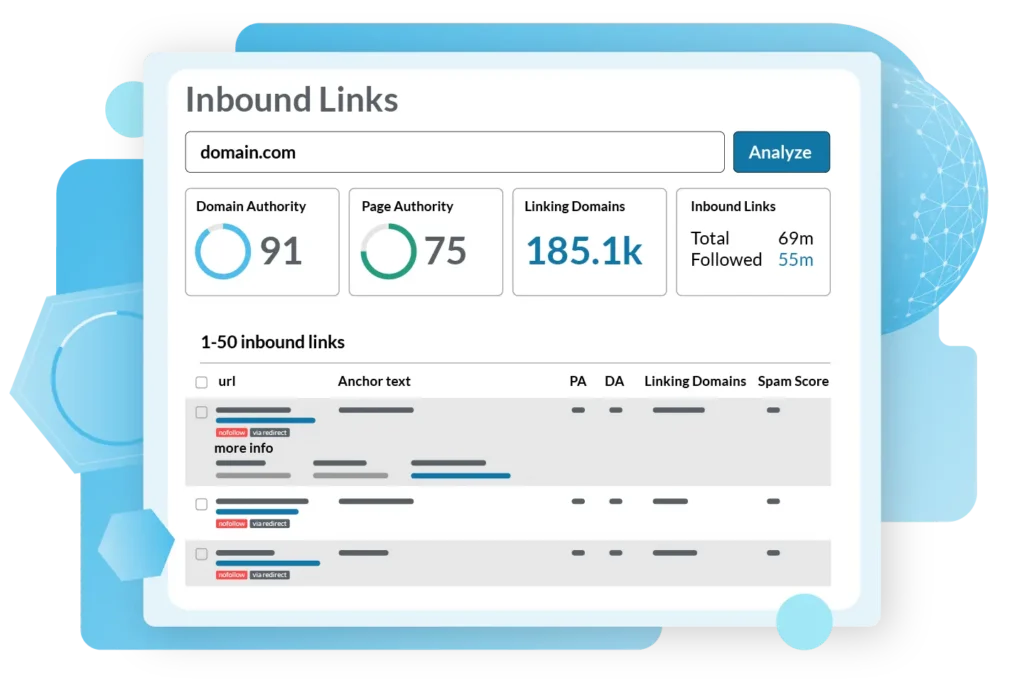
Link Explorer helps us to investigate
Inbound links
Referring domains
Anchor text
Link building opportunities
Competitor backlinks
Authority-related metrics
Finding referring domains and valuable backlinks
We care less about:
“How many backlinks do we have?”
And more about:
“Which referring domains actually contribute to our authority/relevance?”
Understanding Spam Score without panicking
Spam score is not something that makes us want to remove backlinks at the first sight. A backlink is a signal, and we have to analyze the overall profile, relevance, and spam score of the referring domain before taking any action.
Link Intersect: one of our favorite backlink opportunities
This is perhaps one of the most beginner-friendly ways to find backlink opportunities. We can use it to ask:
“Which websites link to my competitors but not me?”
With a click of a button, we have a list of websites that want to promote similar products/services as our competitors but are not promoting us.
The 2026 01net review mentioned Link Intersect as one of Moz’s interesting features.
Finding websites linking to competitors but not us
This feature essentially transforms backlink research into prospecting.
For example, with Link Intersect we can ask:
Who links to Competitor A?
Who links to Competitor B?
Who links to both Competitor A and Competitor B?
Who links to Competitor A but not to Competitor B?
Who links to Competitor B but not to Competitor A?
That is how we can find websites linking to our competitors but not us.
Now, ideally, those websites want to promote products similar to our competitors’, so we are essentially researching potential link building partners.
What Moz is missing for modern link building
Moz is not really a prospect outreach platform.
As a link building agency, we still need to qualify prospects, outreach, build relationships, create content offers, follow-up, negotiate, and review link relevance. Moz helps us to find opportunities, but it does not replace the link building process itself.
Is Moz good enough for beginners building backlinks?
Yes, absolutely. Especially when they understand that quality and relevance matter more than simply building hundreds of backlinks.
Our verdict on Moz Pro backlink analysis
8.5/10
Backlink analysis remains one of Moz’s strongest suits
Moz Pro Site Audit Review: How Good Is Its Technical SEO?
What Moz On-Demand Crawl actually checks
Moz can crawl websites and identify technical and on-page issues.
For a beginner, it is helpful because it transforms technical SEO into a list of items that potentially need improvement.
Finding technical SEO errors beginners commonly miss
A crawl can help us to spot
Various crawlability/crawling errors
Redirect issues
Page optimization issues
On-Page Grader: can it actually improve our pages?
It can certainly help us identify optimization opportunities, but we would not use it as a basis for making improvements. SEO is not a popularity contest, so a page with a high On-Page Grader score is not guaranteed to rank. Good pages answer the questions users ask.
How Moz explains what we need to fix
One reason why Moz makes for a good SEO tool for a beginner is that it treats complex concepts like technical SEO and on-page SEO optimization with a degree of simplicity. The software aims to educate the user rather than confuse them.
Crawl comparison: tracking our SEO improvements over time
Historical comparison is helpful
SEO is not a one-time task, so we need to see:
Are there fewer issues now than before?
Are we fixing critical issues?
Are we introducing new issues?
Are our changes actually working?
Where Moz site auditing feels slower or weaker
Crawling speed is something that is definitely worth mentioning.
A recent 2026 review found that larger crawls by Moz tend to be slower compared to some of its competitors. It is not going to matter much for a smaller website, but it can affect larger sites.
Our verdict on Moz Pro for technical SEO
8/10
Moz Pro is good enough for most small and medium-sized websites, but larger sites will benefit from a more advanced solution.
Moz Rank Tracker Review: Is It Reliable Enough to Monitor Rankings?
Setting up keyword rank tracking in Moz
Rank tracking is one of the simplest features in Moz in terms of set up.
We can choose
Keywords
Target URL
Search engine
Country
Device
or search context where applicable
And track changes over time.
Daily ranking updates: how useful are they?
Daily updates are great when we are making active optimizations, but we would not stress over daily ranking changes. SEO trends are more important than daily ranking movements.
Tracking rankings across Google, Bing, and Yahoo
Moz can track rankings across multiple search engines.
Current Moz reviews indicate that Google, Google Mobile, Yahoo, and Bing are supported.
Tracking rankings by country and device
This is important for international SEO, which explains why we track rankings across countries.
A ranking in the United States is not necessarily indicative of performance in the United Kingdom, Canada, or Australia.
For international SEO, we would segment our rankings by country.
Which ranking metrics actually matter to our team?
We care about:
Target keyword position
Organic clicks
Impressions
Conversion rate
Revenue or leads per click
Rank distribution
Pages with higher/lower ranks
Than anything else.
What Moz rank tracking doesn’t show us
A rank tracker will rarely tell us whether traffic has brought in revenue.
We would still have to use separate analytics to review conversions.
Our verdict on Moz Pro Rank Tracker
8/10
Simple, reliable, and good enough for most SEO teams.
Moz Pro for Beginners: Is It Actually Easy to Learn?
Our marketing team’s first impression of the Moz Pro interface
The interface is functional.
However, this is one area where newer platforms can feel more modern.
The 2026 01net review similarly found Moz intuitive but dated compared to alternatives like Semrush and SE Ranking.
How long would it take for a complete beginner to understand Moz Pro?
A complete beginner should not expect to understand everything at first.
However, they also should not feel overwhelmed.
We would expect a learning path like this:
Keyword Explorer → SERP analysis → Rank Tracking → Site Crawl → Link Explorer → Competitor Research
That is a sufficient set to get started.
Which Moz Pro tools are easiest for someone just starting out?
Our recommendation for a beginner would be:
- Keyword Explorer
- Rank Tracking
- Domain Overview
- SERP analysis
These are the reports that provide the most immediately understandable value.
Which features have the steepest learning curve?
Backlink analysis and competitive research require more SEO knowledge to be useful.
The issue is not that the buttons are not labeled.
The issue is that a novice will not know what to do with the information.
Can someone with no SEO experience use Moz Pro effectively?
Yes, but not as an SEO.
That is an important distinction.
The single worst mistake a beginner could make when using Moz Pro
Trying to use every feature.
A novice can waste a lot of time chasing around the dashboard without accomplishing anything.
We would recommend a more focused approach.
Our beginner-friendly Moz Pro workflow
Research → Validate → Optimize → Fix → Track → Learn → Repeat.
Everything else is commentary.
Moz Pro Pricing 2026: What Will You Actually Pay?
Moz has multiple plans, and current 2026 research suggests that Starter costs about $49/month monthly or about $39/month billed annually, Standard costs about $99/month or $79 billed annually, Medium costs about $179/month or $143 billed annually, and Large costs about $299/month or $239 billed annually.
However, since SaaS plans are often subject to change, we recommend double-checking the Moz Pro pricing page before making a purchase.
Moz Pro pricing breakdown by plan
| Plan | Monthly | Equivalent annual billing |
|---|---|---|
| Starter | $49/mo | ~$98/mo |
| Standard | $99/mo | ~$179/mo |
| Medium | $179/mo | ~$249/mo |
| Large | $299/mo | ~$599/mo |
Current 2026 research suggests that these are the plans as of this writing, and annual billing makes a significant difference in the final price.
What does the Standard plan actually give us?
The Standard plan is the entry-level plan for those who want to do more than play around with Moz.
However, we would still be mindful of limitations since a lower headline price can be misleading if the actual limits cut off our workflow.
Is the Medium plan the sweet spot for most users?
For an emerging SEO, Medium can be the sweet spot.
The Medium plan has significantly higher limits and additional features, according to 2026 pricing comparisons.
However, “sweet spot” is relative and depends on what we actually need.
When does the Large plan become a good value?
When the extra limits and features make financial sense.
We would not upgrade just for the sake of having more.
Who actually needs the Premium plan?
Large-scale SEO operations and agencies with specific needs will likely find the value proposition of the top plan more compelling.
However, for a beginner, it is probably not worth it.
How does monthly billing compare to annual billing for Moz Pro?
Paying annually can make a big difference in the final price.
However, we would not commit to an annual plan before understanding our needs.
Which Moz Pro tools are only available on higher plans?
Each plan has limitations, and it is always worth comparing:
- Keyword limits
- Number of campaigns
- Crawl limits
- Number of keyword lists
- Reporting options
- Seats
- Competitive research limits
- Backlink query limits
Is Moz Pro too expensive for a small-time blogger?
This is where our opinion becomes more nuanced.
If we are a small-time blogger with a niche audience and only a few SEO projects per month, Moz Pro could be too expensive.
Is Moz Pro worth it for a freelancer?
It depends on how much work we do.
If we have multiple clients and need to do regular keyword research, audits, rank tracking, and reporting, it can be a solid investment.
That is why Moz Pro for a freelancer is a fundamentally different value proposition than Moz Pro for an amateur blogger.
How much does Moz Pro cost per keyword and project?
We would not recommend basing our decision on simple math.
We should always ask ourselves what we get for our money.
If Moz helps us find a content opportunity that drives leads for months, the value calculation looks very different.
What would our team buy with a limited SEO budget?
We would buy smaller plans first and only upgrade if we need more keywords or features.
That is healthier than just buying the most expensive plan at first.
Moz Pro Free Trial: What Should You Test Before Paying?
Moz Pro currently offers a 30-day free trial, according to 2026 reviews.
This gives us a chance to understand the product before committing.
How Moz Pro free trial works
The free trial lets us actually test the workflow.
That is how we would use it.
The exact SEO tasks our team would test during the Moz Pro free trial
We would focus on:
- Keyword discovery
- SERP analysis
- Competitor research
- Site crawling
- Rank tracking
- Backlink gap analysis
- Reporting
Five Moz Pro features we would test first
Keyword Explorer
Can we find opportunities we did not know about?
SERP analysis
Can we understand why the competing pages are ranking?
Site Crawl
Can it help us identify issues?
Link Explorer
Can we find interesting backlink opportunities?
Rank Tracker
Does the rank tracking workflow fit our needs?
What to measure before deciding to subscribe to Moz Pro
Forget about likes and dislikes.
Focus on these questions:
- Did we find any valuable keywords?
- Did we identify any competitors?
- Did we find any interesting technical issues?
- Did we find any worthwhile backlink opportunities?
- Did we save time with the research?
- Did the data actually change any of our assumptions?
When we would cancel Moz Pro free trial instead of upgrading
If we spend 30 days staring at reports and cannot turn that into any action, we would cancel.
A good SEO tool should make us more productive, not the opposite.
Moz Pro vs Semrush vs Ahrefs vs SE Ranking: Which One Should You Choose?
Semrush is positioned as a marketing and SEO platform covering multiple areas, Ahrefs is the best backlink research tool, and Moz is the most intuitive option, according to 2026 comparisons.
Moz Pro vs Semrush for keyword research
Our recommendation: Semrush
Semrush typically has a more comprehensive set of keyword research tools.
Our recommendation for intuitive design: Moz Pro
If we want something easier to use, Moz Pro is a good choice.
Moz Pro vs Ahrefs for backlink research
Our recommendation: Ahrefs
Ahrefs has the best set of backlink research tools.
Moz Pro is still useful, but serious backlink researchers will want to use Ahrefs.
Moz Pro vs SE Ranking for beginners
SE Ranking is usually positioned as a more budget-friendly alternative in 2026 comparisons.
If we are concerned about costs, we would compare the actual limits.
Moz Pro vs Semrush for competitor analysis
Semrush wins this round.
Moz Pro can help us find competitors, but Semrush has better tools for in-depth competitor research.
Moz Pro vs Ahrefs for small websites
It depends on what we need.
If we need backlink research, Ahrefs wins.
If we want a more comprehensive but entry-level SEO platform, Moz Pro is a good choice.
Which tool gives beginners the best value?
There are no clear winners, but we can break down the considerations.
| Priority | Our recommendation |
|---|---|
| Beginner-friendly SEO platform | Moz Pro |
| Comprehensive marketing platform | Semrush |
| Best-in-class backlink research | Ahrefs |
| More budget-friendly SEO platform | SE Ranking |
| Free starting point | Google Search Console |
Which SEO tool has the easiest learning curve?
We would put Moz Pro near the top of the list.
That is one of its strongest positions.
Which SEO tool would our marketing team choose with our own money?
If we are just starting out, Moz Pro or SE Ranking would be our first choice, followed by Semrush and Ahrefs as we need more research and competitive analysis features.
It always comes down to our specific needs.
Moz Pro for Different Types of Users: Who Gets the Most Value?
Is Moz Pro good for SEO beginners?
Yes, Moz Pro is good for SEO beginners because the basic tools are intuitive enough to help set up a fundamental SEO workflow.
Is Moz Pro good for bloggers?
Yes, Moz Pro is good for bloggers because it helps with keyword research, SERP analysis, rank tracking, and competitive research, all of which are useful for content creation.
Is Moz Pro good for affiliate websites?
Yes, but we need to be careful and prioritize commercial intent. We would use Moz Pro for affiliate websites to find keywords, analyze the competition, and look for opportunities to fill gaps. However, we would avoid chasing traffic for the sake of traffic and focus on keywords with commercial intent.
Is Moz Pro good for small businesses?
Yes, but we need to evaluate the local SEO offering separately since it is not clear how local Moz Pro is in 2026, according to reviews. If the local SEO budget is justified, it would be a good choice for a small business that wants to improve its online presence.
Is Moz Pro good for freelancers?
Yes, Moz Pro is good for freelancers because it covers many aspects of SEO, from keyword research to backlink analysis. It would be helpful for a freelancer who needs to do regular keyword research, audits, rank tracking, and reporting for their clients.
Is Moz Pro good for SEO agencies?
It depends on the specific needs of the agency. Moz Pro can be a good choice for agencies that want a comprehensive but not overwhelming SEO platform. We would compare the reporting, seat, limit, automation, competitive research, and scalability features with the alternatives before making a choice.
Is Moz Pro good for local SEO?
It depends on what we need. Moz Local is a separate product, so we would evaluate it independently before making a choice.
Is Moz Pro good for a one-person SEO operation?
It depends on how serious we are about SEO. Moz Pro can be a good fit for a one-person SEO operation if we want to take our SEO efforts seriously. However, if SEO is only a side gig, there are more cost-effective options.
Where Moz Pro Falls Short in 2026
This is where most generic reviews fail us.
A proper review should tell us what not to buy, not only what to buy.
Moz’s keyword data isn’t always our first option
Keyword difficulty is a useful metric, but we would double-check it with actual SERP results.
No third-party information is sacred, not even Moz.
Why the interface feels outdated compared to some newer SEO platforms
This is a common criticism, and 2026 reviews suggest that Moz’s interface is not as intuitive as some alternatives.
It is not a deal-breaker, but it is worth noting.
Why crawling speed matters to our team
It depends on the size of the websites we work with.
If we work with large websites and need to do regular crawls, it can be an issue.
The missing content marketing layer
Moz Pro is primarily an SEO tool, and we need to think about a separate content marketing platform if we want to do proper content planning, optimization, and clustering, among other things.
Where Moz’s link-building workflow stops short
Moz Pro helps us find link-building opportunities, but we still need to do outreach, and that is where many link-building projects fail.
Why keyword clustering is more important than ever
Search engines are becoming better at understanding topics and related searches, so a modern SEO needs to think in topics, not keywords.
Moz Pro helps us with some aspects of clustering but does not have a comprehensive solution.
Moz’s limitations for AI search and GEO workflows
This is one of the most important considerations for 2026 and beyond.
Traditional SEO visibility is not the same as AI visibility, and Moz does not have built-in tools to track AI visibility.
Moz Pro for AI Search and GEO: Is Traditional SEO Data Enough?
What Moz Pro tells us about Google visibility
Moz Pro helps us understand traditional SEO visibility, which is still relevant.
However, we need to realize that traditional SEO visibility is only one part of the equation.
What Moz Pro does not tell us about AI visibility
A traditional rank tracker cannot answer questions about AI visibility, such as how often a brand is mentioned or what questions are associated with a company.
Can Moz Pro help us understand ChatGPT visibility?
Indirectly, yes.
Having a strong SEO foundation will help us get discovered by AI systems, but we need a separate AI visibility layer.
Moz Pro vs the needs of modern AI-search optimization
Our 2026 framework for AI-search optimization is traditional SEO visibility + AI visibility.
Traditional SEO visibility focuses on rankings, impressions, clicks, backlinks, and technical SEO.
AI visibility focuses on mentions, citations, entities, and answers.
What we would combine with Moz for an AI-first SEO workflow
We would combine traditional SEO tools with an AI visibility layer.
That means tracking mentions, entities, and answers.
It is especially important for teams that are strong in traditional SEO but do not have the tools to track AI visibility.
If AI visibility is becoming a meaningful acquisition channel for our business, Digehub’s AI Visibility Services can be used as a complementary layer rather than a replacement for traditional SEO.
When an AI tool finder is more useful than another SEO dashboard
This is where we are seeing a fundamental shift in the industry.
We are buying too many tools, and the next step is consolidation.
Before buying another tool, we should ask ourselves what problem we are trying to solve.
If the problem is something like “We need keyword data.” , Moz Pro is a good choice.
However, if the problem is something like “we need to find the right AI tools, AI visibility tools, automation tools, and marketing tools for our needs,” we need an AI Tool Finder.
Moz Pro Pros and Cons After Our Testing
What we genuinely like about Moz Pro
Beginner-friendly
It does not feel as intimidating as some alternatives, so we can start using it without feeling like we need an advanced degree in SEO.
Powerful backlink tools
Link Explorer and Link Intersect are still valuable features that we can use for many purposes.
Keyword research
It is not as comprehensive as some alternatives, but it should be sufficient for most small and medium-sized SEO projects.
SERP analysis
SERP analysis helps us get beyond keyword research and actually understand what the competition is about.
Rank tracking
Rank tracking is intuitive and useful.
Established ecosystem
Moz Pro has been around for a while, so it is a safe choice if we want to stick with an established brand.
What we would improve about Moz Pro
Modern interface
Better competitive research
Faster crawling
More content marketing features
Better keyword clustering
More features for AI visibility
The features that justify the subscription
For us, it would be keyword research + SERP analysis + backlink research + rank tracking + site auditing. That is a sufficient set of features to justify the subscription.
The features that do not justify the subscription
We would not subscribe just for the features.
We would upgrade when we actually need more data, not before.
Our biggest surprise while using Moz Pro
The truth is, Moz Pro was not the only option.
A simpler tool can be significantly more productive if everyone actually uses it consistently.
Feature count is not as important as adoption.
Our Moz Pro SEO Workflow: From Keyword to Ranking
Step 1: Find a realistic keyword opportunity
Start with keyword research.
Focus on relevance first, and then look at volume and difficulty.
Step 2: Analyze the current SERP
Look at the pages on the first SERP.
Ask yourself if you can create something better.
Step 3: Study the competing pages
Analyze the content, search intent, topics, authority, backlinks, and user experience of the competing pages.
Step 4: Check authority and backlink gaps
Use the Link Explorer and Link Intersect tools to see where the competitors are stronger than you.
Step 5: Optimize the target page
Make sure to optimize the title, headings, content, internal links, search intent, and structured data.
Step 6: Fix technical SEO issues
Run the crawl and address the issues that affect discoverability and user experience.
Step 7: Track rankings and measure progress
Track the keywords and see how they impact clicks, leads, and sales.
Step 8: Repeat the process
SEO is a continuous process, and the most important thing is to build on past successes.
7 Moz Pro Use Cases Most Beginners Never Take Advantage Of
Finding competitor backlink gaps
Do not simply count competitor backlinks.
Find the domains that consistently link to competitors.
Discovering overlooked long-tail opportunities
The lower-volume queries often have the most precise intent.
Comparing ranking potential before writing
This helps us avoid wasting six hours writing an article that has no chance of ranking.
Identifying pages with weak on-page optimization
Use the on-page data to find optimization opportunities.
Building a realistic keyword portfolio
Instead of focusing solely on big keywords, build a realistic keyword portfolio that includes:
Easy wins
Medium opportunities
Long-term targets
Commercial queries
Supporting informational queries
Monitoring new and lost backlinks
The growth and loss of backlinks can indicate valuable competitive insights.
Using Moz data to prioritize SEO work
The point is not to fix everything.
The point is to fix the things most likely to help.
7 Moz Pro Use Cases Most Beginners Never Take Advantage Of
Finding competitor backlink gaps
Do not simply count competitor backlinks.
Find the domains that consistently link to competitors.
Discovering overlooked long-tail opportunities
The lower-volume queries often have the most precise intent.
Comparing ranking potential before writing
This helps us avoid wasting six hours writing an article that has no chance of ranking.
Identifying pages with weak on-page optimization
Use the on-page data to find optimization opportunities.
Building a realistic keyword portfolio
Instead of focusing solely on big keywords, build a realistic keyword portfolio that includes:
- Easy wins
- Medium opportunities
- Long-term targets
- Commercial queries
- Supporting informational queries
Monitoring new and lost backlinks
The growth and loss of backlinks can indicate valuable competitive insights.
Using Moz data to prioritize SEO work
The point is not to fix everything.
The point is to fix the things most likely to help.
Is Moz Pro Worth It in 2026? Our Final Decision
Buy Moz Pro if these describe your situation
We would buy Moz Pro if:
- We are serious about SEO
- We need more than free tools
- We want keyword research + rank tracking in one platform
- Backlink research is a priority
- We need to manage one or more websites
- We are a beginner who values usability
- We are a freelancer who wants to build a repeatable SEO workflow
- We need to run an affiliate site and want commercial keyword research
- We want a mature SEO platform
Do not buy Moz Pro if these describe your situation
We would avoid Moz Pro if:
- We barely use SEO
- We have a tiny site with a shoestring budget
- We only need occasional keyword research
- We need extensive PPC research
- We need heavy content marketing capabilities
- We need deep AI visibility tracking
- We already have an all-in-one platform that covers everything we need
The Moz Pro plan our marketing team would buy
We would not automatically buy the highest plan.
We would start at the lowest plan that covers our workload and upgrade when the first limitations start to interfere with our work.
The type of website that gets the best ROI from Moz
The best fit for Moz Pro includes:
Content sites, growing businesses, affiliate sites, freelancers, and small agencies.
The type of website that should buy another tool
Big companies that need competitive intelligence, content marketing, PPC, or enterprise-level SEO software can get more value from other platforms.
Our final Moz Pro score for 2026
8.2/10
| Category | Score |
|---|---|
| Ease of use | 8.5/10 |
| Keyword research | 8.5/10 |
| Backlink analysis | 8.5/10 |
| Site auditing | 8/10 |
| Rank tracking | 8/10 |
| Competitor research | 7.5/10 |
| Beginner friendliness | 8.5/10 |
| Value | 7.5/10 |
| AI-search readiness | 6.5/10 |
| Overall | 8.2/10 |
Final verdict: is Moz Pro the best SEO tool for beginners?
It can be, but we would not say it is an automatic default.
For a real beginner who wants to learn SEO properly and needs keyword research, SERP analysis, backlinks, technical SEO, and rank tracking in one established platform, Moz Pro is a good choice.
For a tiny website on a shoestring budget, we would try free tools before spending money on a subscription.
For an advanced marketing team, we would compare Moz Pro with Semrush, Ahrefs, and SE Ranking to see which one fits the team’s needs better.
And for an SEO team that wants to start using AI search, we would look beyond traditional SEO software.
The best tool is the one that solves the problem we have.
It sounds obvious.
It is also one of the easiest things to forget when SEO software sellers try to convince us that their product is the best for everyone.
Moz Pro FAQs
Treating the tool’s metrics as decisions instead of evidence. We would never publish a page simply because Moz says a keyword is easy, reject a keyword because its volume is low, or assume a competitor is unbeatable because its DA is higher. The real SEO skill is turning several imperfect signals into a defensible decision.
Yes, but it covers only part of the problem. Moz can support the traditional SEO foundation, while AI visibility requires additional analysis of mentions, citations, entities, and how AI systems represent a brand. Current research also suggests that AI search rewards topical authority and genuine relevance rather than simple keyword matching.
It can identify promising opportunities, but no tool can guarantee ranking difficulty. We validate Moz’s difficulty estimate against the live SERP, competing pages, search intent, topical relevance, and the strength of the sites actually ranking.
Not automatically. For one small website, we would compare the specific workflow, limits, data depth, price, and features we actually need. Community comparisons consistently show that tool choice depends heavily on the user’s use case rather than a universal winner.
They answer different questions. Third-party keyword tools estimate search demand, while GSC shows how a specific website actually appeared and performed for queries. For decisions about our existing site, we give GSC actual performance data significant weight.
Only as one input. We compare our domain with ranking competitors, but we never use a DA threshold as a substitute for analyzing the actual SERP. This distinction is particularly important for newer websites.
We would narrow the opportunity set rather than give up. We look for long-tail queries, weak SERPs, topical gaps, realistic competitors, and pages where relevance can compensate for weaker authority.
Absolutely, when the intent is strong. A 20-search-per-month query from someone close to making a purchase can be more valuable than a 10,000-volume informational keyword. We prioritize business value and SERP opportunity over volume alone.
Because each platform uses its own datasets and methodology. We treat KD as a screening metric, not a final verdict. Community discussions also highlight cases where different tools produce substantially different difficulty estimates.
Yes. DA is a comparative Moz metric, not a Google ranking factor. We use it to understand relative authority, but evaluate the actual SERP, intent, content quality, relevance, links, and page-level strength before judging ranking potential.
