
Semrush Review 2026: Is It Worth $117/Month? (Campaign Tested)
Chances are, putting money into SEO by 2026 means you’ve wondered something similar. Maybe content campaigns got your attention – then again, so might have pay-per-click ads. Artificial intelligence showing up online could’ve sparked the very same thought. While tactics differ, the core doubt tends to surface all on its own

Only you can decide if Semrush fits your needs at 117 dollars each month. Maybe it’s useful. Maybe it feels too high priced. Some find value where others see waste. Price tags don’t always match results. What matters is how you use it, not what others say. Tools cost money. Time reveals whether that cost pays off. For some, yes. For others, no. Worth depends on outcome, not promises.
It depends – clear answers rarely show up in black or white.
One thing stands out when using Semrush for SEO work, shaping content plans, checking competitors, reviewing backlinks, or organizing paid ads. The tool fits into each task without forcing its way in
Semrush is no longer just an SEO platform.
Now it works like a full digital engine, linking smart search tools with content tuning. One place pulls together ad insights along with how rivals perform online. Think of it as layers – each piece feeds into another, guided by artificial smarts. Patterns emerge where trends meet real data moves. The system watches markets while shaping what gets written. Everything connects without needing separate parts.
Here’s the thing: plenty of companies pay for Semrush but barely touch what it can do. Most stick to just a fraction – around one-tenth or maybe one-fifth – of its full range. What gets used often isn’t even close to everything available. Some tools sit idle while users repeat the same basic steps. It’s not about access; they have that. The gap shows up in actual daily habits. Effort goes into logging in, yet exploration stops early. Features stay hidden simply because no one digs deeper. Routine wins over discovery every time.
People usually think it costs too much because of that.
Truth is, what matters most comes down to your own approach.
What you get from Semrush in 2026 is laid out here – no filters. Not everyone needs it, though some teams will lean on it daily. Strengths stand clear in keyword tracking and competitor snapshots. Weak spots? A few tools feel slow, clunky when juggling big data loads. That $117 per month price tag? It either pays for itself fast or drains budget quietly, depending how deeply you plug in.
Is Semrush Still Useful in 2026?
Semrush Worth 117 Dollars Per Month
- You Invest in SEO
- You publish content consistently
- You Run Ppc Campaigns
- You need competitor intelligence
- You manage multiple websites
- You want visibility in AI-powered search environments
It may not be worth it if:
- You rarely publish content
- You do not focus on organic growth
- You only need basic keyword research
- Your website is still in the idea stage
When companies look to grow their customer list through the web, choosing Semrush often brings strong returns. A solid pick for digital outreach, it helps spot chances others miss. Worth considering if results matter more than flashy tools.
What Is Semrush?
A tool like Semrush gives companies what they need to grow how people see them online. Built for many marketing tasks, it pulls together different parts of a web strategy in one place.
Core capabilities include:
- Keyword research
- Competitor analysis
- SEO audits
- Rank tracking
- Content optimization
- Backlink analysis
- PPC research
- Social media management
- AI-powered content assistance
- Market intelligence
In 2026, Semrush has positioned itself as a visibility platform rather than simply an SEO tool.
Because how people search keeps shifting fast, that change counts.
Businesses now need visibility across:
- Google Search
- AI search engines
- ChatGPT citations
- Perplexity references
- Voice search
- Traditional SERPs
Semrush Pricing 2026
Around $117 each month is what you pay for the basic Semrush option if signed up yearly. Payment every year cuts the cost slightly compared to monthly rates.
Spending much at first seems tough for plenty of small shops.
Still, swapping out Semrush usually means pulling together a few different apps
- Keyword research tool
- Rank tracker
- Site auditor
- Competitor analysis platform
- Backlink monitoring software
- Content optimization tool
Spending on multiple tools usually beats what you’d pay for just one Semrush plan.
Is it really about the price tag on Semrush? Not quite.
Is it really able to bring in over $117 worth of measurable benefit? That’s what matters.
Most businesses would say it’s true. Still, some might disagree. It depends on the situation. Yet generally, they agree. Not every case works out that way.
Semrush Features Tested
1. Keyword Research
Still, keyword research stands out in what Semrush does best. Though many tools try, few match its depth here.
The Keyword Magic Tool offers keyword suggestions
- Search volume
- Keyword difficulty
- Search intent
- SERP analysis
- Topic clusters
- Related queries
Faster opportunity spotting happens when marketers step beyond just using Google Search Console.
What stands out in 2026 is the increasing emphasis on intent-based keyword grouping.
Topic ecosystems give companies a way past single keyword focus. Building around full subjects opens doors wider than chasing one term at a time.
Expertise gets judged more fairly under that method when it comes to AI-powered search tools.
2. Competitor Analysis
One of the biggest reasons agencies use Semrush is competitor intelligence.
You can quickly discover:
- Competitor keywords
- Traffic estimates
- Top pages
- Backlink sources
- Advertising strategies
This dramatically reduces research time.
Instead of guessing what works in your industry, you can analyze proven market winners.
For SaaS companies and agencies, this feature alone can justify the subscription cost.
3. Site Audit Tool
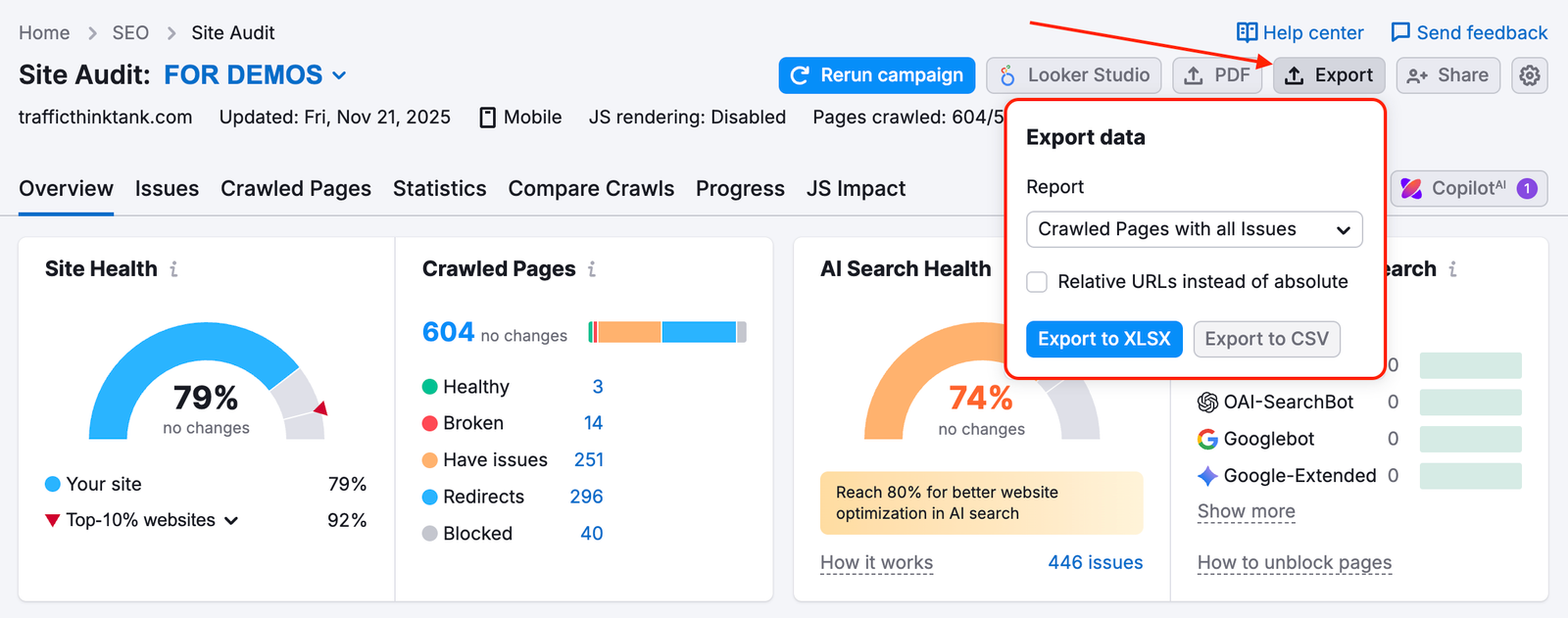
Technical SEO issues silently destroy rankings.
Semrush’s Site Audit identifies:
- Crawl errors
- Broken links
- Duplicate content
- Missing metadata
- Core Web Vitals problems
- Indexability issues
The reporting is visual and beginner-friendly.
Unlike many technical SEO platforms, Semrush makes complex problems understandable.
4. Position Tracking
Tracking rankings manually is nearly impossible in competitive industries.
Semrush Position Tracking allows businesses to monitor:
- Daily ranking changes
- Geographic rankings
- Mobile rankings
- Competitor comparisons
- SERP feature visibility
This is especially useful for agencies managing multiple clients.
5. Backlink Analytics
Backlinks remain a major ranking factor.
Semrush helps users:
- Analyze backlink profiles
- Monitor lost links
- Identify toxic links
- Discover outreach opportunities
While some dedicated backlink platforms offer larger databases, Semrush provides more than enough data for most businesses.
6. Content Marketing Toolkit
Content creation has become significantly more competitive.
Publishing articles just sits there now.
Content must demonstrate:
- Experience
- Expertise
- Authority
- Trustworthiness
Semrush’s content tools help optimize:
- Topic coverage
- Readability
- Semantic relevance
- Keyword placement
- Competitive gaps
Out of nowhere, creating content feels way more intentional now.
Scaling content efforts usually means teams bring in expert help to sharpen their approach. Some companies mix internal ideas with outside support to grow output steadily. Working with specialists helps maintain quality while increasing volume over time. Outside partners often guide strategy when demand outpaces current capacity. Growth-focused brands sometimes pair their data with seasoned marketers to move faster.
Semrush performance across business types
Small Businesses
Semrush works best when:
- SEO drives leads
- Content marketing is active
- Competition is increasing
Should web visits stay low and updates appear now and then, spending money might seem odd. Yet putting funds there could still make sense even when activity dips between posts.
Agencies
Most times, agencies can’t do without Semrush. It just fits how they work.
Benefits include:
- Client reporting
- Competitor intelligence
- Campaign monitoring
- Opportunity discovery
One project covers the fee for several teams. A single job pays what others split across months. Some groups pull full payment from just one task. The price tag disappears after one assignment finishes. Payment returns fully through a solitary effort.
SaaS Companies
SaaS businesses gain substantial value from:
- Competitor analysis
- Content planning
- Organic growth forecasting
- Product-led keyword research
AI Search meets Semrush by 2026
A shift many notice? AI rewriting how searches work online. It’s changing what people see first when they look things up.
More people now find responses through:
- ChatGPT
- Gemini
- Perplexity
- AI-powered search experiences
Just showing up first doesn’t cut it anymore.
Brands must become citation-worthy.
Semrush helps identify:
- Topical authority gaps
- Content opportunities
- Competitor strengths
- Emerging search trends
Right now, clear sight into AI systems shapes how they’re used today.
When companies want more exposure through artificial intelligence, they usually mix regular search engine tactics with specific efforts aimed at AI platforms. Not just relying on old methods, some shift part of their focus toward systems that learn and adapt differently.
Common Semrush Mistakes
Focusing Only on Keyword Volume
Chasing big keywords? That’s what plenty of marketers do. Aiming high often means targeting those popular terms everyone else wants too.
Loudness isn’t a guarantee of bigger earnings. Sometimes quieter brings more.
Intent matters more.
Ignoring Competitor Data
Competitor research is one of Semrush’s most powerful capabilities.
Still, plenty of people hardly use it at all.
Skipping Site Audits
Faulty code behind the scenes might block results even if the words are strong. A site could look fine yet struggle due to hidden glitches underneath.
Tracking Too Many Keywords
Focus on meaningful business keywords rather than vanity rankings.
Pros and Cons
Pros
- Comprehensive marketing platform
- Excellent competitor intelligence
- Strong keyword research capabilities
- Reliable rank tracking
- Useful content optimization tools
- Regular feature updates
Perfect for teams that scale, also works well when needs shift. Growing companies fit right in, so do groups adjusting fast
Cons
- Learning curve for beginners
- Most traffic numbers show direction instead of precision
- Costs rise fast on higher-tier subscriptions
- Smaller businesses may underutilize features
Semrush vs Competitors
Semrush vs Ahrefs
Semrush generally offers:
- Better marketing ecosystem
- Stronger PPC data
- More integrated tools
- Ahrefs often excels in:
- Backlink analysis
- Simplicity
- Link research workflows
Semrush vs Ubersuggest
Deep inside the data, Semrush pulls out more detail than most tools ever reach.
A smaller price tag comes with Ubersuggest, though heavy-duty business needs slip through. Heavy tasks? Not really its strong suit.
Semrush vs Moz
Faster growth pushed Semrush forward, bringing wider tools for marketing work. While adding features, it reached further into campaign needs across different areas.
Choosing the right marketing tool is usually dependent on your business needs.
Future of Semrush
The future of search is moving toward:
- AI-powered discovery
- Entity optimization
- Conversational search
- Multi-platform visibility
Heavy investment by Semrush shows up clearly in these spots. These areas get most of their attention now.
Soon, the system might grow beyond basic search tools. Instead of just tracking rankings, it could start focusing on how AI sees online content. Changes may shift its role completely. One day, spotting visibility through smart systems becomes the main job. Not long from now, old-style SEO features take a back seat. Watching how algorithms notice pages might matter more than ever.
My Experience With Semrush
Most tools fade over time, yet Semrush sticks around – useful through shifts in how people search. Running it through SEO pushes, content builds, even peeks at rival moves, shows its worth again and again. While other platforms come and go, this one holds steady, adapting without losing grip on what matters.
A single effort caught attention – it centered on a U.S. business trying hard to boost unpaid search visits while already sharing content often. Each week brought new posts, yet position numbers stayed flat, results barely moving; interest from potential customers remained low.
Out of the gate, we turned to Semrush’s Organic Research along with their Keyword Gap feature.
Hours passed before spotting rival sites appearing for many high-value search terms the client missed entirely. What stood out came later – some competitor articles drew steady visits on subjects nearly absent from the client’s site.
From these findings, the content plan got a full rethink. Topic groups formed where gaps showed up. Pages rose in priority depending on how likely they were to rank.
Month by month, things started showing up more online once we stopped assuming. Real choices came from real numbers pulled straight from the market.
Here’s what makes Semrush stand out, at least in my view.
Effort isn’t what most companies run short on when things fall apart.
Without clear sight of what truly works in their market, failure follows. When reality stays hidden, results suffer.
What happens out there matters more than plans made here. Hidden truths lead straight to missed chances. Success hides where real behavior shows up. If you cannot see it, you lose it.
Close the gap? Semrush does just that.
What I Enjoy Most
Should I pick just a single tool that keeps delivering, Competitor Analysis stands out. What makes it stick is how often it reveals what others miss. Not every insight shouts its importance – some slip in quietly. Yet they add up over time. One look at rival moves reshapes thinking. It isn’t flashy, but steady. The patterns emerge only if you watch long enough. Surprise finds its way into the details. That quiet edge builds without fanfare.
Some SEO tools show how your site is performing. Others point out issues only after they’ve already appeared. A few highlight patterns nobody else seems to notice. Most just repeat what you already know. Few actually help spot problems before they grow.
Out there, Semrush shows exactly how your market moves. Every shift comes into view through its lens.
What stands out here changes everything.
Starting a fresh campaign usually means I dig into rival sites longer than the one I’m working on. Learning what works for leaders cuts down guesswork that could waste days.
Back to that keyword gap checker I keep opening. Reports on organic research? Always have them up. Checking traffic patterns holds my attention every time around.
What My Team Enjoys Most
Folks on the team? They tend to latch onto separate parts without planning it.
Most folks shaping content lean hard into Keyword Magic Tool alongside Topic Research. Sometimes one comes first, sometimes the other – either way they show up together a lot.
Most of the day, SEO folks are buried in Site Audit along with checking where pages rank.
Right now, marketing planners lean on Market Explorer along with rival insights to spot where expansion might happen.
Finding tools that fit different team sizes isn’t always easy – Semrush handles it without extra steps. What changes things? A design that bends instead of breaks when workloads shift.
Different departments can extract value from the same platform.
Thoughts on Semrush Improvements
Most things work fine – just not every time.
Improvement could start with how clearly AI tracks visibility. Maybe that part needs a second look.
Now that tools such as ChatGPT, Gemini, and Perplexity shape more online searches, tracking brand mentions in AI responses matters more.
Because these systems influence what users see, understanding where a brand appears in their outputs has grown harder to ignore. While traditional analytics focus on websites, new attention turns to synthetic replies. Since answers come stitched together from many sources, spotting references isn’t always straightforward. Yet knowing when and how often a name pops up helps clarify digital presence.
With queries answered before clicks happen, awareness shifts earlier in the journey. So instead of waiting for visits, insight must arrive sooner – right at the point of response.
Though Semrush began shifting paths, fresh chances to innovate remain wide open.
Should Semrush add smarter tools for spotting where AI pulls info, its worth might grow steadily in coming years. One day at a time, better insight into how often AI systems reference data could set it apart. Over months, sharper reports on who sees what through artificial intelligence may build stronger appeal. Little by little, improvements like these could shape long-term trust. Year after year, users might lean on it more if tracking evolves. Step by step, progress here would matter most.
Observations From Industry Talks
Marketers often ask the same question across Reddit Quora LinkedIn and SEO forums
“Is Semrush too expensive for small businesses?”
Most times, I say just about the same thing.
Semrush is expensive if you use it like a keyword checker.
Spending less happens when choices are made here.
Most companies moaning over cost tend to tap just a sliver of what it can actually do.
Most companies getting strong results mix competitor research with content planning. Technical SEO flows into how they track rankings. Market intelligence ties it all together, shaping each step without standing alone.
My Final Recommendation
Thinking About Semrush in 2026?
Yes.
It’s not about size or extras. What matters is how it works.
For anyone pushing campaigns, this cuts through guesswork. Speed matters just as much as insight.
Winning at search usually skips the firms spending the most.
Most times, it’s these folks who know what’s really going on.
From what I’ve seen, Semrush still stands out as a top tool for marketing insights right now.
Frequently Asked Questions
Yes. Semrush offers local SEO features including position tracking by location, local keyword research, listing management capabilities, and competitor analysis. These tools help businesses improve visibility in city, regional, and location-based search results.
Semrush traffic estimates are directional rather than exact. While the platform provides valuable competitive insights and trend analysis, actual website traffic should always be verified using first-party analytics tools such as Google Analytics and Google Search Console.
For many businesses, yes. Semrush combines keyword research, rank tracking, site audits, competitor analysis, backlink monitoring, content optimization, and PPC research into one platform. This can reduce the need for several standalone tools and simplify marketing workflows.
For businesses actively investing in SEO, content marketing, or PPC, the platform can generate far more value than its monthly cost.
Yes. While there is a learning curve, the interface is easier to understand than many advanced SEO platforms.
It depends on priorities. Semrush provides a broader marketing toolkit, while Ahrefs remains exceptionally strong for backlink analysis.
Indirectly, yes. It helps build topical authority, identify content gaps, and improve discoverability across modern search environments.
Semrush offers limited free access, but serious marketers typically require a paid subscription.
Semrush does not directly submit your content to AI platforms, but it helps identify content gaps, topical authority opportunities, and search intent patterns that increase the likelihood of your content being referenced by AI-powered search tools. Strong SEO foundations often translate into better AI visibility.
Semrush traffic estimates are directional rather than exact. While the platform provides valuable competitive insights and trend analysis, actual website traffic should always be verified using first-party analytics tools such as Google Analytics and Google Search Console.
Conclusion
By 2026, showing up online means more than just a spot on page one.
Out there, visibility shows up across search engines alongside AI helpers. Recommendation spots play a part too. Conversational interfaces join the mix just as much.
Still standing among a small group of tools built for wide-reaching visibility plans, Semrush holds its ground. A rare fit for expansive digital tracking needs, it covers more than most others manage. Not many solutions stretch this far – Semrush does.
Most times, putting money into it makes sense when you want lasting visitor gains, sharper insights about the market, yet clearer choices.
Starting fresh means thinking past old-school SEO. Hitting more eyes takes weaving together smart search moves, useful content work, then folding in how AI tools find things. Results stick better when these pieces move as one. Long games favor blended plays.
Start by shaping your draft with Digehub’s free tool that helps refine posts ahead of publication. This one simplifies how you build and polish content without extra steps. It works quietly behind the scenes while you focus on writing. Before hitting publish, give it a try – clearer articles often follow.
