
SEO Tool for Agency 2026 : How to Choose the Right SEO Tool
When choosing the best SEO tool for your agency, you should prioritize features that match the services you provide. First, you need to ensure that the tool provides accurate data about keywords and backlinks. Second, look for SEO software that offers white-label reports and team management. Third, make sure to analyze the cost, number of projects, and free trials.

When choosing an SEO tool for a small or enterprise agency in 2026, the decision extends well beyond a purchase. It touches upon the company’s productivity, client presentation, and profit center.
This guide will not inform you what tool to buy. It focuses on teaching you to choose the SEO tool that fits your agency needs, operations, and budget so that the decision remains relevant in 6 months and not only during the trial period.
Why the Tool You Choose Matters More Than You Think
SEO tools list dozens of features that cater to different needs: keyword research, competitor analysis, rank tracking, technical audit, backlink evaluation, content optimization, reporting, automation, AI-search visibility, etc.
However, the issue with SEO tools rarely lies in the absence of required features. The problem is usually defined by the fact that you have too many options to consider, including the ones that barely serve a purpose.
The best SEO tool for agencies depends on several factors:
- The number of clients and websites under management
- The range of services being offered (SEO, content, local listings, etc.)
- The industries represented by your clients (local, national, international)
- The team’s size, automation needs, and reporting requirements
- The technical complexity associated with your SEO offerings
- The agency budget and its willingness to invest in the tool
A five-person local SEO agency and a thirty-five person enterprise firm will always have different needs and, therefore, choose from different shortlists.
More Features = Better Tools: A Myth
The number of features rarely correlates with an agency’s success directly. A particular tool only becomes valuable when it addresses a pressing issue or covers a set of operations that an agency has to manage on a regular basis. Everything else is extra and may represent a wasted budget, extra learning curve, unnecessary complexity, etc.
The biggest mistake is choosing the tool first
The most common mistake agencies make when choosing an SEO tool is to define the shortlist too early before analyzing their own requirements and establishing what they need to achieve.
Instead, the process should be defined as follows:
Agency requirements → Must-have features → SEO tool shortlist → Testing → Budget considerations → Final decision
Every step from this cycle is relevant, and the following sections will demonstrate why.
1. Defining Agency Needs Prior To Choosing SEO Tools
Before you can even start comparing available SEO tools and narrowing the list of potential options, you need to understand what your agency requires.
The following subsections will outline the key considerations that should inform your decision.
How many clients and websites do you manage?
Make a list of relevant metrics:
- Active clients: the number of active clients that bring revenue to the company
- Websites per client: how many domains you typically manage per one domain
- Keywords: the average number of tracked keywords for each domain
- Pages: the average number of pages crawled for each domain
- Team size: how many people participate in SEO management per domain
- Reports: the number of reports produced per each domain per month
Having more clients typically means working with more websites, more domains, more keywords, more pages, etc. However, complexity often depends on the industries represented by the domains. For instance, five e-commerce sites with 20 thousand SKUs each will demand significantly more attention and resources than fifty local restaurants.
What SEO-related services does your agency offer?
Some of the most common services in the SEO industry include the following:
- Technical SEO
- Content SEO
- Local SEO
- Ecommerce SEO
- Enterprise SEO
- International SEO
- Link building
- SEO consulting
- AI-search visibility
For each of these services, identify what tool features are required and what is an absolute must-have. If the local SEO services offered by your agency do not require international keyword research, then international databases should be removed from the consideration list.
What SEO-related activities take the most time?
Make a list of time-consuming but routine operations and procedures that require human input. Some of the most common time-consuming yet necessary tasks include:
- Keyword research
- Competitor research
- Rank tracking
- Technical SEO audits
- Backlink analysis
- Content research
- Reporting and publishing
- Client management
- Data export
In many cases, the best SEO tool for an agency is the one that allows to automate the most time-consuming tasks or handle them faster than without the tool. For instance, if 60% of operations performed by your team are related to keyword research, prioritize tools that offer advanced keyword research features.
What does your team need to do on a weekly basis?
Think about the primary objective of your team on a weekly basis. It can be defined by the following sentence:
Find opportunities → prioritize them → execute SEO work → measure results → report to clients
Based on this description, the SEO tool should assist in achieving all these objectives without requiring extensive manual effort for any of the steps.
2.Compare These 10 SEO Tool Capabilities When Choosing An Agency SEO Tool
Now that you know what your agency needs, it is possible to move on and analyze the strengths and weaknesses of each available SEO tool. Instead of jumping to features, consider the following capabilities in terms of their potential value to your agency operations.
Does the tool offer keyword research opportunities that matter to my agency?
What to look for:
- Keyword database
- Volume
- Intent
- SERP analysis
- Difficulty
- Competitor keywords
- Clustering
- International databases
- Historical data
When choosing an SEO tool for keyword research, remember that not all data is equal. A database with billions of keywords is not useful if you cannot prioritize them quickly. Ideally, an SEO tool should help you to find opportunities faster than manual research would allow.
Can I perform competitor research with this tool?
What to look for:
- Who are the organic competitors?
- What keywords do they target?
- What pages perform best for them?
- What content gaps exist?
- What backlink opportunities are available?
- Can I track the organic performance of my competitors?
The tool should help you understand who competes with your clients or company in terms of organic search results. Ideally, the tool should prioritize competitors based on relevance, track their performance across different devices and locations, identify SERP features, analyze competitor content, and evaluate backlink profiles.
Does the tool help me detect technical SEO issues?
What to look for:
- Crawl depth
- Crawl limits
- Indexability
- Internal linking
- Redirects
- Canonicals
- Structured data
- JavaScript rendering
- Site architecture
- Prioritization
The value of an SEO tool is not defined by the sheer number of technical issues it can detect. Instead, consider whether the tool helps you prioritize issues that require immediate attention. A crawl report with hundreds of issues detected but no prioritization will become a time-wasting exercise for your analysts.
Are backlink data relevant and useful to my agency?
What to look for:
- Referring domains
- Quality
- New/Lost links
- Competitor backlinks
- Link gaps
- Historical data
- Link discovery potential
Many agencies ignore backlinks or choose SEO tools that do not support extensive backlink data exploration. The value of link data depends on the services offered by the agency. If link building is a significant part of the operations, prioritize tools that allow you to track referring domains, analyze their quality, detect new and lost links, highlight link gaps, and explore historical data.
Can it support your content workflow?
Assess whether the platform will help you carry out a publishing lifecycle:
Keyword → Topic → Research → Brief → Optimization → Performance
A superficial content score is not equivalent to a comprehensive content workflow – don’t conflate the two when comparing the platforms.
Does it support local SEO if needed?
Assess:
- Local rankings
- Map visibility
- Local competitors
- Multi-location support
- Business profile management
- Local reporting
Can you do client-ready reporting without extra effort?
Assess:
- White label reports
- Custom dashboards
- Scheduled reports
- Client access
- Branding
- Data exports
- PDF/CSV reporting
- Automated reporting
Reporting is an integral part of any agency SEO product. It is inseparable from the core competence and thus should be evaluated as such.
Can it automate agency-industry workflows?
Assess:
- Integrations
- API access
- Automated reports
- Data exports
- Automation
- CRM/BI integrations
Ask yourself a pragmatic question: how many hours per month would I save by using this tool? If the tool cannot save you enough time, automation and associated features would not be cost-effective for your agency.
Does it offer AI-visibility insights?
Search behavior has changed and Google’s AI Overviews and similar answer-first features now resolve a considerable amount of queries directly in the search engine which is why AI-search visibility (also termed LLMO, GEO, or AEO, interchangeably) has entered the SEO radar in 2026 as a critical consideration for agencies.
Note that each provider tends to define the notion differently and for your internal operations it is crucial to understand the particular detail set that any given vendor offers.
According to the Conductor SEO glossary, for example, LLMO (large language model optimization) is about “optimizing content so that it appears in the search results for queries handled by large language models such as chatbots, and AI-powered search features such as Google Overviews and Answer Box.”
Meanwhile, according to LLMO researcher Alexander Rus of Evergreen Media, the term LLMO, along with GAIO (Google AI optimization), AIO, and GEO may be used interchangeably to refer to optimizing websites for large language models and AI search engines.
From a practical agency perspective, the glossary nuances are less interesting than the underlying feature set: ask the vendor to describe specifically what they offer under AI visibility, as the term may pertain to citation visibility, brand mentions, or something else entirely. On the other hand, note that AI-visibility features are pertinent only if your agency’s strategic brief explicitly incorporates them.
3. Find a tool that fits your agency type
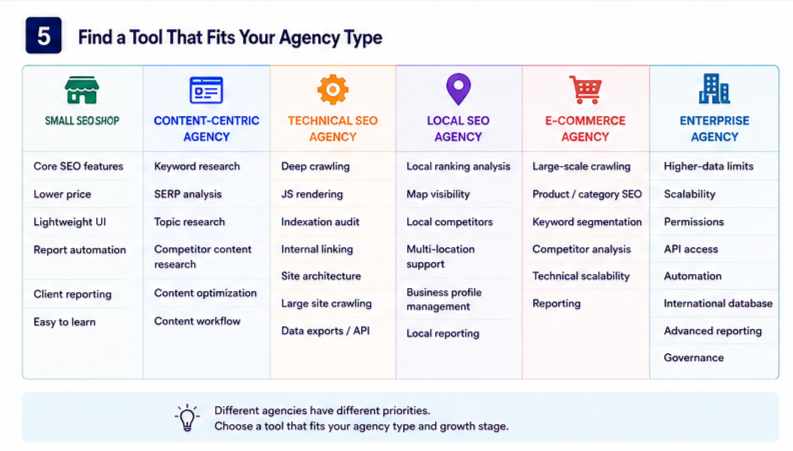
Use this guide to determine your agency type.
Agency type: small SEO shop
Prioritize:
- Core SEO features
- Lower price thresholds
- Lightweight UI
- Report automation
- Client reporting
- Light training
Agency type: content-centric SEO
Prioritize:
- Keyword research
- SERP analysis
- Topic research
- Competitor content research
- Content optimization
- Content workflow
Agency type: technical SEO
Prioritize:
- Deep crawling
- JS rendering
- Indexation audit
- Internal linking
- Site architecture
- Large site crawling
- Data exports/API access
Agency type: local SEO
Prioritize:
- Local-ranking analysis
- Map visibility
- Local competitors
- Multi-location support
- Business profile management
- Local reporting
Agency type: e-commerce SEO
Prioritize:
- Large-scale crawling
- Product/category SEO
- Keyword segmentation
- Competitor analysis
- Technical scalability
- Reporting
Agency type: enterprise SEO
Prioritize:
- Higher data limits
- Scalability
- Permissions
- API access
- Automation
- International database
- Advanced reporting
- Governance
No single tool is universal and fits all agency types. The truth is, there is no such thing as «the best SEO tool, rather, different tools will be prioritized depending on the agency’s strategic brief. The list above allows you to establish your agency’s priorities, which then informs the comparison matrix in the next step.
4. Compare SEO Tools the Right Way
This is where you move from “what do I need?” to “how do I actually compare candidates?”
Build an agency-specific SEO tool scorecard
Use a customizable weighted matrix like the one below, and adjust the weights to match your agency:
| Requirement | Weight | Tool A | Tool B | Tool C |
|---|---|---|---|---|
| Keyword research | 15% | |||
| Rank tracking | 15% | |||
| Technical SEO | 15% | |||
| Competitor research | 10% | |||
| Reporting | 15% | |||
| Scalability | 10% | |||
| AI visibility | 5% | |||
| Automation/API | 5% | |||
| Ease of use | 5% | |||
| Cost/ROI | 5% |
A technical SEO agency should weight crawling and technical SEO closer to 25–30%. A content agency should shift that weight toward keyword research and content workflow instead.
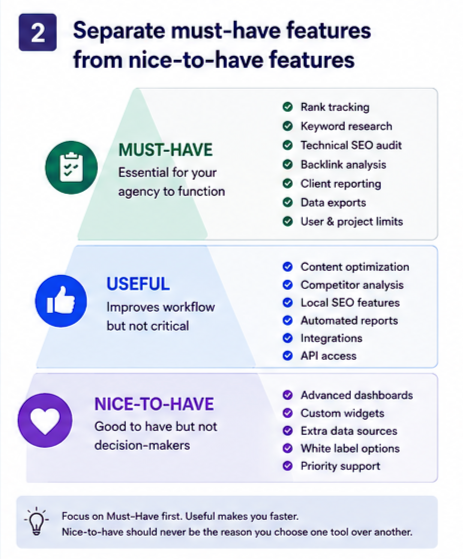
Separate must-have features from nice-to-have features
Categorize each tool’s abilities:
- Must-have – necessary for the agency to function
- Useful – makes the workflow better, but not crucial
- Nice-to-have – should not be the deciding factor between two options
Compare workflows, not features
This is the most crucial change you’ll need to make when you begin searching for SEO tools. You’re not looking for the largest keyword database or the most comprehensive set of reports. You want to ask:
Which tool allows us to find, prioritize, execute, and report on the most valuable keyword opportunities with the least effort?
You’ll begin comparing features within similar frames – for instance, how much work it takes to identify 20 keyword opportunities, analyze three competitors, and perform a technical SEO audit.
5. Calculate the Real Cost and ROI
Don’t be surprised when a tool’s stated price doesn’t match its value to the agency. Compare what the plan actually includes:
- Projects
- Users
- Keyword and crawl limits
- Historical data
- Reports
- API access
- Add-ons
- Extra regions/databases/AI features
Agency SEO tools range from completely free (Google Search Console, GA4) to $229 a month for enterprise-grade rank trackers, with most professional suites landing somewhere between $39 and $140 per month, according to the 2026 authority-weighted market review by New Standard Digital . It’s easy to see why comparing plan prices is a pointless exercise – two tools may well have the same listed cost, but one will allow 5x more keywords per project than the other.
Calculate the real tools cost per client
The simplest method is to use the following formula:
Monthly bill ÷ active clients = base cost per client
Remember that this is a baseline figure – you’ll also need to factor in the time spent working with the tool.
Calculate how much time the tool makes you spend
Subscription cost + employee time + report generation time + extra friction = total cost
More expensive tools often have superior value propositions – in other words, you get more for your money. Several agency owners in the 2026 directory of active SEO agencies actually recommend this method when choosing between SEO tools.
Karl Hughes, owner of two agencies, notes that the fundamentals of SEO remain the same despite the noise around the space – the tools he recommends are the ones his employees actually use, since they’ve been battle-tested to handle real agency needs. The same man advises to think about tools as an investment: how much extra work they add to employees’ plates every month, and whether they allow cutting costs elsewhere.
Calculate the ROI of the SEO tool
- How much time does the tool save you?
- How much time does it save you on report generation?
- Can you take on more clients?
- Can your junior employees work faster?
- Does it reduce the need for other software?
- Does it make you look better to your clients?
6. Test Your Shortlisted SEO Tools Before Buying
Test before you buy, if at all possible. Use the real-life examples – if you can’t use a client’s data for research, use your own. Your test data should include:
- Existing rankings
- Competitors
- Technical issues
- Backlinks
- Content
- Reporting needs
Run the same tests in every shortlisted tool. You can even create a standard test recipe:
- Find 20 real keyword opportunities
- Analyze three competitors
- Conduct a technical SEO audit
- Track a keyword set
- Analyze backlinks
- Compile a client report
- Export necessary data
- Have a junior employee repeat the test
Ask your employees about their experience
Don’t rely on the opinion of a single person – let the staff discuss what they like and dislike about the tool. Ask them:
- Was it easy to use?
- Was the information easy to understand?
- Did the tool require much manual effort?
- Could they use it for other tasks?
- What frustrated them about the interface/platform?
- What couldn’t they do without another tool?
Most experienced SEOs will tell you to never judge a tool on a single test. In fact, AEO Vision’s 2026 roundup of the best SEOs in the field advises to avoid single-bullet-point thinking – the most important metric when test-driving a tool is long-term consistency. The same advice applies to testing the tools your agency is considering – a competent employee can show you exactly how the tool will affect your operations.
Score the real-world experience
Score each tool based on accuracy/usability, speed, workflow compatibility, scalability, reporting, and cost-efficiency. The tool with the best marketing page may not have the best combination of these factors.
7. Avoid these mistakes when purchasing SEO tools
Choosing the most popular tool
Popularity is sometimes a red herring – a widely-known tool may not be the best fit for your agency’s particular needs.
Choosing the cheapest option
A low initial price can turn into a steep learning curve or require you to buy several other tools to make up for its deficiencies.
Prioritizing tools with the largest feature set
More features doesn’t always mean a better tool – it’s crucial to identify the features you actually need.
Not considering limitations
A seemingly affordable plan can become unbudgeted when you factor in the actual number of clients you serve.
Buying tools with unneeded features
Not every feature is valuable to your agency – if a certain function doesn’t make your life easier, it shouldn’t influence your purchasing decision.
Purchasing multiple tools with overlapping features
There’s a reason why this pattern emerges so often in conversations with agency owners:
Tool A (keywords) + Tool B (backlinks) + Tool C (rank tracking) + Tool D (reporting)
Having multiple tools with similar features creates unneeded complexity at multiple levels – your employees now have to learn multiple interfaces, and the data from each tool can’t be used together seamlessly.
Letting only managers choose the tools
Let your employees have a say in the evaluation process – after all, they will be using the chosen tool every day of their professional life.
8. All-in-One vs. Specialized SEO Tools
There’s no one-size-fits-all answer, here, only what’s right for your agency’s current structure.
Criteria for choosing an all-in-one SEO platform
Makes most sense when an agency wants to…
- Create a unified data source
- Streamline their processes
- Reduce subscription costs
- Make training easier
- Standardize operations
- Have a single SEO data repository
Criteria for choosing specialized SEO tools
Makes most sense when an agency has…
… highly specialized needs that require deeper functionality than general-purpose tools can offer, including…
- More robust crawling options
- Niche local SEO demands
- Unique content production needs
- Enterprise data needs
Criteria for choosing a hybrid SEO tech stack
Most agencies will want this:
An all-in-one SEO tool as their base layer + specialized SEO tools for their unique needs
A hybrid approach can give agencies the benefits of a centralized data repository while also having the deeper functionality they need in individual areas in a single specialized SEO tool
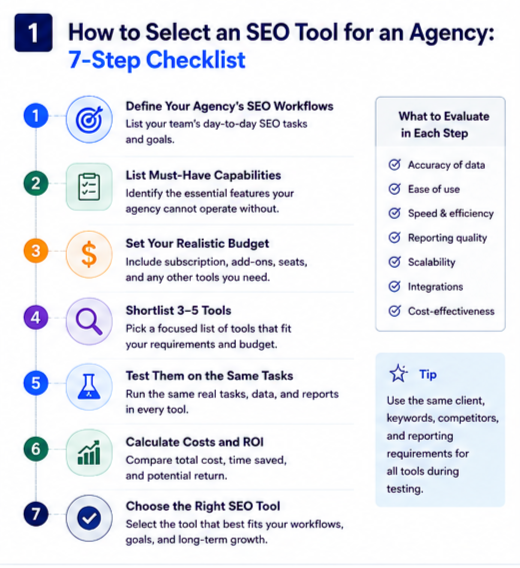
9. How to Select an SEO Tool for an Agency: 7-Step Checklist
The 7-step SEO tool selection process
- Define your agency’s SEO workflows
- List out all your agency’s must-have capabilities
- Set your realistic budget (including costs of add-ons, seats, and any other tools you have to use alongside this one)
- Shortlist 3-5 tools
- Test them all on the same tasks
- Calculate costs and ROI
- Choose an SEO tool that best fits the needs of your agency
A brief overview of each step in the process:
Define your agency’s SEO workflows:
This should ideally be a list of your team’s day-to-day tasks.
Identify your agency’s must-have capabilities:
This should be a prioritized list of the essential features your team needs, without considering any specific vendor’s offerings yet.
Set your realistic budget:
You should take usage costs, any add-ons your agency will need to invest in, additional software costs, and the number of seats/billed users into account, rather than just looking at a particular tool’s subscription price.
Shortlist 3-5 tools:
Avoid getting overwhelmed and having to compare 15+ options; 3-5 is a good number to aim for.
Test them all on the same tasks:
You should be evaluating how well each tool does on the same set of tasks you define, using a similar client, the same set of keywords, the same competitors, and the same reporting requirements.
Calculate costs and ROI:
Always consider opportunity costs when calculating how much budget this purchase would consume for your agency, rather than only the subscription price.
Choose an SEO tool that best fits the needs of your agency:
Your team should consider a given tool’s fit according to these criteria: capabilities, workflow efficiency, ease of use, scalability, and ROI.
10. Which SEO Tools Should Agencies Use? A Decision Tree
Use this decision tree as a guide for choosing between all-in-one SEO platforms, specialized SEO tools, and hybrid SEO tech stacks.
Choose an all-in-one SEO platform for your agency if…
…your agency wants centralized workflows, prefers streamlined operations, and doesn’t want to juggle multiple subscriptions with complicated billing.
Choose a specialized SEO tool for your agency if…
…your agency has one specific requirement that requires deeper functionality than all-in-one SEO platforms can offer.
Choose a hybrid SEO tech stack for your agency if…
…you want to use an all-in-one SEO platform as your base but also need deeper functionality in certain areas.
Choose based on your agency’s most pressing needs
Rather than getting caught up in what tools have the most exciting marketing language, anchor your decision in what your agency most needs to accomplish right now. Examples:
- To resolve bottlenecks around keyword research, prioritize keyword intelligence.
- To resolve issues with technical SEO, prioritize crawling depth and technical analysis.
- To get more consistent client reports, prioritize SEO dashboards, reporting automation, and white-label options.
- To be able to take on more clients profitably, prioritize the SEO tool’s ability to scale and automate your current workflows.
- To get more value out of AI searches, prioritize meaningful AI-search visibility rather than an “AI SEO tool” with little value that tacks an extra few thousand dollars onto your bill.
SEO Tool Selection Checklist
Before short-listing tools
- We know how many clients we manage
- We know how many websites we manage
- We know our main SEO services
- We know our biggest workflow bottlenecks
- We know our realistic monthly budget
- We know our must-have features
Before starting a trial
- We short-listed 3-5 tools
- We prepared the same tasks
- We selected a sample client website
- We know what data we need
- We know what reports we need
Before buying
- We checked keyword limitations
- We checked crawl limitations
- We checked user/seat limitations
- We checked costs of add-ons
- We tested report generation
- We tested exporting options
- Our delivery team tested the tool
- We calculated cost per client
- We estimated ROI generation
- We checked if the tool can scale with us
Frequently Asked Questions
Should an SEO agency use one all-in-one platform or multiple specialized SEO tools?
It depends on your agency’s needs. Use an all-in-one platform for simpler, centralized workflows. Add specialized tools when you need deeper functionality in specific areas. A hybrid setup often works best.
How many SEO tools does an agency actually need as it grows?
There is no fixed number. Use enough tools to cover critical workflows, but avoid unnecessary overlap, extra subscriptions, and fragmented data.
Should agencies choose an SEO tool based on data accuracy or workflow efficiency?
Both matter. Reliable data is essential, but the best tool is one that helps your team turn that data into SEO actions with minimal manual work.
Is it worth paying for both Semrush and Ahrefs, or can one replace the other?
Only if both provide unique value your agency actually uses. If one tool covers your essential workflows, paying for both may create unnecessary cost and overlap.
How should an agency evaluate whether an SEO tool is actually worth its monthly cost?
Look beyond the subscription price. Consider data quality, employee time saved, reporting efficiency, usage limits, additional costs, and potential client capacity.
What should an agency test before switching to a new SEO tool?
Test the same keywords, competitors, technical audits, rankings, backlinks, reports, and exports in both tools. Compare accuracy, usability, speed, and workflow efficiency.
How can an agency tell whether an SEO tool will scale with its client base?
Check project, keyword, crawl, user, location, API, and reporting limits at your expected client volume. Also check how pricing changes as usage increases.
When should an agency replace several specialist tools with one all-in-one platform?
Consider consolidation when tools have overlapping features, data must be combined manually, employees switch between too many platforms, or subscription costs are becoming difficult to justify.
Should an agency choose different SEO tools for different SEO services?
Yes, priorities can vary significantly. Technical SEO may require advanced crawling, while local SEO needs location-based data and content-focused agencies may prioritize keyword, SERP, and content research.
How long should an agency test an SEO tool before committing?
Test it long enough to run your real workflows repeatedly, not just during a feature tour. Evaluate discovery, execution, reporting, exports, and team usability before committing.
Final Verdict: Choosing the Best SEO Agency Tool Is About Finding the Right Fit
We hope you found these tips on choosing the best SEO tool for an agency helpful. Here are three key takeaways to consider:
- Define your agency before comparing SEO tools.
- Focus on testing SEO tools’ workflows rather than comparing their features.
- Remember to measure the cost-effectiveness and strategic value of the SEO tool you choose.
The best SEO tool for an agency in 2026 is not the one with the most features (and the priciest invoice). The right fit for your agency is the tool that you and your team can use consistently to deliver on your own agency SEO needs at a price that makes financial sense for your agency’s long-term strategy.
