
Hostinger Pricing 2026: Every Plan Compared
Pricing note: Hostinger pricing is region-dependent, varies by currency, billing term, promotions, and account settings. The USD figures in this guide were verified against Hostinger’s public pricing pages in July 2026. Always check the final price before checkout.
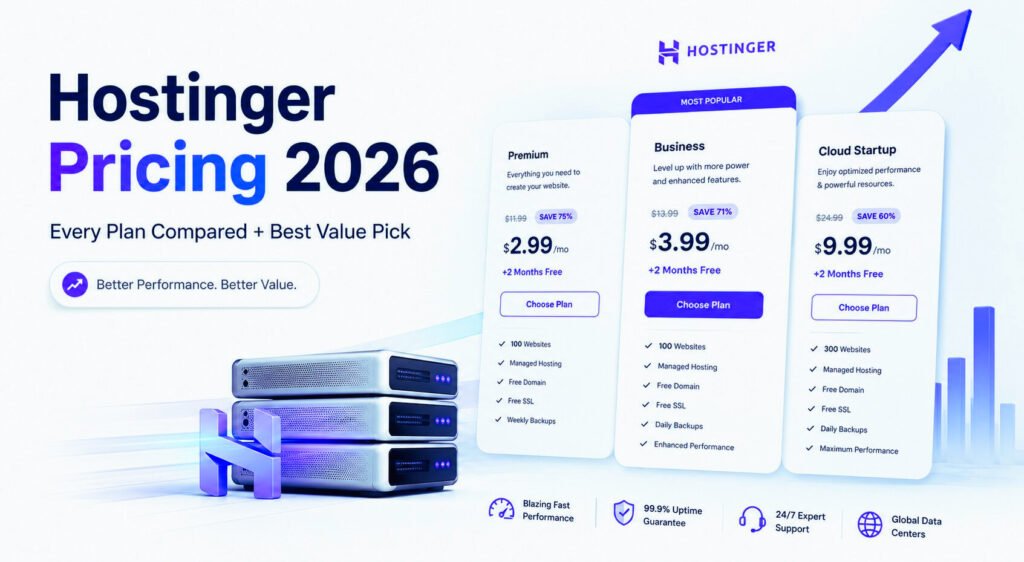
Hostinger Pricing 2026: Quick Answer
If you are comparing Hostinger plans in 2026, the short answer is:
Premium is the cheapest entry-level web hosting, Unlimited is the best overall value, Cloud Startup is the right choice for most resource-intensive and high-traffic projects, and KVM VPS is the preferred option for those who need full control over the server.
As of July 2026, Hostinger’s web hosting page lists the following plans:
| Hostinger plan | Current introductory price | Renewal price | Best for |
|---|---|---|---|
| Premium | $2.99/mo | $10.99/mo | Small websites and beginners |
| Unlimited | $3.79/mo | $16.99/mo | Multiple websites and growing businesses |
| Cloud Startup | $7.99/mo | $25.99/mo | Higher-traffic sites and demanding projects |
| KVM 1 VPS | $6.49/mo | $11.99/mo | Developers and resource-heavy applications |
| KVM 2 VPS | $8.79/mo | $14.99/mo | Medium-scale applications |
| KVM 4 VPS | $12.99/mo | $28.99/mo | Larger workloads |
| KVM 8 VPS | $25.99/mo | $49.99/mo | High-resource workloads |
The first three are Hostinger’s core mainstream web hosting and managed cloud hosting plans. KVM VPS is a separate category that represents a higher level of control and resources over a traditional shared hosting plan.
My recommendation for most businesses would be Unlimited. Premium is an excellent choice for budget-conscious customers, but Unlimited provides significantly more headroom for multiple sites, storage, backups, and business-critical use at only a slightly higher price for the promotional billing period. Cloud Startup is a better value than Premium for most performance-focused projects.
That said, the cheapest plan is not always the best value. Let’s discuss the changes in more detail.
Hostinger Pricing 2026: What Has Changed?
One of the most common mistakes I see when comparing Hostinger is using an old article as a reference point. Hostinger has been rebranding and adjusting its plans for several years, and its own documentation even notes that hosting limits can vary depending on the date of account opening. As of July 2026, Hostinger’s website lists several plan categories that were previously merged under the Business name.
A more recent change is that the plan previously known as Business is now named Unlimited on Hostinger’s official US web hosting pricing page.
The updated list now includes four core plan types:
- Premium
- Unlimited
- Cloud Startup
- KVM VPS, as a separate category
On the current web hosting page, Hostinger highlights Premium for creators and small businesses, Unlimited for more flexible long-term projects, and Cloud Startup for agencies and higher-traffic needs.
This means that any older article or review that recommends the Business plan may already be outdated. If you are comparing a 2024 or 2025 guide, you may want to double-check the dates.
1. Hostinger Premium
Starting price: $2.99/mo
Renewal: $10.99/mo
Billing example: 48 mo for $143.52 at the current promotional price.
Hostinger Premium is the most budget-friendly mainstream web hosting plan. It is intended for smaller sites, creators, and businesses that do not require substantial resources. As of July 2026, the plan includes:
- Up to 3 websites
- 20 GB SSD storage
- 2 GB RAM
- 1 CPU core
- 40 PHP workers
- 400,000 inodes
- Weekly backups
- CDN
- Free domain for one year
- Free SSL
- WordPress
- Website builder
- AI tools
- 2 mailboxes per website for one year
- 30-day money-back guarantee
Hostinger’s current price for Premium is $2.99/month on a 48-month term and states that it renews at $10.99/mo.
Who should choose Premium?
I would recommend choosing Premium if you are launching:
- A personal website
- A portfolio
- A blog
- A small company website
- A landing page-based business
- A low-traffic project
A Premium plan is also a good choice if you are launching a business-critical website but want to minimize the initial expenses. You can always upgrade to a more powerful plan if your traffic or resource needs increase.
Who should skip Premium?
If you know that you will need to launch multiple websites or use resource-heavy WordPress plugins, I would advise against choosing Premium as the primary plan. The entry-level option has limitations in terms of websites, storage, PHP workers, and traffic-handling capabilities. The $2.99 price may be tempting, but the resource ceiling is the more important consideration.
2. Hostinger Unlimited
Starting price: $3.79/mo
Renewal: $16.99/mo
Billing example: 48 mo for $181.92 at the current promotional price.
Unlimited is the most recommended plan for a small business, marketer, or agency owner that intends to launch an actual business asset. As of July 2026, it includes:
- Unlimited websites
- 50 GB NVMe storage
- 3 GB RAM
- 2 CPU cores
- 60 PHP workers
- 600,000 inodes
- Daily backups
- Easy data restoration
- CDN
- Ecommerce
- Free domain for one year
- Free SSL
- AI tools
- Priority 24/7 support
- Unlimited mailboxes per website for one year
- WordPress
- Website builder
- Node.js
Hostinger’s current price for Unlimited is $3.79/month for the 48-month promotional term, renewing at $16.99/mo.
Why I consider Unlimited the best value
At this point, it is worth noting that the difference between Premium and Unlimited is relatively small. The promotional price difference is only $0.8 per month.
For the additional $3.79, you get:
- Unlimited websites as compared to 3 in Premium
- 50 GB storage instead of 20 GB
- 3 GB RAM instead of 2 GB
- 2 CPU cores instead of 1
- Daily backups instead of weekly
- 600,000 inodes instead of 400,000
- A more flexible environment for business use
Unlimited is a significantly more compelling choice than Premium for anyone who wants to launch a business-critical project, a content site, a client-focused website, or multiple websites. For most small business owners, it is the sweet spot in terms of price and capabilities.
The important caveat
Do not confuse Unlimited with truly unlimited resources. The plan allows you to host an unlimited number of websites, but CPU cores, RAM, PHP workers, storage, and other resources still have predefined limits. This is the case for all shared hosting plans, including WordPress-specific options.
3. Hostinger Cloud Startup
Starting price: $7.99/mo
Renewal: $25.99/mo
Billing example: 48 mo for $383.52 at the current promotional price.
Cloud Startup is a step above standard shared hosting and is aimed at agencies and higher-traffic projects. As of July 2026, it includes:
- Unlimited websites
- 100 GB NVMe storage
- 4 GB RAM
- 4 CPU cores
- 100 PHP workers
- 2,000,000 inodes
- Daily and on-demand backups
- CDN
- Dedicated IP
- Managed WordPress and WooCommerce hosting
- Unlimited SSL
- AI tools
- Priority 24/7 support
- Unlimited mailboxes per website for one year
- 15 vibe-coding credits
Hostinger’s current price for Cloud Startup is $7.99/month on a 48-month term, with renewal at $25.99/mo.
Who should choose Cloud Startup?
Cloud Startup is a good choice if your website is an important asset that requires higher performance and reliability. It is suitable for:
- High-traffic blogs
- Ecommerce websites
- SaaS marketing sites
- Growing businesses
- Agencies
- Large content websites
- WordPress sites with heavier demands
- Projects that require additional performance headroom
I would not recommend choosing Cloud Startup simply because it offers more resources than Unlimited. If your website does not have substantially higher demands, a more expensive plan would be a wasted investment.
Hostinger KVM VPS Pricing 2026
When it comes to KVM VPS, you are no longer comparing similar shared hosting plans. VPS (Virtual Private Server) is a virtual server that is much more flexible and offers greater control and resources than shared hosting.
Hostinger’s current US VPS pricing page lists four KVM plans:
| VPS plan | Intro price | Renewal | vCPU | RAM | NVMe storage | Bandwidth |
|---|---|---|---|---|---|---|
| KVM 1 | $6.49/mo | $11.99/mo | 1 vCPU | 4 GB | 50 GB | 4 TB |
| KVM 2 | $8.79/mo | $14.99/mo | 2 vCPU | 8 GB | 100 GB | 8 TB |
| KVM 4 | $12.99/mo | $28.99/mo | 4 vCPU | 16 GB | 200 GB | 16 TB |
| KVM 8 | $25.99/mo | $49.99/mo | 8 vCPU | 32 GB | 400 GB | 32 TB |
These are the specifications as of July 2026.
KVM 1
KVM 1 is the entry-level plan, offering 1 vCPU, 4 GB RAM, 50 GB storage, and 4 TB bandwidth. It is a good choice for developers who want more control over the server environment.
KVM 2
KVM 2 provides double the performance of KVM 1 and is recommended for applications such as n8n. It is a good choice for medium-scale applications.
KVM 4
KVM 4 is designed for applications that require substantially more resources. It is not necessary for a marketing website but can be a good choice for more resource-heavy applications, services, databases, automation, or workloads.
KVM 8
KVM 8 is the most powerful plan among the four options. It offers 8 vCPU cores, 32 GB RAM, 400 GB storage, and 32 TB bandwidth. It is suitable for applications and services with particularly demanding requirements, but it would be an overkill for a standard WordPress blog.
Hostinger Pricing: Promotional Price vs Renewal Price
This is the most important consideration when choosing a web hosting plan, and it is often overlooked. Hostinger’s promotional pricing is significantly lower than the standard renewal price. As of July 2026, Hostinger lists the following prices on its US web hosting page:
| Plan | Intro price | Renewal price |
|---|---|---|
| Premium | $2.99/mo | $10.99/mo |
| Unlimited | $3.79/mo | $16.99/mo |
| Cloud Startup | $7.99/mo | $25.99/mo |
The difference between the introductory and renewal pricing can be substantial. For example, Premium’s $2.99 price may seem like a great deal, but the $10.99 renewal price is significantly more expensive. I recommend budgeting around $132 per year for Premium, $204 for Unlimited, and $312 for Cloud Startup at the standard renewal rate.
That said, most people will only renew their subscriptions if they are satisfied with the service. The promotional price is a good budgeting point for the first year, but I recommend using the renewal price as a reference point for subsequent years.
How Much Does Hostinger Cost After Renewal?
Using Hostinger’s current US renewal prices:
Premium
$10.99/mo or $131.88/year (approximately).
Unlimited
$16.99/mo or $203.88/year (approximately).
Cloud Startup
$25.99/mo or $311.88/year (approximately).
The lesson here is simple: always budget around the standard renewal price. You will rarely get a significant discount when your subscription renews, so it is best to use the standard rate as your reference point.
How Much Does Hostinger Cost for a Website?
It depends on the website. For a simple one-site project, Premium may be sufficient, but Unlimited is a much better value if you need to launch multiple websites. For a serious business-critical project, Cloud Startup is the right choice. For developers, KVM VPS is an option, but it is important to consider the differences between a marketing website and a resource-heavy application.
“Cost per website” is not a useful metric in this case. A $3.79/mo plan is a much better value than a 1-site business plan.
Hostinger Premium vs Unlimited
When comparing these two options, here is a summary of the most important differences:
| Factor | Premium | Unlimited |
|---|---|---|
| Websites | 3 | Unlimited |
| Storage | 20 GB SSD | 50 GB NVMe |
| RAM | 2 GB | 3 GB |
| CPU | 1 core | 2 cores |
| Backups | Weekly | Daily + easy restoration |
| Inodes | 400K | 600K |
| Intro price | $2.99/mo | $3.79/mo |
| Renewal | $10.99/mo | $16.99/mo |
Premium is much cheaper, but Unlimited offers much better value. If you are launching a personal project, I would recommend saving the money and choosing Premium. If you are launching a business-critical project, Unlimited is the right choice.
Hostinger Unlimited vs Cloud Startup
This comparison is more relevant for most business owners. As of July 2026, Unlimited costs $3.79/mo, and Cloud Startup costs $7.99/mo during the promotional period. In other words, Cloud Startup is more than twice as expensive as Unlimited at the introductory rate. However, Cloud Startup also includes:
- 100 GB NVMe storage
- 4 GB RAM
- 4 CPU cores
- 100 PHP workers
- 2,000,000 inodes
- Daily and on-demand backups
- Dedicated IP
- Cloud infrastructure
The value proposition depends on your needs. Cloud Startup is clearly a better option if you need the additional resources and performance headroom. For most business owners, however, Unlimited offers better value.
Which Hostinger Plan Is Best for WordPress?
For a new WordPress website, I would recommend either Premium or Unlimited, depending on the expected traffic and resource requirements. For a serious business-critical project, Cloud Startup is a good choice. The choice between Premium and Unlimited depends on the expected traffic and resource requirements.
WordPress performance can be affected by a wide range of factors, including:
- Plugins
- Themes
- PHP workers
- CPU
- Database performance
- Caching
- Images
- Third-party scripts
- Traffic
- WooCommerce
Hostinger’s current plans have different capacities in terms of PHP workers, CPU cores, and RAM. As a rule of thumb, I would choose Cloud Startup for a serious WordPress project and leave Premium for a simple blog.
Which Hostinger Plan Is Best for a Small Business?
For most small businesses, I would recommend Unlimited. It is important to have enough resources to support a professional website, business pages, blog content, lead forms, analytics, SEO tools, images, and other assets. At the same time, a VPS server is not necessary at this stage, and Cloud Startup is too expensive for most small business owners.
Which Hostinger Plan Is Best for Ecommerce?
For a small ecommerce project, Unlimited may be enough depending on your architecture, catalog depth, traffic, and applications stack. Hostinger appears to offer native ecommerce support across its main web hosting plans, with Cloud Startup providing more capacity and managed services. However, hosting is only one pillar of performance, and a store can be slow for other reasons:
• Heavily optimized product images or JS
• Resource-heavy third-party applications
• Lack of caching and poor database queries
• Ineffective technical SEO or checkout optimization
Upgrading the server alone will not resolve these issues, which is why I would not recommend looking at hosting in isolation.
Hostinger for Agencies and Multiple Client Websites
When it comes to agencies, the conversation is not centered around the cheapest plan for a single website.
Hostinger has an option specifically for agencies that handles the complexities associated with multiple client sites, including site-specific user permissions, client dashboards, website isolation, daily backups, dedicated IP, and the ability to host many sites under one account. This has a significant impact on the economics of a small web agency compared to traditional shared or VPS hosting.
Instead of viewing the cost per website in isolation, an agency needs to consider:
o Hosting costs + management overhead + client access management + backups + security + scalability
By adopting a more sophisticated view of the economics, an agency can often find that a more expensive plan ends up being cheaper overall.
Does Hostinger Have a Free Domain?
It depends on the plan but for most of them, you do not pay extra for the domain during the first year. However, this should be taken with a caveat that a free domain typically means you will have to renew it at a higher price after the promotional period. This is why I would advise to separate the budget for the initial domain registration from the long-term costs. The current pricing pages for Hostinger explicitly state which plans provide a domain name for the first year.
Does Hostinger Include SSL?
Yes, Hostinger offers unlimited free SSL certificates with its main shared hosting plans. The same applies to the cloud options, although some of their security-related features appear to be limited compared to fully managed platforms.
However, SSL is just one aspect of a website’s security and should not be conflated with overall safety. Website protection requires consistent software updates, secure authentication practices, careful plugin management, regular backups, proper file permissions, and server hardening. Hosting is helpful but it is not a magic wand that makes a website immune to attacks.
Hostinger’s AI Features in 2026
One area where things appear to be changing for the better is artificial intelligence. The company has been gradually incorporating more AI-powered features into its website creation ecosystem.
It currently lists several AI-related features on its website building pages, including AI SEO, email marketing, website generation, and “vibe coding” depending on the plan.
From a marketer’s perspective, this is an important trend that should be monitored, but I would not necessarily recommend choosing one cloud hosting provider over another based on their AI-related capabilities.
The critical question is whether such features take a significant amount of manual work away from the user, for instance, by automating the content production or coding process.
If an AI tool helps generate general copy that still needs substantial editing, its value is limited to reducing the volume of repetitive tasks. In terms of SEO, AI content generation needs to be supplemented with research, original insights, and a clear strategic direction to deliver meaningful value.
Hostinger Pricing by Country
While some companies attempt to attract international customers by advertising the lowest prices in USD, Hostinger actually employs a localized pricing model. If you were to visit the website from the UK, Canada, Australia, or any other region, you would likely see prices in local currencies.
For instance, the current India page displays plans in Rupees rather than Dollars, while the Bangladesh page uses Taka. This means that when you are trying to compare prices or budget for a purchase, it is important to look at the local checkout rather than relying on the figures shown on the United States page.
This nuance also applies to billing and taxes, which can vary significantly between countries. For multinational companies, I would advise to establish a separate budget in your local currency rather than basing everything on the USD price listed on Hostinger’s website.
Common Hostinger Pricing Mistakes
Mistake 1: Focusing only on the monthly cost
A figure such as “$2.99/month” appears attractive, but I would advise to look at the fine print before making a decision. You might be paying this amount for a yearly billing cycle, whereas a truly monthly subscription would be considerably more expensive.
Always make sure to review the contract terms and ask about the following:
o Payment cycle – yearly vs. monthly
o Initial deposit
o Renewal cost
o Domain renewal fee
o Additional expenses such as taxes
Mistake 2: Going for the cheapest option regardless of resources
Cheap hosting is not always a scam – sometimes it really is the cheapest option available. However, I would advise to carefully analyze the value proposition offered by each plan. A higher-priced product may provide significantly better performance and/or allow you to avoid expensive upgrades in the future.
Mistake 3: Being misled by the word “unlimited”
“Unlimited” is a relative term that does not necessarily mean there are no limitations. Make sure to distinguish between truly unlimited features (websites) and those that are restricted by resources (CPU, RAM).
Mistake 4: Confusing shared/managed hosting with VPS
Shared and managed options are not direct substitutes for VPS hosting, even though they provide a similar level of convenience. While they allow you to host a website without technical expertise, VPS is an entirely different animal that provides greater flexibility at the cost of complexity.
Mistake 5: Overlooking the renewal cost
This is the most important mistake of all, in my opinion. Always consider the long-term sustainability of your choice. How much will you have to pay yearly to keep your website online? How does this cost compare to the initial deposit? How does it align with your overall budget?
How much will you have to pay yearly to keep your website online? How does this cost compare to the initial deposit? How does it align with your overall budget?
How to Choose the Right Hostinger Plan
Here is a decision-making framework that I find useful:
Step 1: Determine the number of websites
Do you need hosting for one small website or multiple projects? If it is the former, consider getting started with Premium. For the latter, an unlimited plan is more cost-effective.
Step 2: Estimate your resource requirements
Focus on performance rather than traffic. Ask yourself the following questions:
- Are you planning to use resource-heavy applications?
- Are you going to use WordPress?
- Are you going to use an ecommerce platform?
- How much are your images going to weigh?
- How much traffic are you expecting?
- What level of automation are you going to need?
Step 3: Define your growth expectations
If you are launching a major project and do not want to upgrade later, get a bigger plan. If you are just testing an idea, start with something smaller and move up as you go.
Step 4: Compare the renewal costs
This is extremely important, so make sure to review the final price before proceeding to checkout.
Step 5: Determine your technical requirements
Are you going to need a full command of the operating system or will Managed Hosting be sufficient for you?
Step 6: Calculate the value based on the total cost of ownership
This metric is more useful than any other in my opinion. The formula is simple:
Hosting + Domain + Add-ons + Renewal Cost + Management Time
The last component is often overlooked, but it is critical to understand how your choice will impact your day-to-day operations.
Hostinger Pricing 2026: My Best Value Pick
If I had to choose one option for an average small business, marketer, or blogger, I would go with Unlimited. It is not the most powerful or the cheapest plan, but it provides a good balance between the two.
With it, you get more websites, greater storage capacity, CPU, RAM, and daily backups, CDN, and a better resource footprint compared to Premium, all for a relatively low price. You also get significantly fewer limitations compared to Cloud Startup.
My overall recommendation would be as follows:
- Best for beginners: Premium
- Best overall value: Unlimited
- Best for growing sites: Cloud Startup
- Best for developers: KVM VPS
- Best for agencies: Agency plan
This approach allows you to make a choice based on your specific requirements, rather than blindly following marketing recommendations.
Is Hostinger Worth It in 2026?
For many users, Hostinger is the perfect balance between affordability and performance. With its current product offerings, it is possible to get a reliable website for a low price and use a variety of tools, including AI and website creation assistance. However, it is a good idea to analyze your requirements before making a choice, since there are use cases where more specialized solutions make more sense.
For me, Hostinger is worth considering for users that want:
- Low-cost entry
- Ease of use
- Managed WordPress
- Website building tools
- Multiple websites
- Native AI tools
- Beginner-friendly interface
It is less compelling for those that need enterprise-level reliability and/or extreme customization.
To summarize, Hostinger is not a cheap alternative to traditional web hosting – it is a comprehensive platform with various levels of functionality that should be chosen based on the user’s requirements.
Hostinger Pricing 2026: Final Comparison
| Use case | Best Hostinger option | Why |
|---|---|---|
| Personal website | Premium | Lowest entry cost among all mainstream options |
| Small blog | Premium | Can host several entry-level sites |
| Professional business website | Unlimited | Better performance headroom |
| Multiple websites | Unlimited | Can host an unlimited number of sites |
| Growing WordPress site | Unlimited or Cloud Startup | Depending on the workload |
| Ecommerce | Unlimited or Cloud Startup | More performance headroom |
| High-traffic website | Cloud Startup | Additional resources |
| SaaS/application | KVM VPS | Greater flexibility and resources |
| n8n/automation workload | KVM VPS | VPS resources |
| Web development agency | Agency hosting | Client management tools |
| Large resource-heavy project | KVM 4/KVM 8 | Higher CPU and RAM capacity |
What This Means for SEO
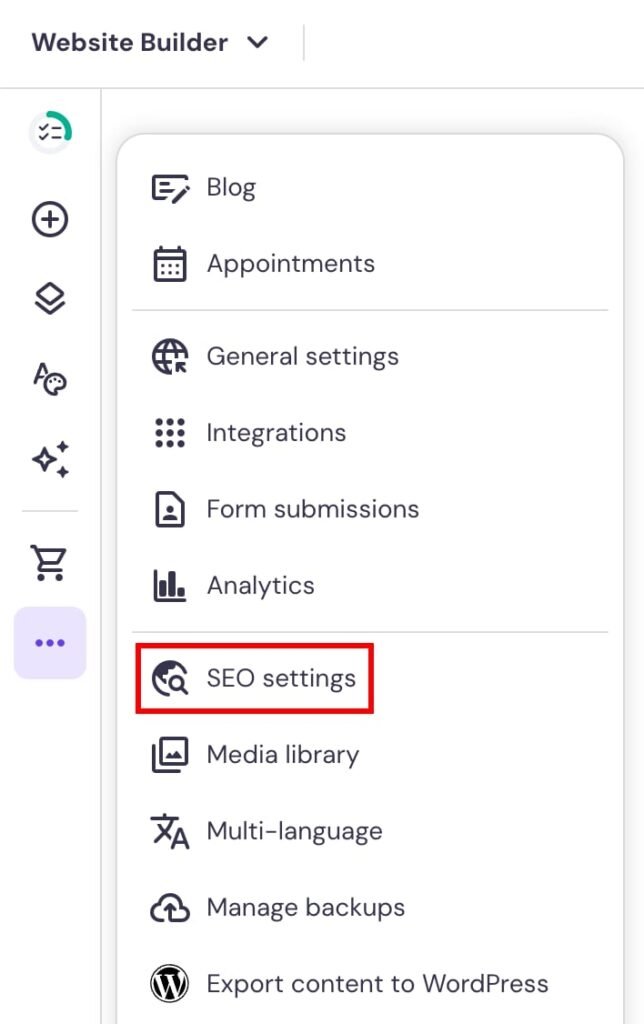
There is one critical consideration for SEO professionals that I want to add. Website hosting is an enabler but it is not a substitute for actual SEO work. A fast server, reliable uptime, and sufficient resources can enhance the performance, but they are only table stakes.
There are many other factors that contribute to higher rankings, including:
- Ranking factors
- Intent-specific optimization
- Content volume and quality
- Internal linking and architecture
- Technical SEO
- Authority and digital PR
- User experience and page speed
- Structured data and brand mentions
- Search demand
In 2026, there is an additional consideration that goes beyond traditional SEO. Your website needs to be optimized not only for search engines but also for AI discovery. This means that the same principles apply to AI-driven discovery surfaces such as Google Search, AI assistants, and recommendation engines.
In other words, a technically sophisticated website with excellent hosting is not enough. You also need to have high-quality content that provides value to the searcher.
If your SEO strategy relies on technical optimizations only, it may be time to re-examine your approach. A good starting point is to evaluate your website against the following criteria:
- Ranking factors
- Intent-specific optimization
- Content volume and quality
- Internal linking and architecture
- Technical SEO
- Authority and digital PR
- User experience and page speed
- Structured data and brand mentions
- Search demand
For businesses that need help with a more comprehensive approach, Digehub offers SEO Services that focus on sustainable growth rather than superficial optimizations.
AI Search and Hostinger: What Businesses Should Think About Search in 2026
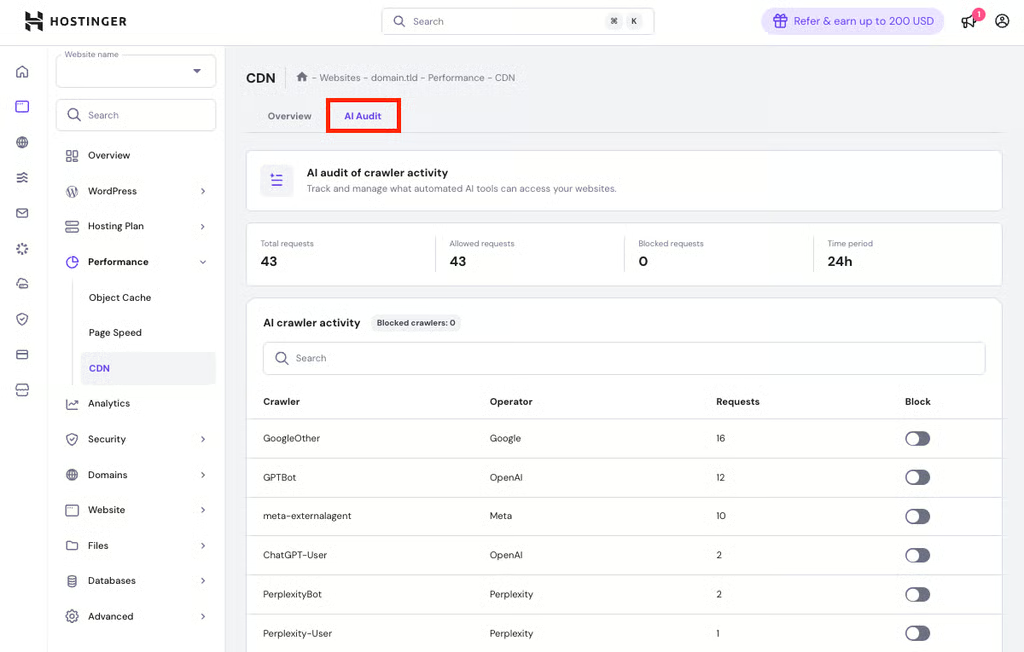
Search behavior is changing. More users are substituting traditional search with AI assistants that help them find products, compare options, and make purchasing decisions. It means that visibility in search results is no longer sufficient.
Businesses need to ensure that they can also be discovered through AI-driven channels. One consequence of this trend is that the traditional SEO playbook is no longer enough.
In particular, companies should be aware of the fact that they can appear in the search results while still being “invisible” to AI assistants. In real life, it means that a business can have a strong presence in Google while being unable to provide direct answers to simple questions.
The solution is to optimize the website for both channels, focusing on natural language, structured data, and first-party expertise. In practice, it means that businesses should strive to provide helpful answers to common questions on their website.
From an operational perspective, it helps to think of large language models (LLMs) as additional discovery channels that require optimization. Instead of relying on a one-size-fits-all approach, companies should analyze their specific needs and build an appropriate strategy.
For instance, those that want to leverage the capabilities of LLMs would benefit from additional guidance, including:
- Ranking factors
- Intent-specific optimization
- Content volume and quality
- Internal linking and architecture
- Technical SEO
- Authority and digital PR
- User experience and page speed
- Structured data and brand mentions
- Search demand
This approach is the foundation of Digehub’s AI Visibility Services, which are designed to help businesses get found by searchers as well as AI assistants.
Expert Insight: Do Not Let Hosting Become the Bottleneck
I have noticed a pattern among digital marketing professionals where an excessive amount of time and energy is spent on relatively inconsequential issues. For instance, an entire team can spend months debating whether it makes sense to reduce the cost of a web server by 10%, while neglecting fundamental growth levers that drive real revenue.
I have seen it happen dozens of times in the context of website marketing, including:
- Sites that continue to publish low-quality, thin content while struggling to attract backlinks
- Webscraping attempts to gather content ideas without actually analyzing the competition
- Ecommerce projects that rely solely on broad keywords with low commercial intent
- Websites with poor internal linking structure
- Brands that fail to capitalize on their own presence in the media
- Companies that do not optimize their content for AI assistants
These issues, and many others like them, consistently appear in my work with business owners and in-house marketing teams. Website hosting is not the root cause of these problems, which is why I believe it is important to invest more time and effort into other areas.
In particular, I think businesses should operate according to the following hierarchy when it comes to growth:
Infrastructure → Technical health → Search strategy → Content → Authority → Conversion
Once the underlying technical needs are addressed, attention should be diverted to improving content quality and search visibility. The same philosophy applies to all verticals, including SEO, content marketing, and AI discoverability.
What Will Change Next?
The industry is approaching a turning point where infrastructure needs to be integrated with technical, content, and growth strategies. This is evident from the way companies such as Hostinger have evolved in recent years, offering a wide range of services from AI website building to email marketing and SaaS solutions.
The next phase will see the emergence of more end-to-end platforms that unite infrastructure, search optimization, content production, and growth. For marketers, it means rethinking the way they operate in the context of this broader ecosystem.
Frequently Asked Questions
Businesses should evaluate total cost of ownership rather than the advertised monthly price. A practical calculation is: Hosting + Domain + Add-ons + Renewal Cost + Management Time. This approach helps reveal whether a cheaper plan is genuinely more economical or whether a higher-tier plan could reduce future upgrades, maintenance, and operational overhead.
A higher hosting plan can provide additional resources and potentially improve website performance when the existing hosting environment is a bottleneck. However, upgrading hosting alone does not guarantee better rankings. Technical SEO, content quality, search intent, internal linking, authority, structured data, and user experience remain critical.
AI features can reduce repetitive website-building, content, SEO, or development tasks, but they should not be the primary reason to select a hosting provider. Marketers should evaluate whether the AI features produce useful outputs, reduce manual work, and integrate with their broader workflow.
It can. Promotional pricing is substantially lower than standard renewal pricing on several plans. For accurate budgeting, businesses should calculate the expected annual renewal cost rather than treating the introductory price as the long-term hosting expense.
Unlimited can work for smaller ecommerce stores with moderate traffic and a relatively simple application stack. Cloud Startup is more appropriate when the store has a larger catalog, higher traffic, heavier applications, or greater performance requirements. Hosting alone, however, cannot solve problems caused by inefficient code, plugins, databases, images, or checkout processes.
The main difference is control and infrastructure. Managed web hosting is designed for users who want a simpler environment for websites, while KVM VPS provides greater control and dedicated virtualized resources. VPS is generally more appropriate for applications, automation, databases, and workloads requiring server-level customization.
No. The advertised monthly figure can depend on the billing term and promotional pricing. You should compare the total upfront payment, renewal price, billing cycle, domain costs, taxes, included features, and resource limits before choosing a plan.
It depends on the workload. Cloud Startup makes more sense when a website needs additional CPU, RAM, PHP workers, storage, backups, or performance headroom. For a typical small business website, Unlimited may provide better overall value without paying for resources you do not need.
Premium can be sufficient for a smaller WordPress site with modest traffic and a limited plugin stack. Unlimited is generally the better choice if you expect multiple websites, heavier plugins, more content, higher traffic, or greater resource requirements.
No. “Unlimited” primarily refers to the number of websites you can host. CPU, RAM, storage, PHP workers, inodes, and other technical resources still have defined limits, so the plan should be evaluated based on resource requirements rather than the name alone.
Final Verdict
Hostinger’s 2026 web hosting cost analysis appears to suggest affordability, but the value is best evaluated on a case-by-case basis. For an average personal project, I would advise to start with Premium.
For most small businesses, bloggers, and marketers, Unlimited seems to offer the best value in terms of additional resources. Cloud Startup makes more sense for growing sites with increasing traffic, while KVM is clearly better for large-scale production.
And if you want to remember only one rule about the Hostinger pricing, let it be the following: focus on the long-term costs rather than promotional discounts.
Hostinger can be worth the money, but only for the right projects. For the infrastructure-heavy production environments, Digehub can help with SEO Services, Content Marketing, and AI Visibility. And if you want to try something right now, you can always take advantage of Digehub’s Free SEO Blog Writing Tool.
The ultimate objective is to build the infrastructure, then build the visibility around content as the catalyst for conversions.
