
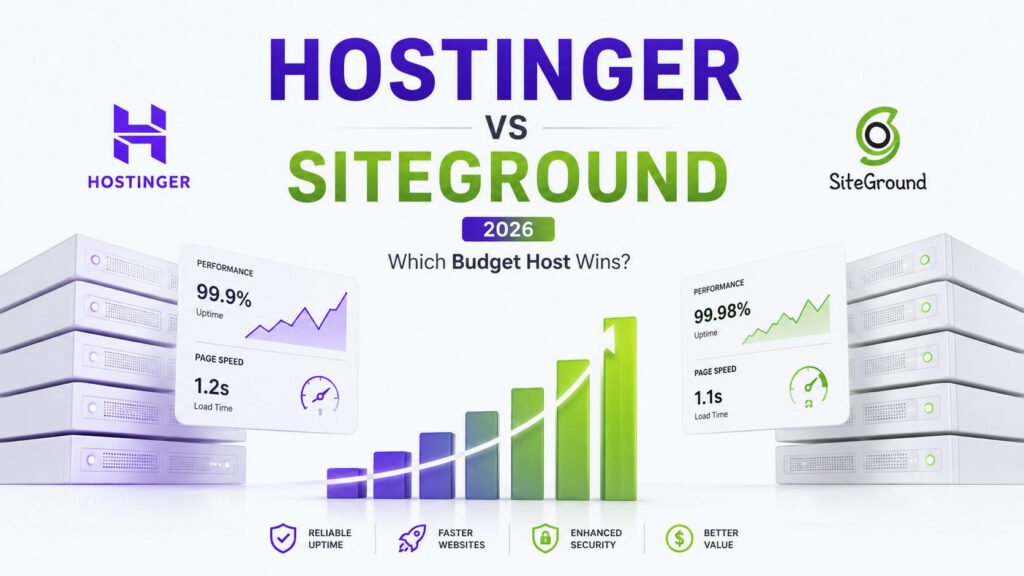
Hostinger vs SiteGround 2026: Which Budget Host Wins?
The race to pick the best web host has become more challenging than ever in 2026. Website owners now look beyond the entry-level hosting plan to consider a variety of factors when choosing a hosting service. Modern webmasters want better optimization, faster Core Web Vitals, guaranteed uptime, security, flexibility, AI-friendly infrastructure, and scalable performance.
It explains why the Hostinger vs. SiteGround debate remains one of the most popular comparisons on the internet.
Both are well-established brands in the hosting industry, but each takes a different approach. While Hostinger focuses on affordable but powerful shared hosting plans, SiteGround promotes its premium WordPress hosting services. Ultimately, these companies appeal to different budgets and ambitions.
However, the real question is, which budget-friendly web host is better at delivering on promises? Which hosting company provides more value for money? And what should matter more to you when selecting a hosting provider?
This guide will discuss the strengths and weaknesses of Hostinger and SiteGround 2026. We will have a closer look at the features, performance, WordPress optimization, security, caching technologies, scalability, customer support, and value. We will also explore what these hosting companies can bring to agencies, bloggers, SaaS, e-commerce, and business owners in general.
Quick Answer
If you only need the short version, here’s the answer.
Hostinger vs SiteGround: Category Winners
| Category | Winner |
|---|---|
| Lowest Initial Cost | Hostinger |
| Overall Value | Hostinger |
| WordPress Optimization | SiteGround |
| Beginner Friendliness | Hostinger |
| Website Speed | Tie — depends on site type |
| Scalability | SiteGround |
| WooCommerce | SiteGround |
| Developer Features | SiteGround |
| Ease of Use | Hostinger |
| Customer Support | SiteGround |
| AI Tools | Hostinger |
| Small Business Websites | Hostinger |
| Growing Businesses | SiteGround |
Color guide: Green = Hostinger wins · Purple = SiteGround wins · Gray = Tie
Choose Hostinger if you need cheap hosting, first-time domain owner, portfolio/blog, small business site, or you’re happy with basic value.
Choose SiteGround if you need WooCommerce hosting, expect traffic growth, client platforms, caching needs, or top-tier support.
Why is this comparison relevant in 2026
Websites hosting industry has evolved in the last several years.
Website owners’ priorities have shifted from “how much storage/bandwidth” to “what hosting provider offers better value”.
Factors like
- AI visibility
- Google Core Web Vitals ™️
- Page Experience
- Website security
- Conversion rate optimization
- Server load time,
- renewal cost sustainability
and more
all influence modern website owners’ decisions.
Modern search engines reward websites offering better user experience and performance. These improvements indirectly impact SEO value and user satisfaction.
With the rise of AI website discovery tools like ChatGPT, Perplexity, and Gemini – websites must appear in search results to be found by users. While the hosting provider cannot guarantee visibility, it can deliver on performance, technical needs, and server stability to meet these requirements.
Therefore, the competition between website hosting providers represents a battle for business owners’ attention and budgets.
Hostinger vs SiteGround 2026 at a Glance
Hostinger vs SiteGround: Full Comparison
| Feature | Hostinger | SiteGround |
|---|---|---|
| Starting Price | Lower | Higher |
| Renewal Cost | Moderate | Premium |
| Control Panel | hPanel | Site Tools |
| WordPress Optimization | Excellent | Excellent |
| Server Technology | LiteSpeed + NVMe | Google Cloud + NGINX |
| Free CDN | Yes | Yes |
| Free SSL | Yes | Yes |
| Daily Backups | Selected plans | Most plans |
| AI Website Builder | Yes | Limited |
| Managed WordPress | Yes | Yes |
| WooCommerce Support | Good | Excellent |
| Staging | Higher plans | Included |
| Developer Tools | Basic | Advanced |
| Beginner Friendly | Excellent | Very Good |
Color guide: Green = Excellent/Yes · Purple = Good · Amber = Limited/Higher plans · Red = Higher cost
At first glance, both providers seem similar. However, the differences become much more noticeable when examining how they manage performance, caching, server resources, and website growth over time.
Hostinger vs SiteGround 2026 : Pricing Comparison
Pricing is often the first factor people consider, but it should never be the only one.
Many hosting companies attract new customers with promotional discounts. The real comparison begins after those introductory offers expire.
Hostinger Pricing
Hostinger remains one of the most affordable premium hosting providers available.
Generally, you receive:
What’s Included with Hostinger
Color guide: Green = Included on all plans · Amber = Varies by plan
Hostinger delivers the best balance of cost and value for:
- bloggers
- freelancers
- startups
- portfolios
- local businesses
- small ecommerce stores
Even after renewal, many of these clients find it cheaper than upgrading to a premium managed hosting.
My thoughts on Hostinger’s money-making proposition
Instead of keeping useful but less critical options buried under expensive checkboxes, Hostinger bults them right into the product. It makes smaller businesses and independent professionals more capable and self-sufficient.
SiteGround pricing
SiteGround differentiates itself from the competition by not positioning itself as a budget option. It promotes its sophisticated infrastructure, WordPress-managed hosting services, level of support, and optimization.
Typical plans include:
What’s Included with SiteGround
Color guide: Green = Included on all plans · Amber = Varies by plan
Although the introductory prices may appear competitive, renewal costs increase significantly.
This higher long-term investment often makes sense for websites where uptime, performance consistency, and advanced optimization directly influence revenue.
Pricing Comparison Table
Hostinger vs SiteGround: Value Comparison
| Category | Hostinger | SiteGround |
|---|---|---|
| Introductory Price | Lower | Higher |
| Renewal Price | More affordable | Premium |
| Value for Beginners | Excellent | Good |
| Enterprise Value | Good | Excellent |
| Included AI Features | More | Fewer |
| Premium Performance Features | Good | Excellent |
| Overall Value Score | 9.6/10 | 9.1/10 |
Color guide: Green = Advantage · Purple = Good · Red = Higher cost
Can the Cheapest Web Hosting Actually Be the Most Profitable?
Not necessarily. It’s easy to fall victim to a false economy when choosing a web host.
Many people only consider the entry-level pricing when comparing different hosting services.
But let’s imagine two different scenarios:
Your company
is saving money on the hosting
your website is growing steadily
you are upgrading now and then
and have only a small amount of infrastructure-related overhead
so that choosing the cheapest web hosting service possible, such as Hostinger, is actually a good idea.
The other company uses
WooCommerce,
processes tens of thousands of visitors,
has a high dependence on the checkout performance,
needs staging,
and has more developers working on the site than your entire team.
In this case, the choice of the more expensive SiteGround as the web hosting provider can actually be cost-effective. If you calculate correctly, you will see that the loss in the budget due to the higher price is compensated by the savings on other expenditures.
So, the cheapest web hosting service is not always the most cost-effective one.
Features Comparison
Hosting features can look similar on a pricing page, but their practical value often differs.
Let’s compare what both providers actually deliver.
Hostinger vs SiteGround: Feature Breakdown
| Feature | Hostinger | SiteGround | Winner |
|---|---|---|---|
| Free SSL | ✓ | ✓ | Tie |
| Free CDN | ✓ | ✓ | Tie |
| AI Website Builder | ✓ | Limited | Hostinger |
| Website Migration | ✓ | ✓ | Tie |
| Automatic Backups | ✓ | ✓ | Tie |
| Email Hosting | ✓ | ✓ | Tie |
| Staging | Limited plans | Better | SiteGround |
| Git Integration | Basic | Advanced | SiteGround |
| Developer Tools | Good | Excellent | SiteGround |
| Control Panel | hPanel | Site Tools | Preference |
Color guide: Green = Hostinger wins · Purple = SiteGround wins · Gray = Tie / preference · Amber = Limited
While both offer the basics, SiteGround has an extended set of tools for agencies and developers. At the same time, Hostinger is more focused on extreme affordability and simplicity, which is vital for novice users and small businesses.
Ease of Use
A good website hosting provider has to offer a convenient interface for building and managing sites with minimum overhead.
Hostinger
The company’s custom hPanel control panel is one of its strongest suits, as it is intuitive enough for a first-timer while still offering plenty of customization and management options for serious developers. You can deploy basic CMSs such as WordPress with little to no hassle and configure your domain, email accounts, backups, and other common tasks.
Overall, Hostinger’s interface is much more approachable for someone with no technical background than many similar services.
SiteGround
SiteGround does not use the standard cPanel system, having developed its own Site Tools several years back. While some of the default tasks may take longer to master, the toolset offers much greater flexibility for advanced users.
This is exactly what you need as an agency or a serious developer who manages multiple websites. In case of standard operations, the tools are intuitive enough for the average user. Still, for someone who has never dealt with code, Hostinger’s interface is likely to be less intimidating.
Expert Say: Ease of use is not only about the intuitive design of the interface. It also refers to how much time you spend trying to figure out what to do in the particular section. As you can see, both companies do well in terms of usability. However, Hostinger is more geared toward universal simplicity, while SiteGround is focused on advanced customization.
Beyond the Checklist: The Right Tools for the Right Person
When comparing any two products or services, it is easy to get caught in the eternal question of what is better. And while both Hostinger and SiteGround offer excellent solutions, it is also important to analyze what you need.
The requirements for a WordPress blog maintained by a single person would be much lower than for an online store selling hundreds of items per day. And while it may be fun to check off all the boxes for one service, you may ultimately be much happier with a seemingly lesser option that serves your purpose better. This approach is even more relevant when comparing website hosting systems.
Need help choosing the best CMS or website builder for SEO purposes? A competent team of experts at Digehub knows how to develop an efficient strategy for website growth based on technical SEO and AI Visibility. It is vital to choose not only the right tools but also properly tune your website for the best results.
Speed and Performance: Which Hosting is Faster?
Speed is frequently the most critical criterion for choosing between two hosting services. Fast sites tend to perform better in almost every regard: have more visitors, higher conversion rates, better Core Web Vitals, and so on.
At the same time, the actual speed of a website is defined by numerous variables that go beyond the comparison of the two hosting companies, such as server location, caching, databases, and website code, among others.
So, what gives? Is there a significant difference between Hostinger and SiteGround in terms of performance?
Performance Comparison at a Glance
Performance Comparison
| Performance Factor | Hostinger | SiteGround | Winner |
|---|---|---|---|
| Server Infrastructure | LiteSpeed + NVMe SSD | Google Cloud + NGINX | Tie |
| Static Content Delivery | Excellent | Excellent | Tie |
| Dynamic WordPress Pages | Very Good | Excellent | SiteGround |
| High Traffic Stability | Good | Excellent | SiteGround |
| Shared Hosting Performance | Excellent | Excellent | Tie |
| WooCommerce Performance | Very Good | Excellent | SiteGround |
| Server Response Time | Excellent | Excellent | Tie |
| Global Data Centers | Multiple Regions | Multiple Regions | Tie |
Color guide: Dark Green = Excellent · Green = Very Good · Purple = Good · Dark Purple = SiteGround wins · Gray = Tie
The critical difference is that both are not slow. It depends on what you will put on the host and how much it will need to grow in the future.
What Technologies Are Used by Hostinger And SiteGround?
The overall performance of Hostinger and SiteGround is not measured solely by the speed of the homepage loading. Both web hosting providers have different infrastructures with unique technologies and instruments for improving performance.
Hostinger’s Performance Technologies
Hostinger aims to provide high performance and power for affordable prices. The company has numerous instruments for optimization and achieving remarkable results in terms of speed. These are:
- LiteSpeed web server
- SSD NVMe storage
- HTTP/3 support
- Built-in LiteSpeed Cache
- Object caching support
- Cloudflare plugin
- Optimized PHP versions
- Global data centers
LiteSpeed is one of the best solutions for WordPress hosting, especially in shared plans. Together with the cache plugin, it can provide an impressive performance boost if correctly configured. Overall, Hostinger is one of the fastest web hosting providers, which is perfect for small businesses, personal blogs, portfolios, websites with WooCommerce, and medium-sized sites in general.
SiteGround’s Performance Technologies
Unlike Hostinger, SiteGround has a different set of hosting optimization tools and technologies. The list includes:
- Google cloud platform
- NGINX Direct Delivery
- Dynamic Cache
- Memcached
- Ultrafast PHP
- SG Optimizer
- HTTP/3 support
- Built-in CDN
The company uses the power of Google Cloud to provide stable performance for dynamic and big websites. With additional performance optimization at the server level, SiteGround is perfect for WordPress with many plugins, high traffic, membership sites, online stores with thousands of products, and medium or high-load sites in general.
Comparison: Hostinger Vs. SiteGround Speed
When comparing web hosting providers, it is often not enough to rely only on the performance of the homepage. It is essential to consider how the site will work when there are many plugins, pictures, WooCommerce products, themes, logged in users, checkout system, and database queries.
Website Type vs Better Hosting Choice
Best Fit for Hostinger
- Personal Blog
- Business Website
- Portfolio Website
- Local Business
Hostinger shines for smaller projects and straightforward setups. It’s cost‑effective and easy to manage, making it ideal for individuals and small businesses.
Best Fit for SiteGround
- Agency Website
- WooCommerce Store
- Membership Site
- SaaS Marketing Site
SiteGround is stronger for complex, high‑traffic, or e‑commerce projects. Its advanced features and reliability make it a better fit for agencies and growing businesses.
For less demanding websites, most of the end-users will not notice a significant difference between the two hosting providers.
As the complexity and traffic grow, SiteGround’s infrastructure begins to show its advantages over Hostinger.
Core Web Vitals and SEO
One of the most common misconceptions about SEO is that changing the web hosting provider will somehow improve one’s rankings. In most cases, this is not the case, as the impact that a hosting provider has on a site is mostly indirect. A better hosting provider will improve the technical SEO of one’s site by:
- Reducing the server response time
- Improving Largest Contentful Paint (LCP) and other Core Web Vitals
- Enhancing overall performance and stability
- Minimizing downtime
- Improving Time To First Byte (TTFB)
- Ensuring better uptime and accessibility for search engine crawlers
If your site already has great metrics and passes all of the Core Web Vitals tests, it is unlikely that switching to a different hosting provider will improve it significantly. On the other hand, if your server is underperforming and its technical limitations are dragging down your metrics, switching to a better provider will give your site a much-needed boost.
Note: If you are considering switching to a different hosting provider to improve your Core Web Vitals, chances are, you are not looking at the right tools. First, optimize your images, JavaScript, CSS, and server response time before jumping to conclusions about your hosting provider. We recommend WordPress users to try out the built-in tools that come with their CMS.
Which Hosting Provider is Better for WordPress?
Both hosting providers are fully compatible with WordPress, but they have different approaches to WordPress hosting.
Hostinger
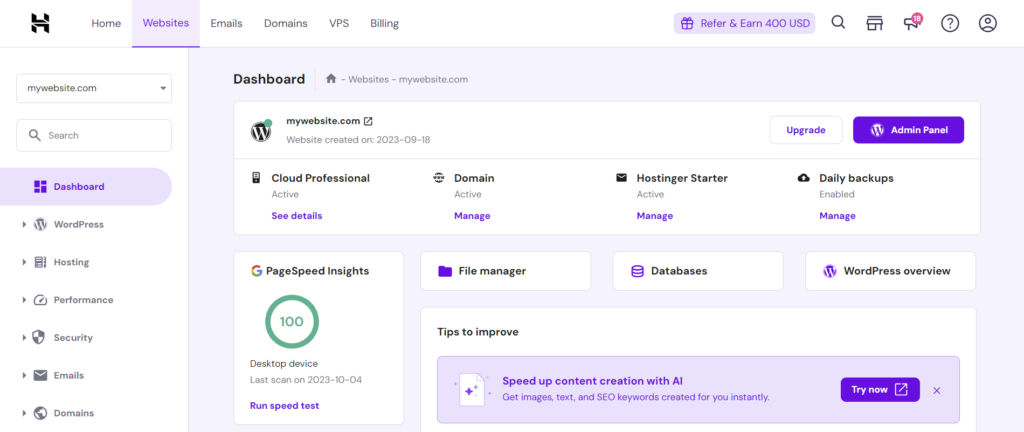
Hostinger is a more beginner-friendly option that offers features such as:
- One-click WordPress installation
- Automatic updates
- LiteSpeed Cache compatibility
- Easy-to-use interface
- AI website builder
- Managed WordPress hosting
If you are new to WordPress or want to build a simple website without getting bogged down in technical details, Hostinger is the way to go.
SiteGround
SiteGround’s approach to WordPress hosting is more feature-focused, offering:
- SG Optimizer
- Dynamic Cache
- Automatic updates
- Staging
- Git integration
- Managed security
- Advanced developer tools
These features are better suited for agencies and developers who want to take advantage of WordPress’s full potential.
WordPress Comparison
WordPress Features Compared
| WordPress Feature | Hostinger | SiteGround |
|---|---|---|
| Easy Setup | Excellent | Excellent |
| Beginner Friendly | Excellent | Very Good |
| Staging | Limited plans | Better |
| Developer Workflow | Good | Excellent |
| Built-in Optimization | Excellent | Excellent |
| Managed Updates | Yes | Yes |
Color guide: Dark Green = Excellent · Green = Very Good · Purple = Good · Amber = Limited
For bloggers and small businesses, Hostinger covers almost all the requirements.
At the same time, for agencies that manage hundreds of clients, SiteGround often proves to be more productive.
WooCommerce Performance
WooCommerce is much more resource-heavy than a regular blogging platform.
Every search, purchase, account alteration, or inventory update requires additional database operations.
That is why the underlying infrastructure plays such a big role in such CMS performance.
Hostinger
The provider is recommended for deploying small-scale online stores and applications with a limited product catalog.
It perfectly works under high loads and has a great optimization layer called Litespeed.
Thus, the performance of Hostinger is suitable for the majority of small and medium-sized projects.
SiteGround

SiteGround offers dynamic caching, Memcached, and Google Cloud infrastructure to keep online stores running even under heavy traffic.
The provider is ideal for agencies with many clients, subscriptions, and large product catalogs.
If you have a profitable online store and are thinking about scaling, it is safer to invest in performance rather than neglect security.
Security
Good hosting security is far from a nice-to-have option.
A compromised website not only scares away customers but also breaks the entire business continuity and search visibility.
Fortunately, both providers include strong security features.
Security Features: Hostinger vs SiteGround
SiteGround generally offers more advanced managed security features out of the box, while Hostinger provides excellent protection for most websites.
Customer Support
Support quality is most important when something goes wrong.
Both companies provide 24/7 support, but the support methods differ.
Hostinger
The strengths include:
- live chat
- multilingual support
- knowledge base
- beginner-friendly guides
The support system is most useful for people who need straight answers and step-by-step guidance.
SiteGround
SiteGround has a great support team that helps with tricky technical problems.
They specialize in WordPress-related issues, including plugins, server configuration, performance optimization, and WordPress migration.
Businesses that host mission-critical websites may benefit from their expertise.
Scalability
Many companies make the mistake of purchasing hosting services based on their traffic today. A 2026 study reports that websites attract 20 times more visitors within two years after launch.
This is why it is important to choose a hosting plan that grows with your audience.
Hostinger Works Best For
- new websites
- bloggers
- freelancers
- startups
- local businesses
- small e-commerce stores
SiteGround Works Best For
- agencies
- SaaS companies
- growing businesses
- WooCommerce stores
- publishers
- enterprise WordPress websites
If you want to avoid repeated migrations between cheap and enterprise-level plans, think about your company’s growth trajectory.
AI Search, LLM Visibility, And Why Hosting Matters
In 2026, many companies want to rank #1 in regular search engines like Google, but also increase their visibility in emerging AI search platforms, such as ChatGPT, Gemini, and Perplexity. This is because now, AI visibility optimization matters more than ever.
The hosting provider determines how likely your website is to be indexed by AI crawlers. However, better rankings require additional optimization efforts.
You can improve your chance of being discovered by large language models (LLMs) through:
- reduced server response time
- overall page performance optimization
- reduced downtime for AI crawlers
- structured data markup
- improved website performance in different geographic locations
In other words, your hosting company affects your technical SEO profile and indirectly influences your ability to build backlinks and content visibility. To increase your chance of being recommended by AI assistants, you should combine enterprise-grade hosting with a comprehensive content and SEO strategy.
Strategic Note: Companies that want to leverage AI search should think about visibility at the infrastructure level. While any reliable hosting provider can help you rank higher in regular search results, strategic link‑building and technical optimization are required for large language models. Digehub’s AI Visibility services help brands prepare for the transition to AI‑driven search by analyzing existing content and implementing improvements to technical SEO, regular search engine optimization, and content personalization at scale.
Common Mistakes When Choosing Between Hostinger and SiteGround
When comparing two hosting providers, avoid these mistakes:
- Picking a company based on the cheapest introductory offer.
- Focusing too much on the first-year pricing.
- Buying more hosting resources than you need.
- Thinking that enterprise-level plans improve SEO.
- Launching a website before optimizing images, code, and other content.
- Paying for developer tools that are not used.
- Underestimating the value of a professional support team.
Selecting the best web hosting service is rarely about price. It is usually about avoiding expensive mistakes, such as selecting a company that does not offer reliable customer support for mission-critical applications.
Hidden Renewal Costs: The Truth About Hosting Pricing
One of the biggest mistakes made by first-time website owners is buying hosting services based on the “lowest price”. In most cases, the price listed on the homepage is only available for the first year. The auto-renewal cost determines how much you will pay every year unless you cancel the subscription.
Pricing transparency is often limited for promotional offers, which is why it is important to calculate your budget based on monthly or annual payments, rather than a single fee.
Cost Factors: Hostinger vs SiteGround
If you are running a personal blog, a small business, or a start-up, Hostinger’s lower renewing prices could be more convenient for your budget.
SiteGround, on the other hand, is not necessarily more expensive. You pay for the managed infrastructure, support, caching, and other tools that would make your business grow. The crucial question is whether these conveniences are worth the extra money.
Total Cost of Ownership
The cost of a web hosting service is not always as straightforward as the price you pay for it. In particular, comparing the monthly payments of different providers can be misleading.
A more accurate assessment should be made based on the Total Cost of Ownership (TCO).
This metric considers various factors associated with using a hosting service, including
- Hosting renewals
- Migration expenses
- Downtime risks
- Time spent maintaining the server
- Performance optimization
- Security costs
- Developer productivity
For instance, if a high-end solution helps you reduce the time spent on server maintenance and website performance optimization, it can be more cost-effective than it seems. Similarly, if you do not need the advanced infrastructure and features, a cheaper plan is likely to be the best choice.
Which Hosting Provider Offers a Higher ROI?
Everything depends on the website and your particular needs. If you run a blog or a small online store, you may want to choose Hostinger. It offers affordable plans suitable for personal projects and small businesses. On the contrary, if you need managed infrastructure and additional tools to scale your business, SiteGround is the right choice.
Best ROI for Different Website Types
Website Type vs Recommended Host
The right hosting provider depends on various factors. It is not a matter of choosing the best but rather the one that fits your current needs and future goals.
Our Ultimate Comparison for You: Hostinger vs SiteGround
Choose Hostinger as your preferred web hosting provider if:
- you are a novice at website building
- you have a small budget
- you run a blog or a portfolio website
- you have a small business
- you demand the best value for your money
- you need a reliable hosting provider with an intuitive interface
Hostinger is among the best value-for-money web hosting providers in 2026.
Choose SiteGround if:
- you host multiple WordPress websites including agencies
- you run an online store that uses WooCommerce
- you want to scale your business rapidly and predictably
- you need professional development tools
- you require premium-level technical support
- you value performance over introductory affordability
SiteGround plans are worth the extra money if you need the best WordPress hosting experience.
The Truth About Hostinger and SiteGround
While comparing Hostinger vs SiteGround, the first aspect that stands out is the emphasis on price. Although it is a significant factor, we believe that businesses should prioritize performance and scalability when choosing between these two hosting providers.
Additionally, our research indicates that website owners tend to change their hosting services more frequently than necessary. In most cases, the issue lies not with the hosting provider but with the optimization of the website’s content, such as images, databases, plugins, and caching mechanisms.
By optimizing your website’s performance, you can ensure that you are getting the most out of your current hosting plan rather than upgrading solely based on speed concerns.
If you are looking to create a blog, portfolio, or small business website, you will benefit greatly from choosing Hostinger. However, if you are managing an expanding WooCommerce store or a large WordPress website, SiteGround’s competitive advantage guarantees that you will get the most out of your investment.
Web Hosting Industry Trends in 2026
Web hosting companies have evolved from mere website servers to intelligent assistants.
Many companies are integrating artificial intelligence into their hosting platforms to help website owners manage, build, and optimize their websites. Trends show that the following aspects of website building and hosting will become more important:
AI-driven website building and management
Performance optimization at the server level through HTTP/3, server-level caches, optimized PHP setups, etc.
Focus on security through malware scanning, account isolation, and proactive software updates
Sustainability through cutting-edge energy-efficient hosting solutions
Looking Ahead: Future of Web Hosting
In the coming years, web hosting companies will continue to compete based on performance and additional features they offer at affordable prices.
We can expect to see more hosting companies adopt AI to help website owners with server optimization, caching, performance monitoring, security, and backups.
As more companies use artificial intelligence in search, website owners should consider how to leverage these technologies to maximize the value of their website. Hosting is only one element of a much bigger puzzle that involves technical SEO, content creation, structured data, and other factors.
Frequently Asked Questions
The decision should be based on expected business growth rather than current website size. Businesses with relatively static websites often gain the greatest value from Hostinger’s affordability and strong everyday performance. Organizations expecting rapid traffic growth, expanding ecommerce operations, or increasing technical complexity may benefit from SiteGround’s scalable infrastructure and advanced optimization features. The most cost-effective decision is choosing a platform that supports your next stage of growth without requiring an early migration.
Migration can be worthwhile if your current hosting environment is limiting performance during peak shopping periods, slowing checkout pages, or creating resource bottlenecks. However, migration should not be the first solution. Before switching providers, review image optimization, database performance, plugin quality, caching configuration, and theme efficiency. If these areas are already optimized and performance challenges remain, upgrading to SiteGround’s managed infrastructure may provide measurable operational benefits.
The advertised monthly fee is only one component of total ownership cost. Businesses should also evaluate renewal pricing, migration expenses, premium backups, staging environments, email hosting, developer tools, downtime risks, support quality, and the operational cost of maintaining website performance. A hosting provider with a higher subscription fee may ultimately reduce long-term expenses if it minimizes technical issues and improves operational efficiency.
Agencies should evaluate workflow efficiency rather than introductory pricing. Hostinger is a strong option for agencies serving smaller clients with relatively simple websites. SiteGround becomes more attractive for agencies managing larger WordPress projects because its staging environments, developer tools, advanced caching, and premium support reduce deployment risks and ongoing maintenance effort. The time saved managing multiple websites can often outweigh the higher hosting cost.
Neither Hostinger nor SiteGround receives preferential treatment from AI search engines. AI visibility depends primarily on content quality, structured data, topical authority, crawlability, and technical accessibility. Reliable hosting supports these goals by improving uptime, page speed, and consistent content delivery. Businesses aiming for stronger AI visibility should combine reliable hosting with technical SEO, schema markup, and content designed to answer complex user queries comprehensively.
A CDN and caching plugins significantly improve website performance, but they cannot fully compensate for server-side limitations. Dynamic requests, database queries, checkout pages, logged-in users, and WordPress administration still depend heavily on your hosting environment. Premium hosting becomes increasingly valuable for websites with complex functionality, while smaller websites can often achieve excellent performance on budget hosting when properly optimized.
For startups, freelancers, bloggers, and small business websites, Hostinger often provides a stronger three-year ROI because of its lower renewal pricing and excellent performance-to-cost ratio. SiteGround can generate a higher return for businesses where uptime, faster workflows, premium support, and advanced performance optimization directly affect revenue. The highest ROI comes from selecting hosting that matches your operational requirements rather than choosing the lowest monthly price.
There is no universal visitor threshold because website complexity matters more than pageviews. A lightweight blog receiving 150,000 monthly visits may still perform well on Hostinger, while a WooCommerce store with only 20,000 monthly visitors could benefit from SiteGround due to heavier database activity and dynamic page generation. Instead of focusing only on traffic, evaluate CPU usage, memory consumption, concurrent users, checkout performance, and server response consistency.
The two platforms use different optimization strategies. Hostinger relies on LiteSpeed Web Server, NVMe storage, and LiteSpeed Cache to deliver excellent performance on shared hosting, particularly for blogs and small to medium WordPress websites. SiteGround uses Google Cloud infrastructure combined with NGINX Direct Delivery, Dynamic Cache, Memcached, and Ultrafast PHP to maintain stable performance for dynamic websites, WooCommerce stores, membership platforms, and higher traffic environments. The better choice depends on your workload rather than benchmark numbers alone.
Not necessarily. If your website already meets Google’s Core Web Vitals thresholds, has fast server response times, and provides a good user experience, switching from Hostinger to SiteGround alone is unlikely to produce meaningful ranking improvements. Hosting primarily supports SEO by improving infrastructure reliability, uptime, and performance. Greater gains usually come from optimizing content quality, search intent, internal linking, structured data, and technical SEO rather than changing hosting providers.
