
Copy.ai vs Writesonic 2026: The Ultimate Budget AI Review
The economics of AI content procurement have shifted radically. If you are managing digital operations, evaluating an AI tool based solely on its monthly subscription price is a fast way to bleed margin. The real equation isn’t what the software costs per month, it is your cost-per-usable-word.
When an enterprise or a scaling agency buys a low-tier tool that hallucinates facts or outputs generic text, the financial drain isn’t the software bill. The true cost is the manual revision tax, paying a skilled editor to clean up structural artifacts and baseline copy.
In 2026, the market has forced a sharp divergence between the two leading platforms. Copy.ai has transformed its architecture to become an automated Go-to-Market workflow system, an AI OS for sales and operations teams. Copy.ai vs Writesonic has doubled down on search engine dominance, positioning itself as an end-to-end AI Search Visibility platform designed to rank content across both traditional Google SERPs and newer generative AI engines.
Choosing between them requires matching your core business processes to their architectural strengths. If you deploy the wrong one, you will find yourself paying for secondary point solutions to plug the structural gaps.
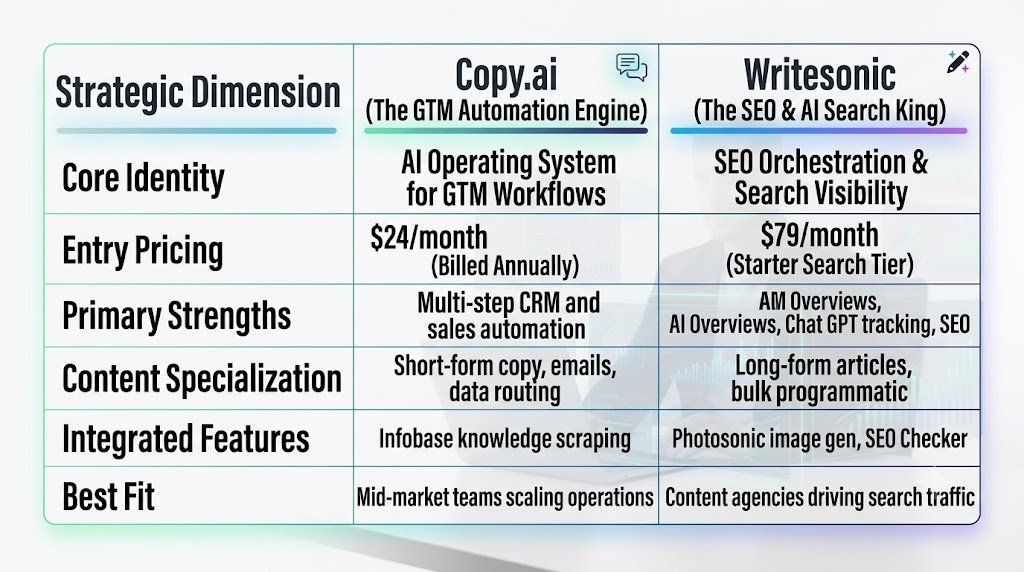
The Quick Verdict of Copy.ai vs Writesonic Which Offers True Value?
For organizations whose primary growth engine is organic traffic and content scale, Copy.ai vs Writesonic provides a superior return on investment. It integrates real-time search data, native search engine optimization scoring, and advanced tracking for AI discovery search tools directly into its ecosystem.
For growth teams, operational leaders, and sales departments focused on automating multi-channel messaging, cleaning lead lists, and scaling prospecting cadences, Copy.ai is the more cost-effective choice. It moves beyond simple text fields to manage complex data workflows across your entire tech stack.
The Macro Shift: How the Platforms Diverge
To understand which platform gives your business more value, you have to look at where their engineering teams spent their capital over the last twelve months.
Copy.ai as the Go-to-Market AI OS
Copy.ai actively abandoned the identity of a simple writing assistant. The platform recognized that text generation is a commodity. Instead, they built an orchestration layer designed to eliminate manual data entry and disjointed marketing tasks.
Through its advanced workflow builder, Copy.ai allows users to connect API endpoints, scrub incoming inbound leads, cross-reference data against an internal corporate Infobase, and generate highly personalized outbound sequences without human intervention. It is built to serve as an anti-point solution, consolidating tools for sales, growth marketing, and operational teams into a singular interface.
Writesonic as the AI Search Visibility Suite
Writesonic took the opposite strategic path. They realized that with the rise of AI Overviews, ChatGPT Search, and Perplexity, traditional search engine optimization was morphing into multi-platform search visibility.
Their 2026 suite is built to defend and scale your brand’s digital footprint. It doesn’t just write text, it tracks how often your brand is cited inside AI search tools, monitors consumer sentiment across generative engines, and builds programmatic articles designed to satisfy natural language processing algorithms. The platform includes a native SEO checker, deep integrations with Semrush, and a full content scoring system that updates alongside search engine algorithm shifts.
For a broader breakdown of how this market space has evolved on a budget level, you can read our comprehensive Copy ai review 2026 best budget AI writing tool to anchor your feature evaluations.
Feature Showdown: Content Quality, SEO, and Workflow Efficiency
Long-Form Article Generation and Search Benchmarks
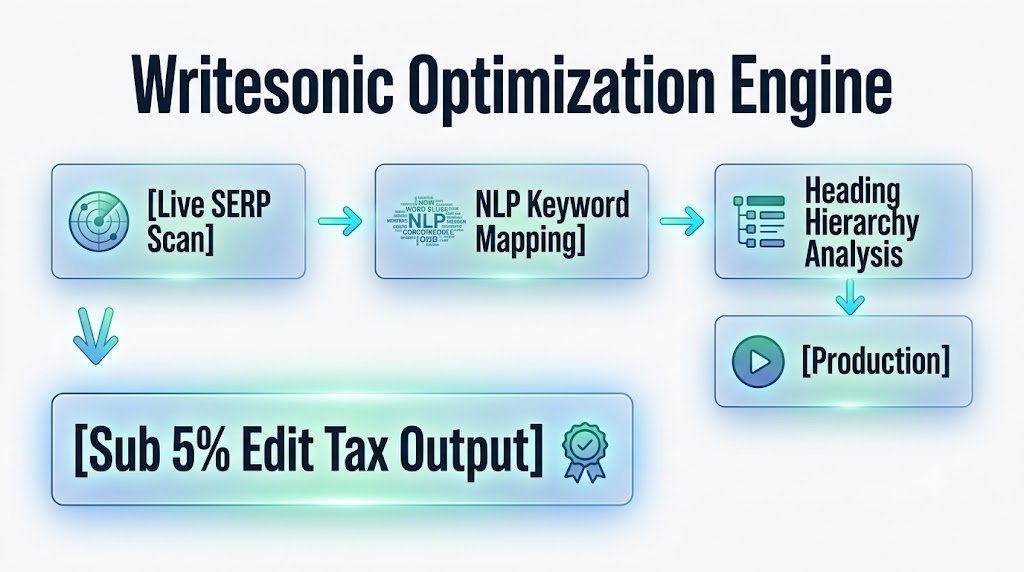
When it comes to generating long-form blogs that require zero structural editing, the platforms pull apart. Writesonic’s AI Article Writer uses a structured, wizard-guided process. It forces the user to input target keywords, pulls live competitive data directly from the current Google SERPs, maps out an explicit heading hierarchy, and loops in semantic variations before generating a single word.
The result is a highly cohesive piece of prose that reads with natural editorial flow. Because it loops in real-time web browsing via Chatsonic, the output rarely contains the temporal hallucinations common in standard model generations.
Copy.ai approaches long-form content through its structured drag-and-drop workspace and workflow templates. While its underlying models, including GPT-4 and Claude 3, produce highly polished prose, it lacks the native, real-time search engine optimization guards built into Writesonic. Writing an article in Copy.ai often requires a separate subscription to an optimization tool like Surfer SEO or Clearscope to map out semantic keyword density, adding a significant hidden software fee to your monthly stack.
Workflow Automation and Operational Scale
This is where Copy.ai justifies its cost for operational teams. Writesonic allows for basic bulk content uploads, which works perfectly if you are trying to output a hundred product descriptions from a structured CSV sheet. However, Copy.ai handles multi-step, dynamic automation logic.
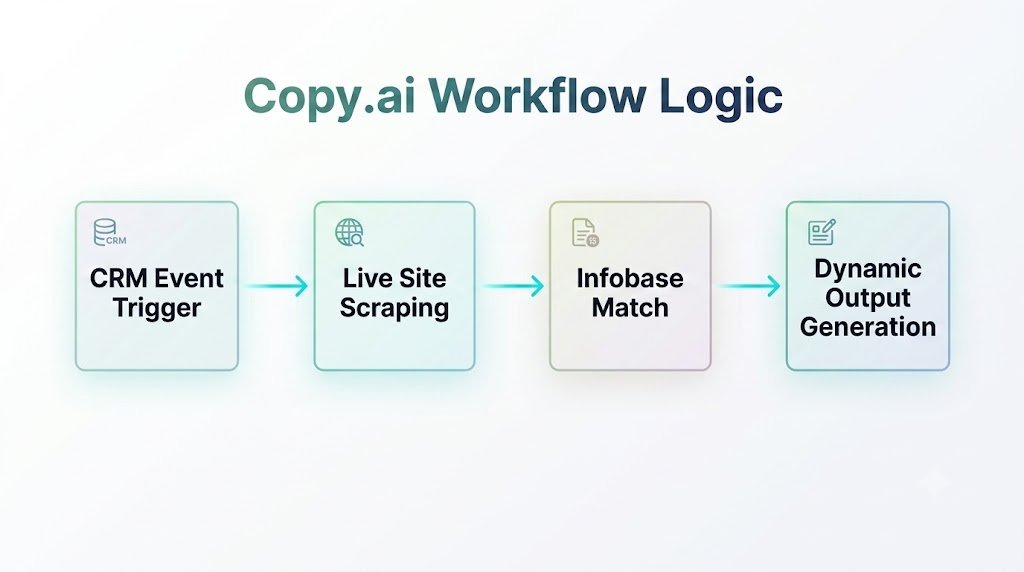
With Copy.ai, you can build a workflow that triggers the moment a new user signs up in your CRM. The system can automatically scrape their website, analyze their market positioning, check your internal company playbook for product positioning guidelines, and write three distinct, hyper-personalized onboarding emails tailored to that user’s specific vertical. This structural sophistication functions like an automated digital employee, rather than a text generator box.
Brand Voice and Multi-Client Management
For agencies juggling a portfolio of distinct corporate clients, maintaining brand consistency is a critical operational bottleneck. Both tools offer brand voice engines, but their structural execution is completely different.
Writesonic allows teams to upload brand style guidelines and analyze sample text to build unique voice profiles. This ensures that its long-form blog writer maintains a conversational, professional, or authoritative tone depending on the assignment.
Copy.ai builds upon this concept by tethering its brand voice profiles directly to its Infobase system. This means the AI doesn’t just mimic your tone, it actively references your verified corporate facts, product features, and compliance rules. It prevents the engine from inventing features or pricing terms that do not exist, a common issue when scaling content across multiple client accounts.
If you are currently evaluating other major players in this tier to see how they manage enterprise brand voice, review our analysis on jasper.ai vs copy ai to map out the exact feature variations.
The True Cost: Pricing Breakdown and Bottom-Line ROI
Sticker prices are intentionally misleading. To understand what you will actually spend, you must look at how features are gated across premium tiers.
Analyzing the Entry Plans
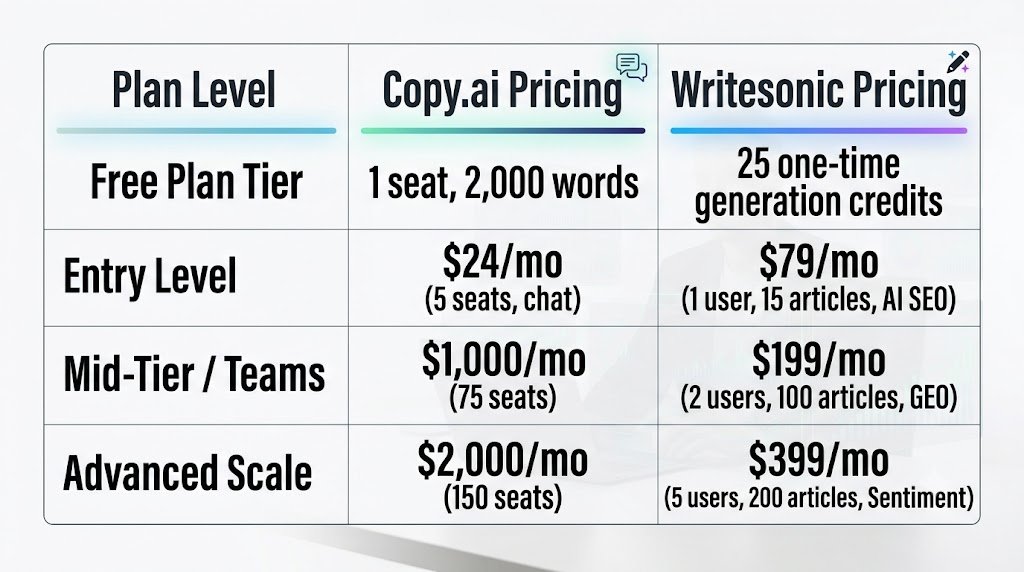
Copy.ai offers a highly competitive entry tier starting at twenty-four dollars per month when billed annually. This tier provides five user seats and unlimited words inside their chat interface. It is an exceptional value for small teams who need a collaborative sandbox for short-form copy, social media formatting, and email development.
Writesonic’s pricing strategy reflects its transition into an enterprise-grade search platform. Its entry plans are divided by application type. If you only need their conversational chat system, Chatsonic is available as a point solution for twelve dollars per month. However, if you are an agency or digital marketer who needs to generate search-optimized articles, track AI Search Visibility, and access advanced SEO tools, their Starter plan begins at seventy-nine dollars per month. While the upfront investment is higher, it eliminates the need to pay for secondary SEO analytics tools.
Scaling to the Enterprise Tier
At the growth and agency scale, the pricing paths diverge based on business volume. Writesonic scales predictably with usage tiers, its plans moving from one hundred ninety-nine dollars to three hundred ninety-nine dollars per month as your required monthly article volume and keyword tracking footprint expand.
Copy.ai shifts from its entry plan directly into high-scale corporate deployment options, with plans starting at one thousand dollars per month. This cost reflects its position as an infrastructure replacement tool. At this tier, you are paying for massive workflow volume, custom API accessibility, SOC2 data compliance, and deep operational automation.
To contextualize how these pricing frameworks compare to older market standards, look over our comprehensive Jasper ai review 2026 features pricing pros cons overview to spot emerging value trends.
Real-World Use Cases: Which Tool Wins in the Field?
Scenario A: The Content Marketing Agency Focused on Search Growth
Imagine an agency tasked with scaling organic traffic for ten diverse enterprise clients. The primary objective is producing deep, research-heavy blogs that clear search engine optimization audits and earn real estate within search engine AI summaries.
In this scenario, Writesonic is the decisive winner. Its ability to run real-time competitive analysis, extract exact natural language processing keywords from live search results, and grade content quality before publication drastically reduces manual line-editing.
Instead of an editor spending forty-five minutes checking keywords and facts, the draft arrives ninety-five percent complete. This minimizes your cost-per-usable-word, maximizing your operational margin.
Scenario B: The Go-to-Market Team Scaling Outbound Outreach
Consider a mid-market business development team that needs to process five hundred inbound webinar signups every week. They need to enrich these leads, determine their industry vertical, and drop them into a custom, multi-channel sales pipeline with messaging tailored precisely to their organizational challenges.
In this environment, Copy.ai completely outperforms Writesonic. Writesonic is simply not built to execute multi-step database actions or route complex information across tools.
Copy.ai treats text generation as a single step in a broader digital conveyor belt, pulling data from your CRM, validating it against internal product playbooks, and outputting highly customized communications with zero manual intervention.
Common Implementation Mistakes with AI Content Suites
1. Treating Output Volume as an Efficiency Metric
Many marketing teams purchase an unlimited-word AI subscription and instantly flood their production pipelines with hundreds of generic articles. This approach actively damages long-term brand equity and search ranking stability.
Modern search engines use advanced helpful content classification systems designed to isolate and penalize programmatic text that offers zero unique perspectives. True efficiency is measured by how much manual time is saved during the research and editorial phases, not by how many thousands of words your tool can output in sixty seconds.
2. Failing to Build a Centralized Knowledge Database
Both platforms offer tools to ingest company files, product data, and brand identity documents. Despite this, many users continue to prompt the platforms using generic inputs, resulting in bland, uninspiring text that sounds exactly like every other competitor in their vertical.
Your output quality depends entirely on the uniqueness of your input. Before building a single piece of public-facing content, you must systematically populate your tool’s asset manager with proprietary insights, customer interview transcripts, and explicit brand constraints.
Future Trends: AI Search Optimization and Autonomous Workflows
The separation between these two tools highlights a broader evolution in the digital marketing landscape. Content production is no longer about writing fast, it is about visibility and systematic execution.
As search engines shift toward direct answer engines, winning organic traffic requires structuring your websites and blogs so that generative systems can easily crawl, parse, and cite your insights. Platforms like Writesonic are moving directly into this space, building dashboards that measure your brand’s share of voice inside automated chat answers.
Concurrently, business execution is moving toward agentic automation. Simple software features are being replaced by autonomous systems that evaluate context, make decisions based on past performance data, and alter their workflows without constant human oversight. Copy.ai’s emphasis on deep workflow integrations shows a future where the copywriter doesn’t just write a message, they manage the entire system that distributes it.
Strategic Recommendation: Maximizing Digital Marketing ROI
Selecting an enterprise tool is rarely about finding the absolute best option, it is about choosing the system that matches your current growth constraints.
If your core growth strategy relies on establishing digital authority, scaling high-impact search visibility, and capturing consumer interest across traditional and AI search platforms, your capital is best spent on targeted search optimization infrastructure. Ensuring your content strategy aligns with search engine guidelines requires a rigorous approach to technical SEO, strategic keyword clustering, and clear data architecture.
To help teams evaluate their existing content assets and spot technical indexing roadblocks, we built a completely free SEO blog writing tool to help refine your baseline parameters before you invest in high-scale platform software.
If you are trying to navigate these shifting search algorithms, protect your current keyword rankings, or build an architecture that ranks consistently inside AI summaries across the USA, UK, Canada, or Australia, establishing a clear framework is crucial. We can partner with your team to audit your current digital footprint, optimize your technical structures, and deploy advanced search visibility methodologies. Explore our specialized SEO Services or learn more about optimizing your architecture for generative search models through our dedicated AI Visibility Services.
Frequently Asked Questions
Which tool is better for writing long-form, search-optimized blog posts?
Writesonic is explicitly engineered for long-form search engine optimization. Its integrated keyword scoring, live SERP data extraction, and structured template builders ensure that generated articles require far less manual editing to clear optimization standards compared to Copy.ai.
Can Copy.ai automate tasks across external software systems?
Yes, Copy.ai specializes in multi-step workflow automation. It integrates with thousands of external software platforms via native API systems and Zapier, allowing teams to build complex pipelines that process data, enrich inbound leads, and personalize outbound cadences automatically.
Does Writesonic include native AI image generation?
Yes, Writesonic includes Photosonic, an integrated AI image generation engine. This allows content creators to produce custom blog graphics, social media visuals, and featured images directly inside their editorial workspace without switching tabs.
What is the concept of a cost-per-usable-word in AI procurement?
Cost-per-usable-word measures the total financial investment required to turn an AI draft into a polished, public-ready asset. This calculation includes the underlying software subscription cost plus the manual hourly wages paid to an editor to correct hallucinations, structural defects, or generic prose.
Is Copy.ai or Writesonic more secure for enterprise corporate data?
Both platforms offer enterprise-level data protection and privacy standards, including SOC2 compliance options on their higher tiers. This ensures that internal corporate playbooks, customer relationship data, and proprietary infobases remain segregated and are never utilized to train public AI models.
