
How to Use Semrush for Keyword Research in 2026, A Complete Step-by-Step Guide
Keyword research has evolved, and it isn’t a matter of finding a keyword with a decent search volume and shoving it into your content any longer. Google and other search engines are smart enough to understand your topical authority, the searcher’s intent behind queries, the quality and quantity of your content, its overall UX, and how well it answers AI-driven searches.

That’s why keyword research is a much more involved and sophisticated process now. Semrush is one of the most powerful SEO tools on the market, but many people and agencies are using only a small percentage of its functionality.
You cannot build a winning content strategy by searching for a query in the Keyword Magic Tool, exporting a CSV file, and creating content based on that information. This approach may have worked a few years ago, but not in 2026.
The most successful SEOs and content creators use Semrush as the full-fledged research platform to identify search demand, analyze the competition, define search intent, group keywords into topical clusters, prioritize topics, and build content based on them. Following this methodology has proven to be much more effective than relying on a single metric.
For example, if you have a keyword that has 10x higher search volume but doesn’t have commercial intent compared to another keyword, it’s better to invest your time and effort into the low-hanging fruit. In this article, I’ll show you how to use Semrush for keyword research in 2026, starting with seed keywords, exploring search intent, analyzing competition, grouping keywords into clusters, and prioritizing them based on your business goals.
This guide will be helpful to in-house SEOs, agencies, SaaS founders, and content writers trying to figure out how to research keywords using Semrush.
Quick Answer
If you’re looking for the fastest way to use Semrush for keyword research, follow this workflow:
This workflow allows you to think beyond keywords and truly optimize your content for ongoing rankings, topical authority, and visibility in both regular and AI search.
Why Keyword Research Is Different In 2026
Search behavior is changing. The way we search and find information is transforming with the evolution of new tools. Google Search is no longer the only way to get answers or make comparisons between products/services.
We now have AI assistants like ChatGPT, Perplexity, and Gemini that assist us in our search queries, comparing products/services and much more.
As such, keyword research is no longer just about volume or popularity. You must also think about intent, entities, and what related questions someone might ask when searching.
When evaluating keywords for inclusion in your content, you need to take the following factors into account:
- Intent – rather than popularity,
- topic relevance,
- commercial intent,
- competition,
- SERP features,
- and topical authority-building potential.
By optimizing for these elements, you can create content that ranks higher in both Google and AI searches. This is due to the fact that AI searches will increasingly rely upon the most authoritative content available on the web.
Step 1 – Define Your Seed Keyword
Every keyword strategy should have a seed keyword. This is a keyword that you want to focus on when creating content about a certain topic/product/service.
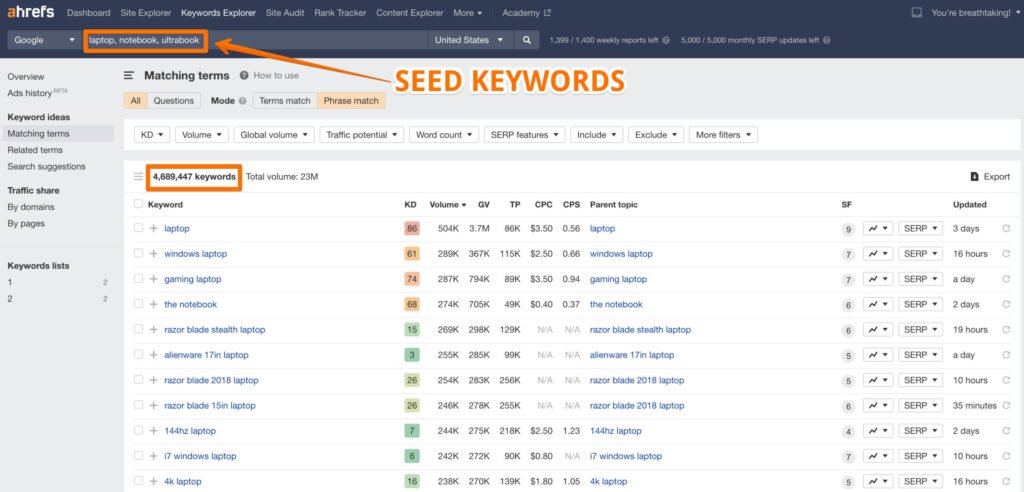
Here are some examples of different business types and the type of seed keywords that they should consider:
| Business Type | Seed keyword | Examples |
|---|---|---|
| Digital Marketing Agency | SEO service | Technical SEO Services, Local SEO Agency, Enterprise SEO, SEO Audit Services |
| SaaS Company | CRM software | HubSpot CRM, Sales CRM, CRM for Small Business, Customer Relationship Management Software |
| E-commerce Store | Running shoes | Men’s Running Shoes, Women’s Running Shoes, Trail Running Shoes, Lightweight Running Sneakers |
| Travel Website | Japan travel guide | Japan Travel Guide 2026, Tokyo Itinerary, Best Places to Visit in Japan, Japan Travel Tips |
| AI-software | AI content generator | AI Blog Writer, AI Copywriting Tool, AI Content Generator for Marketing, AI Writing Assistant |
In this step, it is important not to go for general terms. These are keywords with high volume but low level of specificity.
While high-volume keywords can be useful, they should usually not be your starting point.
If you are a digital marketing agency you likely do not want to target generic keywords such as SEO or marketing. These have extremely high competition and will be incredibly challenging to rank for. Rather you should consider targeting a more specific keyword such as technical SEO.
Once you have your seed keyword, you want to enter it in the Keyword Overview tool to get an idea of what you are working with. Instead of focusing on volume, pay attention to the following aspects:
- Volume,
- Keyword difficulty,
- Intent,
- CPC,
- SERP features,
- Trends,
- And related keywords.
By analyzing this information you will get an understanding of how you can repurpose the keyword and what type of content you can create around it. This is crucial in ensuring that you are creating content with actual demand.
Expert Tip
Many marketers make the mistake of ignoring keywords with low volumes. In reality, these keywords often have a much better chance of ranking due to the specific intent and lower competition. A keyword with a volume of only 300 that precisely matches your service/product may be much more valuable than a generic informational keyword with a volume of 10,000.
As such, remember that volume is a useful metric but should not be the deciding factor in whether or not to include a keyword.
Step 2: Expand Your Keyword List With Semrush Keyword Magic Tool
After finding a working keyword, your task is to expand your target list. This is where Keyword Magic Tool is helpful.
Many novices tend to enter their keyword, export thousands of suggestions, and quit right there. In truth, this is only step one because you need to filter and prioritize your keyword list according to your business needs and search intent.
Start with the Seed Keyword
Let’s start with the seed keyword. Suppose it is SEO services. By entering it into the Semrush Keyword Magic Tool, you get thousands of keyword suggestions:
- seo services for small business
- enterprise seo services
- local seo services
- ecommerce seo services
- technical seo services
- seo agency near me
- affordable seo services
- seo consultant
- seo audit services
- international seo services
Now, instead of trying to target every keyword, narrow your list to keywords that are relevant to your business.
Some effective tactics for doing that could be:
- grouping keywords by intent or theme
- removing irrelevant keywords
- finding commercial keywords
- saving keywords for content creation purposes.
Use the Right Filters
Another essential thing to do is to use the right filters. When working with Keyword Magic Tool, remember not to go after the highest search volume. In most cases, the best keywords for SEO are those that have a decent search volume, keyword difficulty, and competition.
To optimize your keyword list, use the following metrics:
| Metric | Why You Need It |
|---|---|
| Search Volume | Overall search interest |
| Keyword Difficulty (KD%) | Ability to rank on the first page of Google |
| Search Intent | Nature of searcher’s query |
| CPC | Commercial value of keyword |
| Competitive Density | Helps score for paid search |
| SERP Features | Includes rich snippets, AI Overviews, videos, and more |
For example, when you use the filter to sort out irrelevant keywords, you remove keyword variations that have nothing to do with your business. Next, you pick the informational keywords that you will use for blog posts. Then, you save commercial keywords for landing pages and service-specific articles. Lastly, you group similar keywords into thematic clusters for content creation.
Do not overlook long-tail keywords
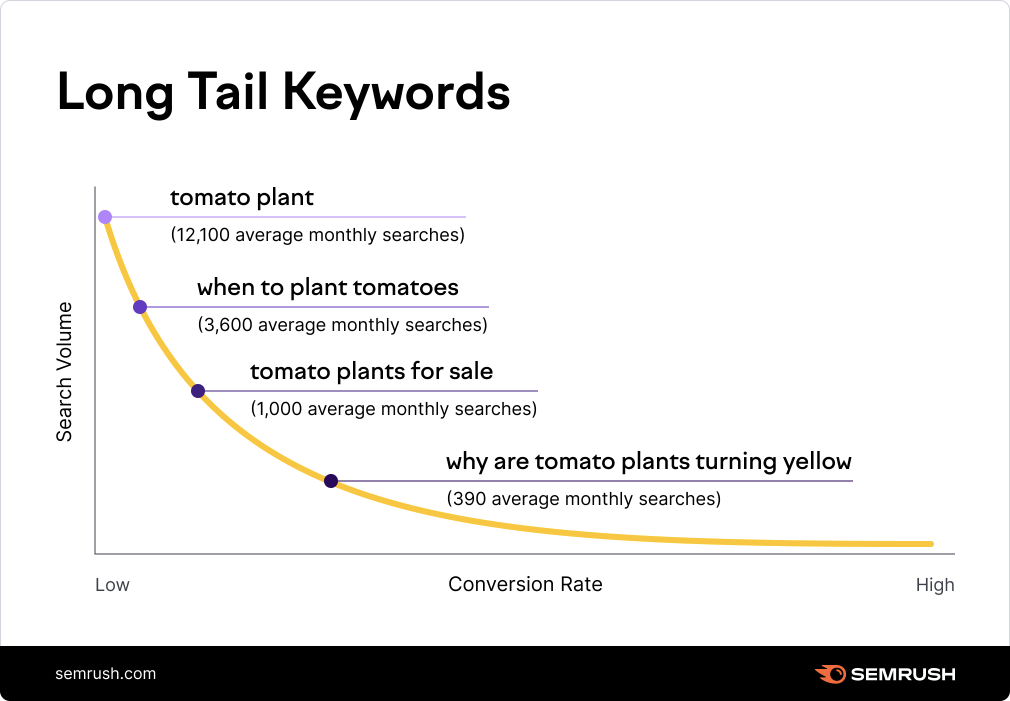
Most website owners make the mistake of pursuing only popular, high-volume keywords. However, there is a lot of value in long-tail keywords, including
- greater user intent
- lower competition
- higher conversion rate
- topical authority building potential
- ability to target AI search
For example, instead of trying to rank for SEO, which is a pretty generic term, you can go after technical seo checklist 2026 and score first place on it. Another example is CRM; instead of targeting it, go after best crm for startups.
Here are other keyword variations:
| Generic Keyword | Long-tail Keyword |
|---|---|
| Email marketing | Email marketing strategy for SaaS |
| Keyword research | How to use semrush for keyword research 2026 |
Use keyword clusters instead of individual keywords
In most cases, keyword research is not about finding the best keyword. Google and Google AI are smart enough to understand what kind of content a user needs. Instead of targeting a single keyword, create a content piece around a set of related keywords.
Let’s say, for example, that you need to write a technical SEO checklist article. Then, your keyword list should include:
- primary keyword: technical seo checklist 2026,
- related keywords: technical seo audit, technical seo best practices, website crawl errors, xml sitemap optimization, schema markup guide, robots.txt optimization, core web vitals checklist, and others.
Such an article will score higher on Google because it covers various technical SEO-related searches.
Save the most relevant keywords in your Keyword Manager
When performing keyword research, it is essential to save the most relevant keywords in your Keyword Manager. This way, you will always know which keywords to prioritize, which SERPs to track, and which keyword groups to use for creating content.
Having a keyword list in your Keyword Manager also helps you build keyword-specific campaigns and share keyword insights with your team. On top of that, it eliminates the need for repeated keyword research since you already have a list of relevant keywords for every piece of content.
Expert Insight
Many marketers make the mistake of ignoring keywords with low volumes. In reality, these keywords often have a much better chance of ranking due to the specific intent and lower competition. A keyword with a volume of only 300 that precisely matches your service/product may be much more valuable than a generic informational keyword with a volume of 10,000.
As such, remember that volume is a useful metric but should not be the deciding factor in whether or not to include a keyword.
Step 3: Determine the Search Intent Before Creating Content
When creating content, you should know not only what keywords to target but also what intent behind them.
In most cases, the intent defines the content type. For example, if the person searches for how to use Semrush keyword research 2026 , it means that they want a tutorial. On the other hand, if the query is related to Semrush keyword research tools comparison , it means that the person is looking for a comparison of different SEO tools.
If Google understands the user’s intent, there is a good chance it will understand it too, so it is necessary to optimize your content for specific intents to make it easier for Google to index and rank your page.
Understand the four types of search intent
| Intent | Definition | Content type |
|---|---|---|
| Informational | Seek knowledge | Blog posts, guides, tutorials |
| Navigational | Want to navigate to a specific website | Homepage or brand page |
| Commercial Investigation | Want to compare different products or services | Review articles, comparisons, buying guides |
| Transactional | Want to buy a product or service | Service or product pages, pricing tables, landing pages |
For example, if a user types in how to use Semrush keyword research 2026 , it means that they need an informational piece of content, such as a tutorial or a blog post. On the other hand, if someone searches for Semrush keyword research tools comparison , it means that they want to know which keyword research tool is the best and deserve a comparison article.
Analyze the search results
Before creating content, it is a good idea to look at the search results and see what Google shows for particular queries.
Ask yourself the following questions:
- What types of content are on the first page of Google?
- Are the results tailored for experts or novices?
- What is the depth of the content? Is it superficial or comprehensive?
- Are there any video results?
- Are there any featured snippets or other elements on the first page?
- Does Google show AI Overviews for the given query and, if yes, what are they about?
- What sub-topics are the articles about?
- Are the search results dominated by certain content formats, such as articles with screenshots or video reviews?
If most results on the first page have a similar format, it might be a good idea to follow that structure because it works. For example, if you need to create a tutorial, and the search results are dominated by articles with screenshots and step-by-step instructions, you will also need to provide visual information.
Look beyond the first page of Google search results
Google search results have changed a lot in the last few years. These days, the SERP includes a lot of different types of content, such as
- AI Overviews,
- Featured Snippets,
- People Also Ask,
- video content,
- image content,
- discussion forums,
- product listings,
- knowledge panels, etc.
Each of these result types shows what Google wants to see for a given query. If multiple top-ranking articles answer the same questions, you might want to include a dedicated FAQ section on your page so that Google picks it up and displays it in the search results. The same goes for video content and other content formats. Google tends to highlight content that directly answers multiple questions. That is why it is important to analyze the SERP and see what exactly Google wants for a given query.
Analyze what competitors are doing
When you have a rough idea of what Google wants, it is time to analyze what other website owners are doing.
Open the top-ranking articles for the given query and answer the following questions:
- What questions does the article answer?
- What topics are missing?
- What screenshots does the article use?
- Does the information in the article look up-to-date?
- Does the article explain the strategy or merely describe the tool?
- Does the article provide helpful tips or merely show how to click around the tool?
For example, for the queries mentioned above, many articles explain how to navigate the Semrush platform but do not go into detail about how actual SEO professionals use Semrush, how they target keywords, and how they organize their keyword list according to the purpose/audience. That way, the articles are useful but lack topical depth, so there is room for improvement.
Think beyond rankings
While it is important to optimize your content so that Google can understand it, it is even more important to think about how to make your content better from the user’s point of view. In other words, if large language models want structured content, it is a good idea to make your content easier to digest.
Here are some things to consider:
- Well-structured content,
- accurate information,
- content that is comprehensive but not bloated with fluff,
- effective use of subheadings,
- examples,
- and actual solutions rather than generic advice.
That way, Google will be able to pick up on your content and include it in the search results.
Expert Insight
When working on content creation, always analyze the search results manually to understand what Google wants. While keyword research is important, it does not tell you what keywords to use.
When you look at the search results and see what content pieces rank on the first page of Google, you can understand what content structure Google prefers. In most cases, such content is comprehensive, well-structured, and covers multiple sub-topics related to the main theme.
By analyzing the SERP, you can optimize your content for Google’s preferences and ultimately improve its rankings. In addition, looking at the SERP allows you to compare different content pieces, see if the information is up-to-date, and determine if there are any topics or questions that have not been answered.
Step 6: Prioritize the Keywords that Drive Your Business Growth
Once you have discovered hundreds of keywords, it can be challenging to decide which of them are worth pursuing. Instead of measuring their popularity, try prioritizing keywords using the four criteria below.
| Factor | Description |
|---|---|
| Search Intent | A keyword’s intent refers to the user’s hidden need when searching for a specific term. Always consider what the user is looking for when choosing keywords. |
| Business Relevance | Ensure that the keyword is relevant to your niche or business. |
| Competition | This metric shows how hard it is to rank higher for a specific keyword. It is essential to balance competition and profitability when selecting keywords. |
| Traffic Potential | This metric indicates how much traffic a keyword can drive to your page. |
A keyword with lower popularity and higher commercial intent can yield better results than a highly searched keyword.
Creating a Simple Priority Matrix
Once you have completed the first step, use the matrix below to sort keywords into three categories.
| High | Medium | Low |
|---|---|---|
| High business value | No high business value | |
| Clear intent | No clear intent | |
| Searchable competition | Low competition | Unsearchable competition |
| Traffic potential | No significant traffic potential |
A topic, rather than a search term, should be the main focus of your content creation. A topic is better organized and optimized than a stand-alone article. Moreover, the latest SEO trends prefer topics over single pieces of content.
Expert Insight
We often see businesses making the critical mistake of pursuing popular keywords when it makes little sense for their overall marketing strategy. A long-tail keyword with a relatively low search volume can yield significantly better results than a popular keyword.
Step 7: Use Google Trends and Search Console To Validate Keywords
Semrush is an excellent tool for discovering new keywords, but it does not always tell you how promising the selected keyword actually is. Let’s explore other ways of analyzing keywords to identify the best options in terms of traffic potential and competitiveness.
Using Google Trends
Google Trends is a valuable resource for determining the level of seasonal demand for a particular keyword and assessing its overall popularity. It can also help you discover new topics and keywords. For example, some keywords have peak seasons when they receive the highest amount of traffic. Trends can help you find the best time to publish articles on specific subjects.
Using Google Search Console
Google Search Console can help you examine the keywords you may have already ranked for. If your website gets sufficient organic traffic, you probably have keywords that are close to ranking higher. The console can also identify pages that require additional optimization. For example, pages with a decent number of impressions but relatively few clicks may benefit from on-page optimization. This optimization method helps you get more traffic by improving the page’s relevance to specific keywords.
A Realistic Approach to Keyword Strategy Based on Google Trends Data
After discovering popular keywords, analyzing trends is the next step. You will find some valuable information in both Google Trends and Search Console. The process of researching and analyzing keywords should not be time-consuming if you leverage the right SEO tools. For instance, using Semrush, Google Trends, and Search Console together is a realistic way to find the most promising keywords.
Step 8: Build Topic Clusters Instead of Working on Isolated Articles
The latest SEO trends suggest that you should focus on building topics instead of individual articles. It means that your content should be better organized around a topic. There are usually multiple ways to optimize a website around a particular theme.
It can help you gain better visibility in AI-driven search results. Multiple supporting articles and videos are better positioned by search engines than a single piece of content.
For example, a topic cluster may consist of the following articles:
| Pillar page | Supporting posts |
|---|---|
| How to Use Semrush for Keyword Research | Keyword Magic Tool Guide |
| Keyword Gap Tutorial | |
| Organic Research | |
| Search Intent Guide | |
| Keyword Clustering Best Practices | |
| Common Semrush Mistakes |
Each supporting post will include a link to the pillar page. In turn, it will improve the pillar page’s authority and rankings. It will also help you develop a more substantial piece of content.
Moreover, this strategy can improve your rankings for related keywords. Each topic cluster allows you to optimize more than one keyword and achieve better results for all of them.
Notes
The entire keyword research process requires you to consider multiple factors beyond search volume. It is essential to remember that a keyword should also be relevant and searchable. A thorough analysis of keywords can make your content stand out and help you attract more traffic. We specialize in SEO and content marketing.
If you need help creating a complete keyword research strategy, Digehub has the experience and skills to provide you with professional keyword research service at an affordable price.
Step 9: Optimize Your Content for AI Search and LLM Visibility
Beyond optimizing for traditional search engines, keyword research also lets you make your content better understood and referenced by AI.
Follow these tips to make your content easily found and used by AI:
- Answer the main question early.
- Use descriptive subheadings (H2, H3).
- Include definitions, tables, and lists.
- Go over related entities, subjects, and topics.
- Use reliable resources to back up your information.
- Provide succinct responses to frequently asked questions.
Don’t try to stuff your content with keywords. Instead, give a comprehensive response that covers the main points. That way, both search engines and users will get value from your article.
Pro tip
The most shared pages are frequently those that comprehensively respond to queries rather than those that include the exact search terms.
Step 10: Track and Improve Your Keyword Strategy
Remember that keyword research is a continuous process. Set aside time to analyze and optimize your keyword strategy based on your findings.
Consider evaluating the following variables:
- Traffic: How much traffic are your keywords driving?
- Rankings: What positions are your target terms showing in?
- CTR: Are users clicking through your links in the search results?
- Impressions: How often does your content appear in search results?
- Conversions: How many users are completing desired actions on your page?
- Engagement: What is the bounce rate, time spent on page, etc.?
Update your articles if some of your keywords start underperforming, their search intent changes, other competitors begin ranking higher for certain terms, or new Semrush features appear. Usually, it is easier to update existing content than create new articles from scratch.
Top mistakes to avoid when doing keyword research
Avoid these common mistakes when doing keyword research:
- Focusing only on search volume
- Overlooking search intent
- Creating numerous articles for similar topics
- Not analyzing competitors
- Not reviewing SERP
- Not updating previous articles
- Skipping optimization for AI search
By avoiding these mistakes, you can maximize the ROI from your keyword research.
The Future of Keyword Research
Researching keywords will become significantly more important in the coming years due to the increased emphasis on AI searches.
In the near future, SEO professionals will need to shift their focus to clusters of information rather than keywords, prioritize search intent, optimize for natural language processing, leverage first-party data and expertise, and update their content regularly. Businesses that embrace these changes will dominate the SERPs and have their web content used by AI to answer queries.
Frequently asked questions about keyword research with Semrush
Create a scoring system based on search intent, business relevance, keyword difficulty, traffic potential, and conversion value. Focus first on keywords that are achievable, highly relevant, and aligned with your business goals.
Group similar keywords into a single content cluster instead of creating multiple pages targeting nearly identical search terms. Regularly audit your rankings to identify overlapping pages and consolidate them when necessary.
Keyword Magic Tool generates new keyword ideas from a seed keyword, while Keyword Gap compares your website with competitors to identify missing or underperforming keyword opportunities.
Review your keyword strategy every three to six months, or sooner if search trends change, competitors publish new content, or Google introduces significant algorithm updates.
Yes. Semrush helps identify user questions, related entities, and search intent. Combined with clear content structure and comprehensive topic coverage, these insights improve visibility in AI-powered search experiences.
Evaluate search intent, business relevance, traffic potential, competition, and conversion value together. A lower-volume keyword with strong commercial intent often delivers better ROI than a broad, high-volume keyword.
Group related keywords into topic clusters using Keyword Manager. Create one comprehensive pillar page supported by several related articles, then connect them with strategic internal links to strengthen topical authority.
No. KD% is only one factor. A keyword with a higher KD can still be worth targeting if the search intent matches your business, the SERP is weak, and you can create significantly better content.
Start with Keyword Overview to validate your seed keyword. Then use Keyword Magic Tool to expand ideas, Organic Research to analyze competitors, and Keyword Gap to uncover keywords your competitors rank for but you don’t.
Don’t rely on Keyword Difficulty (KD) alone. Filter keywords by search intent, business relevance, SERP quality, and search volume. Then manually review the top-ranking pages to identify opportunities where you can create more comprehensive or up-to-date content.
If you’re looking to turn keyword research into a scalable SEO strategy, Digehub can help. Our team combines data-driven keyword research, content strategy, technical SEO, and AI visibility to build sustainable organic growth.
Explore our:
The right keywords are only the beginning. A well-executed strategy is what turns search demand into measurable business growth.
