
What Is Generative Engine Optimization (GEO)? The Complete 2026 Guide
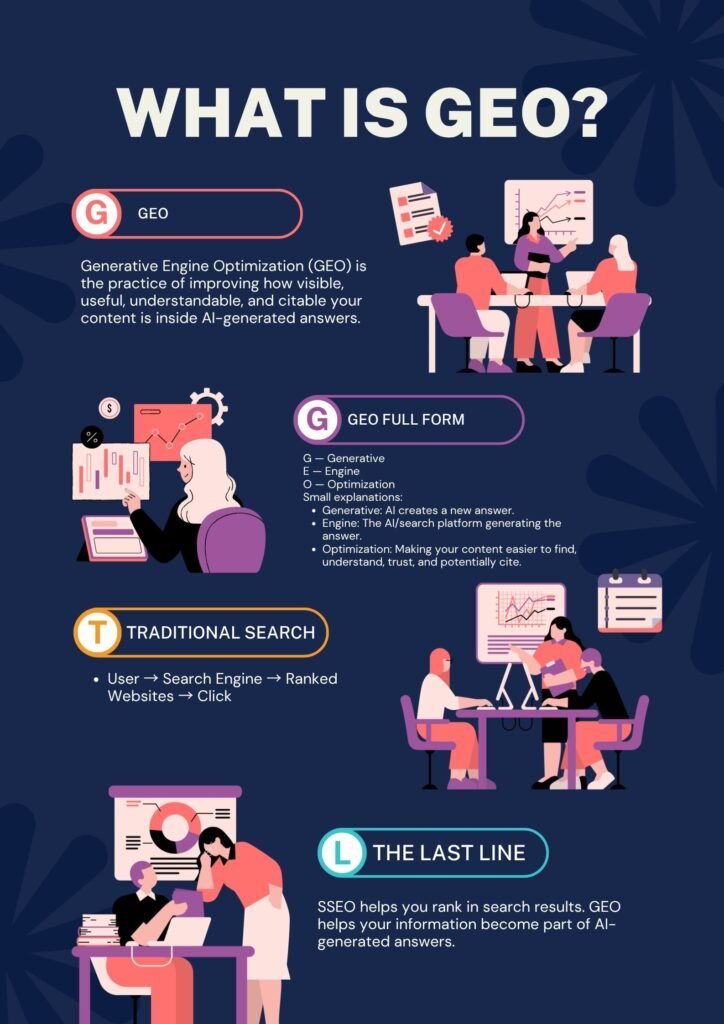
Generative Engine Optimization (GEO) is the practice of optimizing content to increase visibility and citations within AI answer engines like Google AI Overviews, Perplexity, and ChatGPT.
This is not necessarily an official definition, as the field is still young, and there is no widespread agreement yet on what terms should and shouldn’t be used.
In this piece, we use GEO as the umbrella term, and then proceed to detail, in consecutive sections, what the related concept AEO (Answer Engine Optimization) is, and how the two fields compare.
By the end of this article, you will be able to recite – in full, without qualification or inference – the following points:
- What GEO stands for, literally, and where the name comes from
- Why GEO came to be, what changed in the search landscape to make it relevant
- What the 5-step process is that makes up the work of a generative engine
- What AEO is, in full, when it was first posited, and how it differs from GEO
- What the four outcomes are, why they shouldn’t be conflated, and why doing so produces false positives
- What Google has said officially about GEO (or about anything relevant to it)
- What factors affecting visibility have been proven, are only suggested, or are unsubstantiated
- What llms.txt is, who is advocating for its use, and whether there’s any evidence behind it
- How to devise a GEO measurement framework (in detail)
What a business should actively do this year about GEO (in detail as well)
What GEO Stands For, Defined Word by Word
GEO stands for Generative Engine Optimization. Here is the word-by-word breakdown:
Optimization: Strategic fine-tuning of content so these AI models accurately cite and highlight it in their responses.
Generative: AI technology capable of generating original text and synthesized answers.
Engine: The search platforms or AI systems processing user queries.
Engine refers to any of the abovementioned tools, be it Google’s AI Overviews/AI Mode, ChatGPT, Perplexity, Gemini, or Microsoft’s Copilot. These are all different engines, with different processes, not a single engine that puts out different interfaces.
Optimization refers to the standard SEO process, but applied now to generative engines.
Where the term came from
GEO was first formalized in academic scholarship, not in marketing circles, during November 2023, when Pranjal Aggarwal, Vishvak Murahari, Tanmay Rajpurohit, Ashwin Kalyan, Karthik Narasimhan, and Ameet Deshpande – researchers at Princeton University,
The Allen Institute for AI, Georgia Tech, and IIT Delhi – released the manuscript GEO: Generative Engine Optimization , which was presented at ACM SIGKDD 2024 and published in the KDD 2024 proceedings (pages 5-16).
Their thesis, in brief, is that < cite index=”4-1″>Unlike traditional search engines, generative search engines return structured responses containing embedded citations, enabling multifaceted visibility and ranking opportunities beyond simple positional ordering.
Which is to say, instead of just putting links to websites on the SERP, these tools will now integrate those links into the answer, which will have implications for how citations work for SEO (defined below).
The academic work outlining GEO in detail
The researchers who formalized GEO as a concept created a benchmark tool called GEO-BENCH, which they used to assess roughly 10,000 queries across nine different methods of content optimization. Their findings were as follows:
Explicitly: < cite index=”2-1″>the top three optimization methods led to a 30-40% relative improvement on a position-adjusted word count visibility metric, which means that compared to non-optimized content, the optimized content had significantly better visibility metrics.
Implicitly: …< cite index=”2-1″>however, this represents a best-case observation under favorable conditions, not an average, meaning there aren’t consistent results to be had – it all depends on the nature of the query and of the given website < cite index=”2-1″>because the long-tail and lower-ranked queries demonstrated greater gains from optimization.
State this explicitly, because the “GEO increased visibility by up to 40%” talking point is potentially misleading. That is not an overall average – that is a point measurement in a specific scenario in the context of a specific set of queries.
A note on another finding from the research is necessary, because it dispels a common myth about GEO: < cite index=”8-1″>the work found that features such as authoritative language, citations, quotes, and statistics could positively impact the likelihood of appearance in model responses, while keyword stuffing had a detrimental effect, which is the opposite of what some search marketers have theorized.
Why GEO Emerged: The Underlying Data
GEO did not come about as a marketing gimmick unrelated to the overall search landscape; rather, it appeared due to shifts in search behavior that can be measured and quantified.
The zero-click phenomenon existed long before generative search
“Zero-click search”, also known as the tendency for more searches to end on the SERP without ever clicking through to a site, is not something that came about due to generative search. It existed long before AI Overviews, ChatGPT, or Perplexity became a thing – and it is possible to quantify.
As far back as 2018, Rand Fishkin and SparkToro started tracking zero-click searches with clickstream data. < cite index=”27-1″>According to Rand’s 2024 report, zero-click search in the US hit 58.5% in 2024, down slightly from 65% in 2021, with 37% of searches resulting in no further action, 21.4% in another Google search, and 41.5% in a click.
Another point to make here is that < cite index=”28-1″>per Rand’s research as well, zero-click search traffic increased from approximately 40% in 2016 to 60% in 2023 – and that AI answer features accelerated this traffic growth, but did not cause it.
What that means, explicitly, is that long before AI Overviews or ChatGPT, more than half of Google searches in the US in 2021 already ended with no clicks. This phenomenon only increased in 2022 and 2023, and is now close to 60%. Generative search is merely building on a pre-existing foundation.
What changed specifically with generative search
There is a reason why generative search results are a big deal compared to zero-click results. Three specific advances made it clear that generative search would change the SEO space:
Large language models became sophisticated enough to respond to questions directly, in fully-formed prose, and not just to list relevant resources;
Search platforms adopted large language models as tools to power search;
Users started engaging with search differently, via longer queries or queries that had several parts to them, since now they could;
These advances together spelled out one thing clearly: a business’s content could appear on the SERP in a couple of ways, without a user ever visiting the business’s website. This is why we have SEO for visibility, and GEO for citation.
How Generative Search Works: The Exact Five-Step Sequence
The generative search processes the query in five stages: first, it parses the search query, unfolding all the implied sub-queries in the process. Second, it performs research by accessing live indexes or knowledge graphs to find candidate data for each of the discovered sub-queries.
Third, the sources are assessed and scored to determine their credibility and currency. Fourth, the information is combined to formulate a comprehensive response. Finally, the results are presented, citing the sources used.
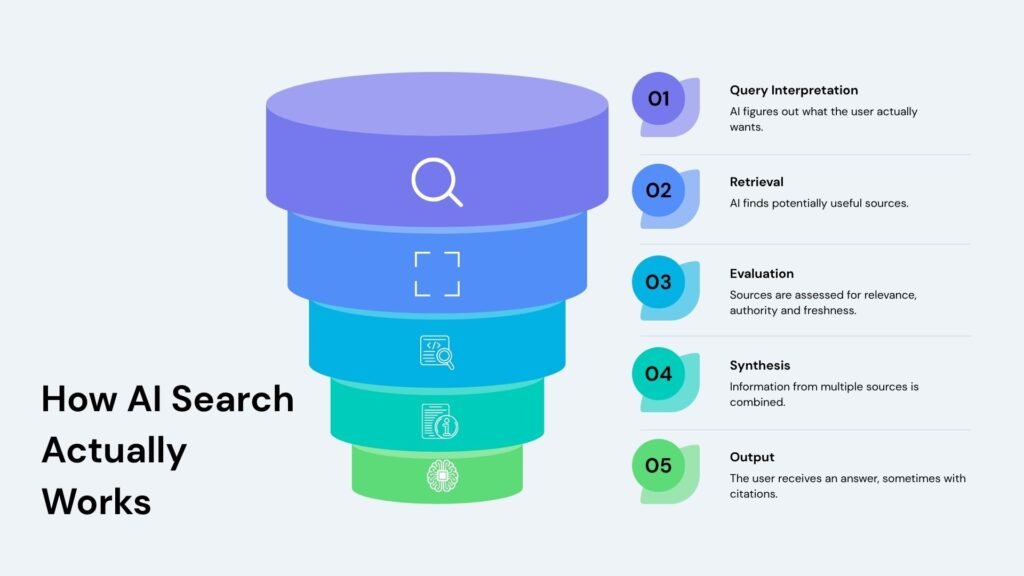
A generative engine answer always follows the exact same creation path. Each of the following tactics is about targeting one particular step – knowing the chain is essential to being able to understand which tactics have worked in which cases.
Step 1 – Query interpretation. The engine understands what is being asked, including what might not be explicitly said. Google has previously revealed that it often performs “query fan-out” – breaking implicit questions into a number of related sub-queries.
An explicit example was illustrated when asking “how to fix a lawn full of weeds”: Google would independently search for best herbicides, methods to remove weeds, ways to prevent weeds, and combine results from all.
Step 2 – Information retrieval. The engine finds candidate answers in a live index, a static knowledge graph, or its own training database, depending on the implementation. For Google’s own AI features, this always takes place within its existing search infrastructure: its AI algorithms utilize the same index and ranking algorithms as the core Google Search.
Step 3 – Evaluation. The candidate answers are scored and sorted according to relevance, authority, freshness, and other criteria.
Step 4 – Synthesis. The most informative answers are combined into one cohesive response. This is what fundamentally distinguishes a generative engine from a standard retrieval-based one.
Step 5 – Output and citation. The final response is presented to the user, along with a clickable link, a silent brand mention, or no citation at all, depending on the engine and the context – even if an answer directly quoted a source’s exact words.
Explicit fact: the major players do not use the same basic retrieval mechanism
Google’s AI Overviews and AI Mode, ChatGPT, Perplexity, Gemini, etc., have differing low-level implementations
Google’s AI Overviews and AI Mode in general are based on retrieval augmented generation (RAG), which uses the existing Google Search index to find relevant documents for queries, and subsequently synthesize answers out of them – not pull information out of its own internal neural network.
ChatGPT’s search function relies on a separate index and utilizes its own scoring mechanism for cited documents.
Gemini utilizes a mix of entity-based ranking, information extraction, and Knowledge Graph techniques, as well as live web retrieval.
Meanwhile, Perplexity performs live web ranking and retrieval itself, independent of any search engine.
The fact is explicit and unrebuttable – any GEO guide that fails to distinguish between different approaches is misleading on purpose. It is entirely possible for an SEO maneuver to improve clicks on one engine and fail completely on another, due to differences in how each engine performs retrieval and synthesis.
4. Four Outcomes That Are Not the Same Thing
This is the single most important distinction in the entire GEO discipline, and it is the concept most frequently collapsed into one vague idea of “AI visibility.” Treat these as four separate, independently measurable outcomes — not stages of one funnel, and not synonyms.
| Term | Explicit definition | Requires the others? |
|---|---|---|
| Discovery | The AI system can locate and retrieve your content at all | No — most discovered content is never used in an answer |
| Citation | Your source is explicitly referenced, usually with a visible link | Requires discovery, but discovery does not guarantee citation |
| Mention | Your brand or product name appears in the generated answer text | Can happen with zero linked source — a brand can be named from general model knowledge alone |
| Influence | Information from your source shaped the answer’s actual content or wording | The most common outcome overall; happens with or without a visible citation attached |
Facts, stated directly and without qualification:
A source can be discovered but not used in any answer.
A source can shape an answer’s exact wording without ever being cited.
A brand can be named for being well-known without any original content from that brand being published, indexed, or optimized.
These four outcomes need to be measured separately. One unified “AI visibility score” that attempts to blend all four outcomes loses nuance and becomes unactionable.
Evidence that this distinction has real-world implications
“Aleyda Solis, international SEO consultant and founder of Orainti, has analyzed the difference between traffic driven by AI and citations earned by AI, finding that brand-entry pages earned the majority of traffic from AI but only a minority of total AI citations, with citations being distributed more widely across discovery- and evaluation-stage content than clicks were.”
What this means, plainly: citation and traffic are different goals, often achieved by different types of content on the same website. A comparison page might drive hundreds of citations and no traffic, while a homepage might drive traffic from users who have already engaged with an AI-assisted research process, who do not need a citation from the same system.
A similar finding, about recommendation: citation is not the same as recommendation
“…Lily Ray, VP of SEO Strategy and Research at Amsive…has explored the difference between being cited by and recommended by an AI system in research about Google’s Overviews,
Finding that while Google’s AI frequently cited the self-published listicles of the brands it evaluated, it recommended – and therefore prominently showcased – competing brands in those same Overviews, with a frequency of approximately 69% according to Ray’s analysis.”
What this means, plainly: a citation signifies that the system used your content as a resource. It does not signify endorsement of your brand, product, or service as a solution. Citation and recommendation are two different outcomes, which a citation-focused metric cannot fully capture.
GEO vs. SEO: The Explicit Difference
SEO targets blue links and user clicks, while GEO targets AI comprehension, brand citations, and direct visibility.
SEO, stated directly: improving a page’s discoverability and rank in a ranked list of results.
GEO, stated directly: improving a page’s visibility, citation, mention, and influence within a generated answer.
Fact: GEO does not replace SEO. The intersection between the two disciplines is not an outlier; it is the foundation of both. Google has stated this directly, both in official documentation and in public quotes from its executives.
“Google’s Search Central documentation on SEO best practices for generative AI features suggests that traditional SEO remains relevant, as Google’s own generative AI features are built upon Google Search’s foundational ranking and quality algorithms, and that therefore, from a Google Search perspective, optimizing for generative AI search is SEO.”
“Danny Sullivan, Director, Google Search and ex-officio Search Liaison for the company, has stated the same point more succinctly: “Good SEO is good GEO” in several public forums.”
What this means, practically: a page that is already optimized for SEO – substantial, useful content with good technical fundamentals and a strong reputation – is already well-positioned for GEO.
GEO does not require an entirely separate optimization stream built on a different set of assumptions; it is a waste of resources to treat GEO-required content and SEO-required content as two entirely separate categories unrelated to each other.
Where GEO differs substantially from SEO, in practice
This is not to suggest that GEO and SEO are identical. State the practical, substantive difference directly:
SEO: rank position, click-through rate, and similar metrics that reflect how high a page appears in a ranked list and how often users engage with it.
GEO: presence within a generated answer, including mentions of specific facts, figures, or perspectives sourced directly from a webpage, which neither traditional SEO nor traditional rank-tracking tools are designed to track or optimize.
Neil Patel, co-founder of NP Digital, explains the relationship and distinction succinctly in one post: “GEO vs. SEO is not either/or – SEO drives visibility in search engines, while GEO ensures content appears in AI-generated answers, and both satisfy user intent through high-quality content creation.
In addition to visibility, SEO focuses on rankings and traffic, whereas GEO concentrates on citations within AI answers, with E-E-A-T being essential for both.” Note the explicit distinction between “rankings and traffic” (SEO) and “mentions within AI-generated answers” (GEO).
AEO explained, in detail: beginner to advanced text
This section is a stand-alone explanation of Answer Engine Optimization (AEO), presented in increasing levels of detail for a reader with no prior knowledge of the subject. It is split into five levels, each of which assumes the reader has read the previous levels.
Level 1 – AEO definition (complete beginner)
AEO = Answer Engine Optimization, the practice of structuring content so it will appear as a direct answer to a specific query.
This can take several forms, including but not limited to:
Featured snippets: the boxed answer that appears above or near the top of a search results page.
“People Also Ask”: expandable question-and-answer boxes that appear on results pages.
Voice search answers: the single answer returned by voice assistants such as Google Assistant, Siri, and Alexa.
Direct answer cards: knowledge-panel-style boxes that appear on the right-hand side of results pages.
What Exactly Makes Some Types of Content More Discoverable Than Others?
Level 1 – The core definition distinguishing AEO from GEO (novice)
The key difference between AEO and GEO is embedded in the name – as stated explicitly by the creators, AEO revolves around a search system extracting one short segment of text from an existing page: a definition, a number, a step.
This excerpt is presented largely in its original form in the search results, with minimal modifications. The system is largely extracting, not generating: this is the defining characteristic distinguishing AEO from GEO, and one of the clearest mechanical differences between the two disciplines overall.
Level 2 – How AEO mechanically differs from GEO (early intermediate)
State the difference explicitly and directly, as most articles on the topic do not:
| Dimension | AEO | GEO |
|---|---|---|
| What the system does with your content | Extracts a short passage largely verbatim | Synthesizes new text combining multiple sources into one answer |
| Best content shape | One clear, complete, self-contained answer to one specific question | Comprehensive coverage of a topic from multiple angles |
| Typical query type | Short, specific, single-fact questions (“What is X?”, “How many Y?”) | Broader, comparative, multi-part questions (“What’s the best X for Y use case?”) |
| Output format | A single extracted sentence, list, or short paragraph | A newly generated paragraph drawing on several sources at once |
| Where it appears | Featured snippets, PAA boxes, voice assistants | AI Overviews, AI Mode, ChatGPT, Perplexity, Gemini |
| Attribution behavior | Source is typically linked directly above or beside the extracted text | Source may be cited, merely mentioned, or used as unattributed influence (Section 4) |
Neil Patel’s quote about the difference is particularly illustrative: “AEO helps content appear as a direct answer – think featured snippets or voice search responses – while GEO creates in-depth content that generative AI can summarize and cite, and the two serve different purposes even though they’re both modern extensions of core SEO strategy.”
Fact, stated without qualification: AEO answers one question, and GEO synthesizes multiple facts.
A page may be excellent for AEO – containing, for example, a single highly quotable definition – while being relatively weak for GEO, as there is little substance beyond that one excerpt. Similarly, a page may be exceptionally strong for GEO – full of original research, deep analysis, and unique data – but contain no single sentence suitable for direct quotation and AEO.
Level 3 – The historical evolution of AEO (intermediate)
While AEO may seem to be an extension of GEO, the practice actually predates it by approximately one decade. This is a crucial distinction, as it defines AEO as an independent SEO practice, and not simply a “smaller” variation of GEO as many marketers perceive it.
Search engines introduced answer-first formats – snippets, knowledge panels, PAA boxes – as a way to reduce the number of clicks required to find a specific fact. This was a click-reduction feature: Google wished to avoid users clicking through to a webpage when a direct answer could be given inline.
Voice search optimization was another driver: a voice assistant cannot read an entire blog post, so articles had to be optimized to provide one clearly extractable answer.
What this means in practice: the skills required for AEO – writing one clear, extractable answer to one specific question – directly overlap with the skills later required for GEO’s “citable fact” system. AEO writing techniques were not developed as an answer to GEO; rather, they were a precursor.
Level 4 – Why AEO and GEO terms get merged in current usage (advanced)
In practice, the two disciplines have merged to such an extent that many companies describe them as synonymous, and optimize for both at the same time. Marketing consultancy Antyra states that GEO, AEO, and AIO (AI Engine Optimization) “generally refer to the same underlying practice, even though the terms emerged from slightly different starting points.”
The reason for this stems directly from the mechanical differences outlined in level 2: in practice, many AI answers blend extracted and synthesized text. Google’s AI Overviews feature can quote one directly extracted fact (AEO) while synthesizing other information (GEO) within the same paragraph.
The infrastructure behind both practices often overlaps: the same page has to be processed by both AEO and GEO ranking algorithms, even if only one ends up being used in the final search result.
Fact, stated directly: there is no objective standard differentiating AEO and GEO, and no universally recognized boundary between the two.
Neither Google nor any standards body officially acknowledges the distinction, and while it may prove helpful in practice, it is also limiting: optimization efforts should instead focus on choosing between mechanical techniques (what to optimize for) rather than getting caught up in the details of labeling.
Level 5 – How content can be specifically structured for AEO discovery (advanced, practitioner-level)
Given the explicit goal of extraction, AEO has specific best practices, many of which were developed independently by marketers before the rise of large language models:
State the direct answer prominently. Put it at the beginning of a relevant section, not at the end of a long paragraph or article. Algorithms favor proximity: the closer the extracted text is to the query, the more likely it is to be used.
Match the phrasing of the question. This increases the odds of extraction, as algorithms tend to favor text that directly echoes the search terms. Rephrase the question as a heading or lead-in sentence before giving the answer.
Make it self-contained. The extracted text should not require users to read other parts of the page in order to understand it – because that is precisely what will happen if it is put in a search snippet. Give enough context for it to function independently as a standalone response.
Use a clear format for the answer. The most common options for AEO are brief sentences, numbered lists, and simple tables for comparison-style queries. Avoid burying the extracted text within complex constructions – a short, clearly stated sentence always has a better chance of being picked up.
Take advantage of structured markup when appropriate. Schema markup serves as a signal to search engines that the content on the page is relevant to specific queries.
While Google’s official guidelines do not specifically encourage the use of schema for its generative AI features (Section 8), structured markup still assists significantly with general discovery: it helps organize information so that it is accessible and extractable by both users and AI systems.
How content can be specifically structured for GEO (contrast)
As noted in level 6.2, GEO is primarily concerned with synthesis – and the specific requirements for content optimization change dramatically, as described fully in section 7.
What Is Verified to Affect AI Visibility – And What Is Not
This section states facts explicitly, using levels of confidence as a qualifier. Nothing is presented as an indisputable fact unless it has been confirmed as such.
Verified and well-supported
Relevance and search intent – content that directly answers the underlying question asked, as opposed to simply matching keywords.
Originality and information gain – perspective, analysis, and facts not found elsewhere.
Google’s guidance on large language models explicitly names “7 tips for first-time homebuyers” as an example of commoditized content: something that could be generated by any similar website, offering no particular advantage to any one domain. This contrasts with an article about an individual’s experience making a specific purchase and the subsequent outcomes.
- First-hand experience – detail that could not have been obtained otherwise.
- Authority and trust signals – consistent demonstration of expertise, credentials, and trustworthiness across the domain.
- Topical coverage – the presence of broad concepts as well as specific terminology, as opposed to a few isolated terms on many unrelated topics. See also: single-topic pages with different variations of the same keyword.
- Freshness that reflects real-world updates rather than superficial changes. Lily Ray has noted publicly that “freshness is shifting from a cosmetic signal to a substantive one – AI systems reward real updates rather than just superficial modifications.”
- Technical accessibility – the ability for AI systems to access and parse content, rather than being blocked by technical barriers. Pages with JavaScript-rendered content or other obstacles must be avoided.
- Clear information structure – direct answers to specific questions placed prominently within a section.
- Entity clarity – consistency across the web in brand, name, and presentation.
Research-suggested, not guaranteed
The original research behind GEO-BENCH suggested that statistical references, quotes, and citations to other sources were positively correlated with visibility across its test set.
It also found that attempts to use keyword density as a ranking factor were negatively correlated – again, across its test set. Other than that, nothing is presented as an indisputable fact, as different queries respond to optimization to varying degrees and in different ways.
Practitioner-observed, informal, category-specific
Lily Ray’s informal research into “best product” queries suggests that “review/product pages and affiliates captured around a third of large language model retrieval for ‘best product’ queries, with a significant concentration of high-value domains within that category…”
This suggests that, for a particular class of queries (commercial, comparative), a specific category of websites (review sites) disproportionately influence large language model results – but not universally so.
Separately, Ray observed a correlation between organic visibility and AI citation rates: “My 11-site experiment suggests that whenever a given subfolder was down in organic traffic, the corresponding AI citations also dropped, rather than varying independently…”
This is an indirect observation, but one that strongly suggests that traditional SEO remains critically important to AI discoverability.
Explicitly false claims to reject
These are explicitly presented as claims to avoid, as they appear frequently across the GEO marketing space and have been disproven either through direct evidence or the lack thereof.
A specific word count does not guarantee citations.
A specific number of headings does not guarantee visibility.
Schema markup does not guarantee AI citations.
Backlinks do not guarantee ChatGPT mentions.
llms.txt does not guarantee AI visibility (see Section 9).
A specific keyword density does not improve GEO – in fact, the original GEO-BENCH research explicitly found the opposite.
Genuinely unresolved
No company (including Google) has published a comprehensive, undisputed list of factors influencing citations for a specific query on a specific day.
The mechanics change frequently, and optimizations that worked in the past often stop working later due to algorithm updates, competitive activity, or both. This is an inherently unstable space with no unified set of signals for visibility or ranking – and any claims to the contrary should be treated as overreaching.
What Google Has Officially Confirmed About AI Overviews and AI Mode
This section contains only statements made directly by Google, either in documentation or in public comments. No third-party speculation, analysis, or opinions are included, as this is not a commentary piece.
Google published a document in May 2026, titled “Optimizing your website for generative AI features on Google Search,” and placed it in the same directory as its SEO Starter Guide – within Google Search Central. This is an explicit acknowledgment of the importance of the topic, and means that what follows has been officially endorsed by Google.
Google’s public optimization advice includes the following, all of which are explicitly sourced from the linked documentation:
“Google’s AI features are built upon the core Search ranking and quality systems. They utilize retrieval-augmented generation (RAG) and query fan-out to synthesize responses using the existing Google Search index…”
llms.txt, content chunking, AI-specific rewriting, and special schema are explicitly not required for Google’s generative features…
Seeking inauthentic “mentions” to influence what Google’s AI features say about a brand unlikely to provide benefits, as…” (See also: “Google’s generative AI features rely on the same ranking and quality systems and signals as Google Search, including Spam policies…”)
“Quantity of content is unlikely to provide benefits over the long term, as publishing more pages does not inherently improve the relevance of a website to users…”
Facts to state without qualification: There is no separate GEO submission process for Google. There is no special schema required to appear in Google AI Overviews. Your pages must follow standard optimization practices and appear in the Google index – or they will not.
What genuinely does change, stated explicitly
Query fan-out implies that for any given query, Google’s AI can use the results from multiple relevant documents to construct a single response.
In practice, this enhances topical coverage and entity clarity: if a search engine sees your domain as a comprehensive resource (covering multiple related topics) and trustworthy source (not penalized in its natural search results), it is much more likely to use your content for AI-generated answers.
It is not a complete rewrite of SEO, but rather a refinement of existing practices – and a shift away from keyword stuffing and similar outdated techniques.
What Google explicitly warns against
Google confirms that the following tactics are explicitly counterproductive, either for its ranking systems or for its AI-powered features:
Publishing many subpages for different variations of a query is considered spam at scale.
Trying to manipulate brand impressions by seeking out inauthentic mentions across different domains is explicitly warned against, as it violates Google’s spam policies.
llms.txt: What It Is, Where It Came From, and What It Is Not
Definition stated directly: llms.txt is a proposed file, placed at the root of a domain (yoursite.com/llms.txt), created in September 2024 by Jeremy Howard (co-founder of Answer.AI). It contains a general overview of a website’s content in a simplified, human-readable format for use by LLMs.
Reason for its creation stated directly: “many large language models currently have a technical limitation preventing them from fully analyzing most websites, as the context window is generally smaller than the size of a typical HTML document.
Converting a complex HTML page with menus, advertising, and other elements into a simplified text format is challenging…” llms.txt was not initially proposed as a search-ranking signal – rather, it was designed to address a technical limitation of HTML parsing.
The format described explicitly: The text file has an H1 site title, followed by a blockquote description, then H2 headers with links to additional Markdown-formatted documentation. There is also a companion file, llms-full.txt, that contains all documentation in one summarized file.
Is it required for Google AI search? No – explicitly confirmed.
Google’s public documentation for AI Overviews and AI Mode makes it clear that llms.txt is not required for inclusion in Google’s AI search results. It is explicitly listed as one of the optimization signals that are not required for inclusion in Google’s index by any of its ranking systems.
Is it a formal web standard? No.
There is no IETF or W3C working group that oversees llms.txt, and no major search engine has formally adopted it, including Google, Bing, or DuckDuckGo. It is, by design and by implementation, a community-driven, unofficial standard.
Does current data show it affects AI visibility? No – evidenced directly.
One large-scale analysis of LLM crawlers’ behavior across more than 500 million events found that the volume of requests actually accessing /llms.txt on any given domain – including from known LLM bots such as GPTBot, ClaudeBot, and PerplexityBot – was effectively nonexistent statistically. llms.txt has little to no impact on AI discovery as it stands.
The difference between experimentation and a required mechanism
Adoption of llms.txt has increased steadily since its introduction, and several companies, including Anthropic, Cloudflare, and Vercel, publish one for their documentation.
Mintlify includes it as an option for documentation sites. That growing adoption is an indicator of value: it suggests that llms.txt will become a standard tool for developers, documentation, and AI coding assistants. It is not yet a search-ranking signal, but it may become one in the future.
Fact, stated directly and without qualification: llms.txt does not currently affect AI citation rates, based on available evidence.
It may genuinely be useful infrastructure for developers and end-users interacting directly with your documentation. It is not a GEO ranking factor, and treating it as one is not supported by the available data.
Measuring GEO: A Repeatable Framework
Fact, stated directly: a single AI query, tested once, is not a reliable measurement. AI-generated responses vary between sessions due to model updates, generation randomness, personalization, and shifting retrieval results.
Rand Fishkin’s research team tested this directly. Using 600 volunteers running identical prompts across multiple AI platforms, the team found that individual responses to the same prompt were genuinely inconsistent, but brand mention frequency could be measured reliably once aggregated across a large enough sample.
What this means, explicitly: GEO measurement must be built as a statistical sampling exercise, run repeatedly over time — not a single spot-check.
The five-step measurement framework
- Build a realistic prompt set covering brand-name queries, category questions, comparison questions, and problem-solving questions.
- Run each prompt repeatedly, across multiple sessions and multiple platforms (ChatGPT, Google AI Overviews/AI Mode, Perplexity, Gemini, Copilot).
- Record outcomes separately for discovery, citation, mention, and influence (Section 3) — not as one combined score.
- Track competitor presence on the same prompts, not just your own brand.
- Connect results to downstream metrics — AI-platform referral traffic, leads, and conversions where trackable.
Example tracking table
| Prompt | Platform | Brand Mention | Citation | Competitor | Source |
|---|---|---|---|---|---|
| “best SEO tool for a small agency” | ChatGPT | Yes | No | 3 named | — |
| “best SEO tool for a small agency” | Google AI Overview | No | Yes | 2 named | /blog/seo-tools-for-agencies |
| “how to choose an SEO tool” | Perplexity | Yes | Yes | 1 named | /guides/seo-tool-comparison |
Hypothetical example, explicitly labeled as illustrative, not real data: a company tracking 40 category-relevant prompts weekly across three platforms for one quarter observes citation rate on its comparison pages rise from roughly 5% to 15% of tracked prompts.
This is a directional signal worth investigating — not proof of a single cause, since AI platforms update for many reasons unrelated to any one site’s changes.
What GEO Is Not: An Explicit List
- GEO is not a magic AI ranking trick.
- GEO is not a replacement for SEO.
- GEO is not a guaranteed citation system — no legitimate practitioner can promise a specific platform will cite you for a specific query.
- GEO is not keyword stuffing; the original GEO-BENCH research found keyword stuffing reduces visibility.
- GEO is not simply adding schema markup.
- GEO is not publishing large volumes of AI-generated pages targeting every possible query variant.
- GEO is not adding an llms.txt file and waiting for citations.
- GEO is not manipulating AI systems through inauthentic or coordinated brand mentions.
- GEO is not writing exclusively for machines instead of the human reader.
Danny Sullivan’s consistent public position captures this last point directly: some gimmicks may produce a short-term advantage, but as systems improve — which they consistently do — content written for real people wins, while content written purely to game algorithms tends to fail over time.
What Businesses Should Do About GEO in 2026: A Direct Checklist
Re-audit visibility regularly, since generative platforms update their retrieval behavior frequently.
Keep SEO fundamentals as the foundation — do not replace them.
Audit technical accessibility specifically for AI crawlers.
Build original, first-hand content prioritizing information gain over restating existing content.
Establish a repeated, multi-platform measurement baseline (Section 10) — not a single spot-check.
Track citation and mention separately from traffic and conversion metrics.
Treat llms.txt as low-priority infrastructure, not a ranking tactic.
Reject guaranteed-citation pitches from vendors — no current platform supports that guarantee.
Summary
GEO stands for getting discovered, understood, and cited by generative AI. AEO (Answer Extraction Optimization) is, as the name implies, an optimization for extracting answers directly from a piece of writing, as opposed to synthesizing longer form responses.
It focuses on single answer extraction from a unified source and is a discipline that predates GEO by about a decade.
Neither AEO nor GEO replace SEO, but rather build on top of it, and no current platform offers any guarantees around citations, and no SEO tactic, including llms.txt, negates the need for original, well-structured, technically accessible content with a strong SEO backbone that has been battle tested across multiple publishing channels and iterations
Frequently Asked Questions
If an AI platform paraphrases my content without linking to me, is that plagiarism or is it “influence”?
It’s influence, not plagiarism in the legal sense that’s been settled by courts as of this writing — this is an active, unresolved area of law (see the ongoing publisher lawsuits against OpenAI and others). From a GEO standpoint, it’s an unattributed but real outcome: your information shaped the answer with no citation. Treat it as a measurement problem (Section 4 in the article — track “influence” separately) rather than something you can currently correct through a takedown request.
Can two competing sites both get cited in the same AI answer for the same query?
Yes, and this is common — a generated answer frequently synthesizes multiple sources into one response, unlike a ranked list where one position excludes others. This is a structural difference from SEO: citation in GEO is not zero-sum in the way rank position is.
Does having a Wikipedia page or being in Google’s Knowledge Graph give a meaningful GEO advantage?
This is genuinely unresolved with public data. Entity recognition (being unambiguously identified as a specific, coherent “thing”) is a verified factor in how systems like Gemini use the Knowledge Graph. Whether a Wikipedia page specifically causes higher citation rates, versus merely correlating with brands that are already more authoritative for other reasons, hasn’t been isolated in any published study I can verify.
If my content is fully paywalled, can it still be discovered, cited, or used for influence?
Discovery generally requires the crawler to access the content — a hard paywall that blocks crawlers (not just human readers) will block discovery outright. A metered paywall that lets crawlers through but blocks human readers can still result in citation, though the click delivers a paywall to the user, which raises a UX and trust concern separate from the GEO question itself.
Do AI platforms treat my own site’s pages as more trustworthy than third-party mentions of my brand?
There’s no verified, published ranking of self-published vs. third-party trust weighting across platforms. What is documented (Lily Ray’s research, cited earlier) is that AI Overviews will cite a brand’s own listicle while still recommending a competitor in the same answer — meaning citation of your own content doesn’t guarantee favorable framing. Third-party mentions in independent, credible sources appear to carry real weight, consistent with how E-E-A-T functions in traditional SEO, but no platform has published an explicit self-vs-third-party weighting.
If ChatGPT and Google AI Overviews give contradictory answers about my product, which one should I try to “fix” first?
Neither system offers a direct correction mechanism the way you might request a Google Business Profile edit. The practical lever you control is the underlying content: if your own site, and independent third-party sources about you, state the fact consistently and clearly, both systems are more likely to converge on it over time as they re-retrieve. There’s no verified fast-track correction path for either platform currently.
Does GEO performance differ for B2B vs. B2C queries?
No published, controlled study I can verify has isolated this specifically. What’s documented is category-level variation — e.g., Lily Ray’s finding that “best product” commercial queries skew heavily toward review/affiliate sites. It’s reasonable to infer B2B research-heavy queries might favor different content types (documentation, case studies) than B2C comparison queries, but that’s an inference, not a verified finding — treat it as a hypothesis to test with your own prompt tracking, not a fact.
Can I use GEO tactics to suppress negative or outdated information about my brand in AI answers?
No verified method exists for suppression, and pursuing one carries real risk. Google has explicitly stated that seeking inauthentic mentions to shape brand perception is unlikely to succeed and is governed by the same anti-spam systems as core Search. The only evidence-backed lever is publishing accurate, current, well-sourced information that gives retrieval systems something better to draw on — not removal of what already exists.
If my site has a strong llms.txt file but weak overall SEO, will that offset the SEO gap?
No. This follows directly from what’s verified: Google has confirmed llms.txt isn’t used by its generative AI features at all, and independent crawler-traffic data shows negligible engagement with the file even among AI-associated bots. There’s no evidence it can compensate for weak SEO on any platform.
How do I know if a drop in my AI citation rate is caused by my own content changes versus a platform-wide algorithm update?
You generally can’t isolate this from citation data alone. The practical method is comparing your citation-rate trend against your organic search trend for the same period, since Lily Ray’s 11-site study found the two move together — if both drop simultaneously, a platform-wide or ranking-system change is the more likely explanation than a content-specific one. If only your AI citation rate drops while organic ranking holds steady, that points more toward a retrieval-specific or platform-side change.
