
Surfer SEO vs Frase 2026 What Each Does for Page Rankings?
The Best Content Tool Isn’t Always the Most Packed with AI
Now things are different with how content gets fine-tuned.
These days, simply stuffing keywords into long posts doesn’t guarantee visibility. Years back, high rankings came from copying what top pages did – same terms, similar length. Now, it’s different. Matching word count and search demand used to be enough. Lately, results aren’t so predictable. What worked before now falls short.

Now it’s clearer how search engines get what users mean. Answers made by machines shift where folks find facts. With time, Google digs into skill level, value, and purpose behind searches.
Running a company in places like the USA, UK, Canada, or Australia means one thing shifts first – doubt about what comes next fades fast when results hit slow. Not if but how fills every meeting now. Pressure builds where growth stalls. Clarity shows up late, usually after mistakes stack high
“Which tool helps me write more content?”
What really matters? That one cuts deeper
“Which tool helps me create content that deserves to rank?”
Here’s when things start shifting between Surfer SEO and Frase.
One tackles the issue one way, yet the other follows a separate path. Though their goals look alike, how they polish content isn’t the same.
With Surfer SEO, you dig into how pages rank by studying real results. It pulls apart keywords using live data from top spots online. Instead of guessing, it shapes your content around what already works. Pages get tuned through insights pulled straight from competing sites that rank high.
Frase puts energy into tools that speed up research, using artificial intelligence to shape drafts. One moment it’s building smart outlines, the next guiding groups through planning what to write. Instead of waiting weeks, teams push pieces live quicker than before. Topic ideas flow straight into structured plans, skipping old bottlenecks.
Looking at lots of SEO routines, a pattern shows up
Rankings aren’t made by the tool on its own. Instead, it supports steps that lead there.
The strategy behind the tool does.
Even top tools won’t help much when pages miss what people really want. What matters shows up only when answers fit the question, feel informed, and actually clear things up. Fancy tech sits empty without useful words behind it.
Key Takeaways
-
Surfer SEO is better for advanced SEO optimization and content audits.
-
Frase is better for AI-powered research and faster content creation.
-
The best choice depends on whether your priority is rankings or publishing efficiency.
-
Both tools support SEO, but neither replaces strategy and expertise.
-
AI visibility and search intent optimization will become increasingly important beyond 2026.
Table of Contents
- Surfer SEO vs Frase 2026 What Each Does for Page Rankings?
- Surfer SEO or Frase – Which Fits Your Needs in 2026?
- Which Tool Should You Choose?
- Surfer SEO and Frase Compared
- The Real SEO Question Is What Tool Actually Makes Content Rank?
- Surfer SEO Review 2026
- Frase Review 2026 Strengths Weaknesses Best Uses
- Surfer SEO vs Frase: Complete Feature Comparison 2026
- Surfer SEO and Frase Compared Across Business Needs
- Surfer SEO and Frase pricing compared?
- The Biggest Mistake Businesses Make With AI SEO Tools
- AI reshaping SEO content methods by 2026
- Expert Insights From Real-World SEO Campaigns
- AI SEO Tools Beyond 2026?
- How Digehub Supports Business SEO Development
Surfer SEO or Frase – Which Fits Your Needs in 2026?
Short answer:
When it comes to sharp SEO tuning, Surfer often fits companies aiming higher in search results while shaping content through insights. Though some prefer simpler tools, those leaning into detailed analysis tend to find value here instead of elsewhere.
Marketers looking to speed up their research might find Frase fits well. Instead of juggling tools, they get help with writing through artificial intelligence. Workflow becomes less tangled, more straightforward. Simplicity shows up where it matters most. Content creation feels lighter, almost without effort. Tools like this tend to fade into the background. What stays clear is how fast ideas turn into drafts.
What works best hinges on what you aim to reach.
Which Tool Should You Choose ?
Which Tool Should You Choose?
| Goal | Better Choice |
|---|---|
| Improving existing SEO content | Surfer SEO |
| Creating detailed SEO briefs | Surfer SEO / Frase |
| AI-assisted article writing | Frase |
| Advanced keyword optimization | Surfer SEO |
| Beginner-friendly workflow | Frase |
| SEO agencies managing clients | Surfer SEO |
| Content teams producing faster drafts | Frase |
| Ranking competitive commercial pages | Surfer SEO |
Color guide: Dark Purple = Both tools · Purple = Surfer SEO · Light Purple = Frase
The important point:
A solid grasp of SEO still matters, no matter which option you pick. These tools just assist – they don’t think for you.
Most wins happen when smart tools meet clear thinking, fresh findings, a sharp stance, followed by solid follow-through.
Surfer SEO and Frase Compared
On first glance, the two look much alike.
One checks what shows up after a query. The other examines those same outcomes too.
One suggests posts you might like. The other points to videos it thinks fit your taste.
Both use artificial intelligence.
One aids writers in shaping better posts; meanwhile, the other streamlines drafting. Each adjusts content for clearer impact.
Yet their core ideas move in separate directions.
Surfer Seo Focus On Optimization
At its core, Surfer SEO centers on a single thought:
Start by checking pages that rank well. Spot recurring traits they share. Then guide makers using clear SEO clues found in performance data.
Most times it goes something like this:
Choose keywords analyze search results improve content edit publish
One main thing the system pays close attention to is
- Keyword coverage
- Content structure
- Competitor analysis
- NLP-related recommendations
- Content scoring
- On-page optimization
This way of working seems recognizable to those focused on SEO, since it mirrors long-standing methods used in search optimization. While not new, its structure follows patterns they’ve seen before.
A content strategist studies top-ranking pages to spot what’s missing. By examining rivals closely, weaknesses become clear. Pages get stronger through careful tweaks made ahead of launch.
Research and writing come first
Frase approaches content creation from a different angle.
What matters most is cutting down how long it takes from start to finish
“I need to create content”
and
“I have a complete optimized draft.”
The workflow is often:
- Find topic research brief write improve
- Frase is particularly useful for:
- Bloggers
- Small marketing teams
- Content creators
- Businesses producing large content volumes
Spending less time on gathering rival data means folks get to produce structures faster. Outlining becomes simpler when tools spot gaps early. First versions take shape without waiting around. Questions pop up naturally during the process. Speed matters more than going step by step.
The Real SEO Question Is What Tool Actually Makes Content Rank?
Here’s when most comparisons start to lose depth.
A common mistake is judging SEO tools only by features.
Better rankings won’t simply show up because there are more features.
Ranking performance depends on several factors:
1. Search Intent Accuracy
Still, a tool might suggest terms people type. Yet knowing the reason behind those words? That part stays out of reach.
For example:
A person searching:
“best CRM software”
Someone browsing here isn’t after what another searcher might want
“how CRM software works.”
One person might look at different options side by side. A choice could come later after seeing what fits best.
A learner could be the one using it next.
A Strong Seo Workflow Requires Understanding
- User motivation
- Buying stage
- Content purpose
- Competitor positioning
With Surfer SEO, the signals behind this optimization carry more weight. Though built differently, its insights push further into what matters. Because patterns emerge clearly, adjustments feel less like guesses. When details align this way, results often follow without extra effort. Stronger clarity here means fewer steps elsewhere.
What if research took less time? Frase gets you up to speed on popular queries without the clutter. A clearer path through user intent starts here.
2. Deep Content With Real Worth
By 2026, simply churning out yet another run-of-the-mill piece hardly cuts it anymore.
Thousands of websites can generate similar AI-written content.
One benefit shows up when you include it alongside
- Expert opinions
- Real examples
- Original analysis
- Industry experience
- Unique frameworks
- Data-backed insights
Surfer SEO shapes content one way. Meanwhile, Frase builds it differently.
Just having either one won’t make you an expert overnight. Authority comes from how they’re used, not just ownership.
3. AI Search Visibility
Search behavior is changing.
Finding companies by way of artificial intelligence in search is something more people notice every day.
So it’s not just about fitting old ranking rules anymore. A business must shape its content so machines can easily grasp what it means. Clarity becomes key when algorithms are reading too.
Modern content strategies should focus on:
- Clear answers
- Semantic relationships
- Strong entity signals
- Expert information
- Trustworthy sources
- Comprehensive coverage
Here’s when efforts to make AI detectable start to matter.
Right now, Digehub notices search shifting – old-school tweaks blending with smart tools shaping what shows up. Relying just on classic Google results? That path could skip tomorrow’s ways people find things online.
When businesses adjust to these changes, using SEO alongside AI visibility efforts often leads to more lasting results. Growth tends to stick around longer that way.
Surfer SEO Review 2026
Surfer SEO Explained Simply?
Starting with how people find things online, Surfer SEO builds tools that show writers what works in top-ranking pages. Instead of guessing, creators tweak their work using live data pulled from search trends. Hidden behind each edit is a pattern spotted across high-performing articles.
Pages grow sharper when shaped by these signals. One insight at a time, content moves closer to visibility. What shows up first often begins here. Real shifts happen without flash or noise.
What it aims to do is straightforward
Start by peeking at top-ranking pages to see their moves. Spot patterns they repeat across sections. Notice how they shape ideas without copying word for word. Shift focus toward structure instead of just wording. Build your version with similar flow but fresh phrasing. Learn from their rhythm, then step off alone.
Surfer SEO Key Features
1. Content Editor
Surfer SEO shines most through its Content Editor. That tool stands out more than others it offers.
It provides recommendations around:
- Keywords
- Content length
- Headings
- Structure
- Words others use on their webpages
This gives SEO teams a way to track progress through clear steps.
Instead of asking:
“Does this article look optimized?”
Teams can analyze:
“How close is this content to competitive ranking patterns?”
2. SERP Analyzer
The SERP Analyzer helps marketers understand ranking competitors.
It examines:
- Ranking pages
- Content structure
- Keyword usage
- Search results patterns
Entering tough markets makes this useful. What matters grows clear when the race heats up.
A single SaaS firm aiming at a tough keyword might first peek at top-ranking pages before drafting anything. Instead of guessing, they watch what works.
Pages that rank now give clues about gaps or angles missed so far. Before typing one word, smart teams check the landscape. What shows up high today shapes smarter plans tomorrow.
3. Content Audits
Fixing old pages can boost search results fast. Sometimes a little tweak works better than new posts. Pages already online might just need clearer words. Updating beats starting over each time. Fresh details often lift rankings without extra effort. Hidden gains sit inside what you already wrote.
Most companies spend their time putting out fresh posts.
Older pages might seem outdated – yet they sometimes hold surprises. Hidden value lies beneath their surface, waiting to be noticed.
A content audit can reveal:
- Declining rankings
- Missing keywords
- Outdated information
- Weak sections
- Optimization opportunities
Beyond most tools, Surfer SEO shows clear strength here. The way it handles details sets a different pace entirely.
Surfer SEO Advantages
Better For SEO Professionals
With Surfer SEO, fitting into daily SEO tasks feels smooth. It works where it needs to without extra steps.
Agencies managing multiple clients often need:
- Data consistency
- Repeatable processes
- Detailed optimization recommendations
This structure comes from Surfer SEO.
Strong Competitive Analysis
When keywords get tough, knowing what others do makes a difference. Instead of guessing, watch who already plays that game – learning their moves helps you adjust your own path without repeating mistakes.
Surfer SEO answers questions
- What topics are competitors covering?
- How detailed are ranking pages?
- What words show up often?
- Where are content gaps?
Helps with growing content work
Large content teams need systems.
Left unstructured, growing output usually brings uneven results. When effort lacks flow, standards tend to slip sideways.
Surfer SEO helps create optimization standards across writers and editors.
Where Surfer SEO Doesn’t Work Well
Most gadgets come up short somehow.
Some limitations include:
Over-Optimization Risk
Following content scores too strictly can create unnatural writing.
A top mark won’t secure it:
- Better user experience
- Better conversions
- Stronger brand authority
Still, people need to edit. Without their touch, something always feels off.
Less Emphasis on Fast Research
While Frase jumps right into drafting, Surfer SEO takes a slower path. Instead of rushing output, it spends more time shaping ideas. One leans on speed, the other on structure. Where Frase builds fast, Surfer pauses to refine. Quick creation isn’t its main move. Thought comes before text here.
When moving fast matters more than fine-tuning, this detail could stand out. Speed-focused groups might notice it slipping into their workflow without warning.
Frase Review 2026 Strengths Weaknesses Best Uses
What Is Frase?
Frase gets ideas moving by tapping into artificial intelligence to shape up online content. One moment you are stuck on what to write, next thing a clear path appears through smart topic digging. Instead of guessing what works, real insights guide each headline and paragraph built. Writing from scratch?
A full draft shows up before the blank page wins. Tweak after tweak feels lighter because suggestions arrive right when needed. Speed mixes with smarts every step where words take form.
Surfer SEO focuses on digging into search performance. Yet Frase aims at smoothing out how content gets made from start to finish.
At its heart lies a single thought
Teams spend less time digging through data when they skip repetitive tasks. Efficiency grows once old methods fade out. Useful content appears faster because of smarter workflows. Manual work fades where better systems step in.
Running a company that puts out material often? This method trims hours off the schedule.
A rush to post many articles each month might make a marketing group lean hard on quick tools, automated fact-finding, even smart software – just as much as fine-tuning numbers guide their steps.
Key Frase Features
1. AI-Powered Content Research
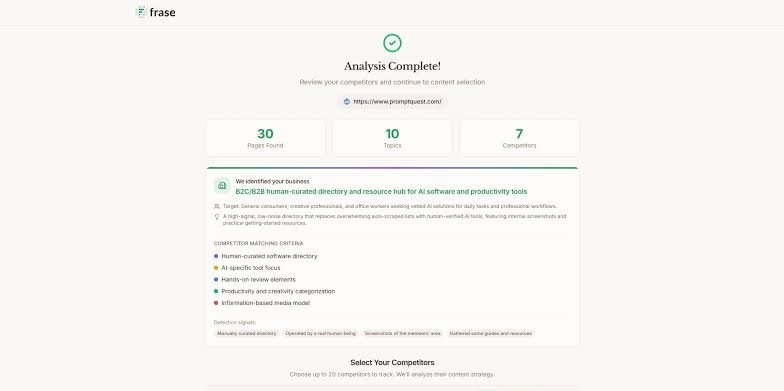
One of Frase’s strongest capabilities is content research.
Marketers skip sorting through piles of search outcomes by hand. They dive straight into insights, thanks to faster analysis tools. One after another, data points unfold without dragging through endless pages. Speed matters when decisions pile up fast. Reviewing takes less time now, leaving room for clearer thinking. Details emerge quicker than before, simply because old methods fade away
- Competitor topics
- Common questions
- Search result themes
- Content gaps
- Important subtopics
Built-in tools speed up how fast teams set up first drafts. Early ideas take shape quicker now.
A SaaS firm writing on CRM tools might turn to Frase to see what fits. One way it helps is by showing which topics matter most. Picture digging into user questions through that platform. Sometimes gaps appear in the original draft – this tool flags them. Think of how searchers phrase queries; Frase reveals those patterns. It pulls common subtopics from top results, giving clearer direction. Real answers come from real searches – it captures exactly that. The goal stays sharp: shape content people actually look for
- What questions users ask
- What subjects do rivals explore
- Which sections should be included
Still, automated tools work best when they follow a clear plan instead of taking charge.
Most top content works because it knows who’s reading, what sells, why it exists.
2. AI Content Writing
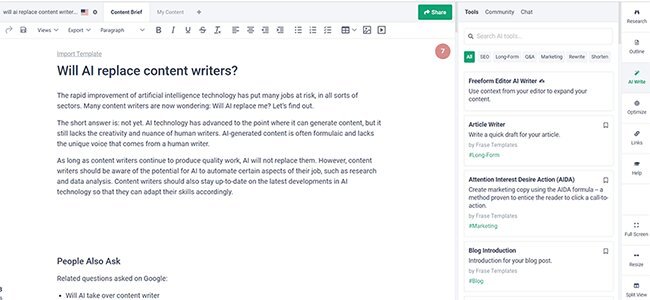
Frase includes AI writing features that help create:
- Article drafts
- Introductions
- Outlines
- FAQs
- Content expansions
Stuck thoughts find movement here, while output picks up pace. Speed builds when hesitation fades. Getting words out becomes easier over time. Hurdles drop away just as momentum grows.
Yet seasoned professionals notice something key
Start here with what AI builds – it’s raw material, nothing more. Not the end product, just groundwork laid out early. What comes next matters far beyond the first draft spun by machines.
Most of the time, the best way to work follows this pattern:
AI Research Meets Human Planning Followed by Machine Help Refined Through Skilled Editing Then Search Engine Tweaking Before Release
3. Content Brief Generation
Writing gets better when there’s a clear guide to follow. A solid outline shapes how ideas flow from start to finish.
Frase builds short briefs that include these items
- Suggested headings
- Questions
- Topics
- Competitor insights
- Content direction
When several writers contribute, uniformity happens naturally. Different voices start sounding alike without effort. Team output feels like it comes from one mind. Matching styles becomes easier over time. Shared guidelines shape each piece quietly. Results stay predictable even with rotating authors.
A good brief ensures writers understand:
- Who the audience is
- What problem needs solving
- What information should be included
Frase Advantages
Faster Content Production
What makes Frase stand out? It’s a strong fit for companies focused on producing lots of content. Size of output plays well here.
Examples:
- Media companies
- Affiliate websites
- Marketing teams
- Growing blogs
Most times when moving fast feels impossible, Frase cuts down how long it takes to gather information.
Beginner-Friendly Workflow
Frase seems simpler to start with, especially when new users find its flow straightforward.
A new marketer can move from:
“I need an article idea”
to:
“I have a researched outline”
Just works, even if you do not know much about search engine rules.
Smart tools help with writing
Working on content with AI? Frase can help out along the way. It fits into team processes trying new methods.
Generating becomes possible through it
- Content ideas
- First drafts
- Supporting sections
- Question-based content
Where Frase Doesn’t Work Well
Basic SEO Settings
Frase doesn’t go as deep as Surper SEO when it comes to fine-tuned insights for marketing pros. While one digs into every detail, the other stays closer to the surface. Marketers needing thorough breakdowns might find themselves wanting more. Depth isn’t its strongest suit compared to the alternative. What you get is useful – just not exhaustive.
Advanced SEO Professionals Often Need
- More granular competitor data
- Deeper optimization insights
- More detailed ranking analysis
AI Content Quality Tied To Approach
Most people think drafts made by AI will work fine right away.
Most times they skip it.
Without:
- Original insights
- Brand expertise
- Real examples
- Strong editing
Pages made by artificial intelligence often look just like many others online.
Surfer SEO vs Frase: Complete Feature Comparison 2026
Surfer SEO vs Frase: Complete Feature Comparison 2026
Side-by-side breakdown of core capabilities
| Category | Surfer SEO | Frase |
|---|---|---|
| Primary Focus | SEO Optimization | AI Research & Creation |
| Content Optimization | Excellent | Good |
| AI Writing | Good | Excellent |
| Keyword Analysis | Excellent | Good |
| SERP Analysis | Excellent | Good |
| Content Briefs | Excellent | Excellent |
| Beginner Experience | Good | Excellent |
| Agency Workflow | Excellent | Good |
| Content Scaling | Excellent | Excellent |
| Existing Content Audits | Excellent | Average |
| AI Draft Generation | Good | Excellent |
| Advanced SEO Strategy | Excellent | Good |
Color guide: Green = Excellent · Purple = Good · Amber = Average
Surfer SEO and Frase Compared Across Business Needs
What a company wants to achieve shapes which tool fits best.
A single writer working alone looks for tools that fit small-scale work. A worldwide software business demands systems built for heavy traffic and large teams. One focuses on simplicity. The other requires complexity handled smoothly behind the scenes.
For SEO Agencies
Winner: Surfer SEO
Agencies usually need:
- Repeatable processes
- Client reporting
- Content optimization systems
- Competitive analysis
A typical day at an agency might hinge on clear SEO gains. That is where Surfer SEO tends to align more smoothly. Progress shows faster, which keeps teams moving without guesswork.
A single approach keeps things steady when handling dozens of sites. Running twenty, maybe fifty pages, demands uniformity across every piece. Without steady methods, small errors grow – control slips. Each site must follow similar rules, yet adapt where needed. One misstep on a handful can echo through them all.
For SaaS Companies
Winner: Surfer SEO
Most software firms chase tough business terms online. Yet ranking stays hard despite heavy spending on searches.
Examples:
- Software comparisons
- Product pages
- Industry solutions
- Marketing resources
- These pages require:
- Search intent accuracy
- Competitor analysis
- Strong topical authority
Most times, Surfer SEO fits better when fine-tuning pages.
Bloggers And Content Creators
Winner: Frase
Bloggers often face challenges like these
- Finding topics
- Creating outlines
- Writing consistently
- Frase reduces friction.
Starting fast means ideas become real quicker for makers. When thoughts shift into posts without delay, output flows more naturally. Finishing work soon after beginning keeps momentum alive through each step. Publishing feels less like a hurdle when steps are smooth.
Small Marketing Teams
Depends On The Goal
Should the main concern be:
Publishing more content quickly:
Frase could work out better.
Improving organic traffic performance:
Surfer SEO may be stronger.
Surfer SEO and Frase pricing compared?
Now prices shift all the time, which means companies need to look at what they actually get instead of just the price each month.
A dollar saved today might cost two tomorrow.
What if we asked this instead:
“Which tool helps create content that generates more traffic, leads, and revenue?”
Surfer SEO Delivers Higher Returns
Surfer SEO can create stronger returns when:
- SEO is a major acquisition channel
- Ranking improvements directly impact revenue
- Teams manage competitive keywords
- Existing content needs optimization
For example:
One step up from page two might bring a flood of new clients. When rankings shift slightly, traffic often jumps without warning. Hidden chances live just beyond the first page. Moving higher tends to uncover them slowly. A slight boost in position changes everything quietly.
Frase delivers higher returns
Frase may provide better value when:
- Content volume is the priority
- Teams need faster production
- Research takes too much time
- Writers need structured guidance
For example:
For a publisher churning out loads of guides, Frase can save time simply by working fast. Speed matters when you’re handling volume, and that’s where this tool fits in well.
The Biggest Mistake Businesses Make With AI SEO Tools
Most businesses purchase SEO tools including Semrush & Ahrefs, hoping they’ll fix low rankings. Some assume the software handles everything once installed. Others believe results come fast without extra effort. A few think just owning the tech means success is guaranteed. Many forget that tools alone can’t replace strategy or skill.
This rarely works.
The software provides information.
Strategy creates results.
A Strong SEO Process Requires
Understand What The Business Wants To Achieve
Before creating content, define:
- Traffic goal
- Conversion goal
- Target audience
- Revenue opportunity
Still, hitting random search terms might bring clicks – just zero results beyond that. Traffic without purpose drifts through, never sticks around. Growth needs more than noise; it demands fit. A site found by accident rarely converts. Relevance shapes real outcomes. Without alignment, numbers mean nothing. Visitors leave fast when intent misses mark.
Analyze What Users Want When They Search
Just because people search a term does not mean you should write about it.
Ask:
Truth hides behind their eyes. Stillness answers better than questions. A glance weighs more than words spoken aloud. Silence builds the real shape of need.
- Are they learning?
- Comparing options?
- Ready to buy?
What people look for shapes how information unfolds. Content bends where curiosity points.
Create better information than competitors
Something different often shows up at the top. What others skip becomes its strength. Not copying matters more than trying harder. Standing apart starts by leaving gaps unfilled elsewhere.
Examples:
- Original frameworks
- Better explanations
- Industry experience
- Real examples
- Updated information
Use Data to Improve
Here, something like Surfer SEO or Frase steps in.
Use software to identify:
- Missing topics
- Content gaps
- Optimization opportunities
- Software shouldn’t call the shots on how you write.
AI reshaping SEO content methods by 2026
The SEO landscape is moving beyond traditional keyword optimization.
Finding stuff online now shifts because of smart machines reshaping search habits.
Businesses now need to think about:
- Traditional Google rankings
- AI-generated answers
- Brand mentions
- Entity recognition
- Information accuracy
People first, algorithms close behind – that shapes smart content moves by 2026. Machines matter just as much as readers when planning what to share. Winning approaches balance how real folks react alongside how tech systems sort things out. Attention shifts fast; staying seen means pleasing eyes and engines alike. What clicks in feeds must also clear digital checkpoints without slowing down.
The Rise of AI Visibility Optimization
AI search systems look for content that demonstrates:
- Expertise
- Trust
- Clear information structure
- Reliable answers
This way, companies need their material seen everywhere – so tweaking it helps. Visibility grows when adjustments fit each place. Reaching people happens more if formats match where they are. Changing things slightly makes a difference overall
- Search engines
- AI assistants
- Answer engines
Change moves fast, yet Digehub guides companies in reshaping how they share content. Instead of old tactics alone, new paths open when classic SEO meets evolving AI-driven visibility tools. Each step blends what works with what’s next, without leaving proven methods behind.
Surfer SEO Or Frase – What Fits Your Needs?
It really comes down to how you plan to grow.
Surfer SEO For When You Want
- Better Search Rankings
- Strong SEO optimization
- Competitive keyword targeting
- Content audits
- Agency workflows
- Ranking-focused strategies
Choose Frase When Needed
- Faster research
- AI writing support
- Simple content creation
- More efficient publishing
Expert Insights From Real-World SEO Campaigns
After working with content-heavy websites and SEO campaigns, one thing became obvious to us.
Most businesses don’t struggle because they lack SEO tools.
They struggle because they use powerful tools without a clear content strategy.
During a recent project for a B2B software company in the USA, the marketing team was publishing content consistently but seeing very little ranking movement.
When we audited their workflow, we discovered that almost every article was written around keywords, not search intent.
The content looked optimized on paper. The content scores were high. But the articles weren’t solving the exact problem users were searching for.
Using Surfer SEO, we re-analyzed competitor pages, identified missing subtopics, improved content depth, and aligned each article with actual buyer intent.
Within a few months, several target pages moved significantly higher in search results and started generating qualified demo requests instead of just traffic.
The lesson?
Optimization helps, but intent alignment drives rankings.
My Personal Take After Testing Both Tools
After testing both Surfer SEO and Frase across different content workflows, I noticed something interesting.
Whenever the goal was creating a better SEO strategy, I found myself opening Surfer SEO first.
Whenever the goal was speeding up research and content production, I often preferred Frase.
Personally, one feature I liked in Surfer SEO was the Content Audit tool.
Many businesses focus heavily on publishing new content while ignoring existing pages that already have ranking potential.
The audit feature often reveals quick wins that can generate results faster than creating another new article.
With Frase, the research workflow stood out.
For marketers producing multiple articles weekly, reducing research time can have a major impact on overall productivity.
What My Team Preferred
When discussing both tools internally, our content strategists and SEO specialists usually leaned toward Surfer SEO for ranking-focused projects.
The reason was simple.
The optimization recommendations felt more actionable when competing in difficult search results.
Meanwhile, writers and content managers often appreciated Frase because it reduced the amount of manual research required before drafting an article.
In reality, the preference often depends on the person’s role.
SEO specialists typically prefer Surfer.
Content creators often prefer Frase.
One Feature I Wish Both Tools Improved
If I could add one improvement, it would be deeper search intent intelligence.
Both tools analyze content patterns effectively.
However, there are situations where two pages target the same keyword but rank because they satisfy completely different user expectations.
Future SEO tools should move beyond keyword analysis and provide stronger intent-based recommendations.
For example:
Instead of suggesting:
“Add these keywords.”
The platform could suggest:
“Users searching this query are primarily looking for comparisons, not tutorials.”
That would make optimization significantly more strategic.
What I Keep Seeing On Reddit And Quora
One question appears repeatedly across Reddit discussions and Quora threads:
“Can Surfer SEO or Frase guarantee rankings?”
My answer is always the same.
No.
Neither tool guarantees rankings.
In fact, some of the highest-ranking pages we’ve analyzed didn’t have perfect optimization scores at all.
What they did have was:
- Better expertise
- Stronger user experience
- More useful information
- Clearer answers
Many marketers become obsessed with reaching a content score of 90 or 95.
Meanwhile, they ignore whether the article is genuinely helpful.
That’s the wrong priority.
What I Would Recommend To A New SaaS Founder
If a SaaS founder asked me today which tool to buy first, my recommendation would depend entirely on their situation.
If they’re creating content themselves and need help researching, outlining, and publishing faster, I’d recommend starting with Frase.
If they already have a content process and want to improve rankings through optimization and competitive analysis, I’d recommend Surfer SEO.
The biggest mistake would be expecting either tool to replace strategic thinking.
The winning combination is still:
Human expertise + SEO strategy + AI assistance.
That’s the formula we consistently see working across industries.
Final Expert Perspective
After testing different content optimization workflows, one thing remains true in 2026.
The businesses winning organic search are not necessarily using the most tools.
They’re using the right tools within a repeatable system.
Surfer SEO is excellent for improving and optimizing content.
Frase is excellent for accelerating research and creation.
Neither platform is the complete strategy.
The strategy comes first.
The tool amplifies the strategy.
Build a content workflow focused on rankings using Surfer SEO or Frase
Just picking a good tool isn’t enough on its own.
Integration shapes the real benefit within your content workflow. What matters most shows up when the tool fits naturally alongside existing processes.
Some businesses buy SEO tools, draft a handful of posts, yet assume results will come without effort. Not every team realizes progress needs more than setup alone.
That rarely happens.
Most strong content groups stick to a clear process.
Begin by exploring keywords that matter
Start by seeing what the keyword could do. Look at its potential before touching Surfer SEO or Frase. Peek into the chance it offers prior to launching those tools. See the space it fills ahead of any software use. Notice the opening it creates before you begin. Watch for the gap it might cover before typing a single query.
A keyword does more than match what someone types into a box. It points toward intent, hints at needs hidden behind short phrases.
It represents:
- A customer problem
- A business opportunity
One step along the way when someone decides to purchase something
For example:
A keyword like:
“best CRM software for startups”
- has commercial intent.
- The searcher is likely comparing solutions.
A keyword like:
“what is CRM software”
- has educational intent.
- The content approach should be completely different.
A strong keyword strategy considers:
- Search volume
- Competition
- Business value
- Search intent
- Conversion potential
Out here, skilled SEO analysis gives a real edge compared to just churning out volumes of material.
Analyze Current Search Results
Both Surfer SEO and Frase help marketers understand competitors.
Yet true insight means looking past top results. Still, it helps to question why certain pages lead. Often clues hide in gaps between them. Always differences matter more than similarities. Sometimes stepping back reveals patterns. Usually fresh angles come from contrast. Again ranking data alone tells half the story.
One error people often make
“Top pages mention these topics, so we should mention them too.”
That creates average content.
Instead, ask:
What are competitors missing?
Look for:
- Unanswered questions
- Weak explanations
- Outdated statistics
- Poor examples
- Missing industry perspectives
Most times, doing it again just lands in the same spot. Chances are slim you’ll improve what already exists. Rarely does a second pass beat the first go around.
The opportunity is creating something more useful.
Create a Clear Content Brief
Starting clear shapes how well words will work later. When directions are sharp, what comes out fits better. A solid start pulls everything into place ahead of time.
A good brief includes:
- Audience
- Who is reading?
- Examples:
- SaaS founders
- Marketing managers
- Agency owners
- Business executives
- Search Intent
What action should the reader take?
Examples:
- Learn
- Compare
- Purchase
- Evaluate options
Content Angle
Why should someone choose this article over others?
Examples:
Weak angle:
“Complete guide to SEO tools”
Strong angle:
“How growing SaaS companies choose SEO tools that actually improve organic acquisition”
Required Sections
Include:
- Main questions
- Supporting topics
- Expert insights
- Examples
- Data points
Write for people before search engines
Most companies rush to tweak their AI-generated material before it’s ready.
They focus on:
- Keyword placement
- Content score
- Word count
before creating something genuinely useful.
The correct order is:
- Human value first.
- Optimization second.
A ranking article should answer:
“Would someone trust this brand after reading this?”
By 2026, that question holds greater weight than just reaching an optimization score.
Improve Content Using Real Expertise
Google and AI systems increasingly reward content that demonstrates experience.
Most AI-written pieces stumble right here.
What they give is facts without context. Still, the bigger picture stays missing.
Adding expertise means including:
- Practical examples
- Industry observations
- Original recommendations
- Expert opinions
- Real workflows
For example:
Instead of saying:
“Surfer SEO helps optimize content.”
A stronger explanation:
“Surfer SEO becomes more valuable when a team uses it as a decision-support system rather than a writing formula. The tool can identify optimization gaps, but experienced marketers decide which recommendations actually improve user experience.”
Authority comes from that gap. It grows where things aren’t the same.
Common Errors With SEO Content Tools
Mistake One Focusing On Content Scores Over Actual Search Position
That sense of fullness just lands right.
But it does not guarantee:
- Better traffic
- More conversions
- Higher authority
Outshining others might happen even with a low score, given sharper responses.
Mistake 2 Not Reviewing AI Written Content Before Sharing
Content creation moves faster with AI. Still, speed isn’t everything when building real value.
It cannot replace:
- Industry knowledge
- Brand voice
- Strategic positioning
Most times, posting unedited AI output leads to bland material.
Mistake 3 Not Recognizing User Intent to Convert
Most companies build useful material hoping people will come – yet hardly any turn into buyers.
A strong content strategy connects:
Traffic Becomes Trust Then Leads To Conversion
Every important article should consider:
- Here lies the issue it tackles.
- What should readers do next?
- What ties this back to what we offer?
Mistake 4 Not Updating When Making Content
Done once does not mean done forever when it comes to SEO. It keeps needing attention over time.
Pages that show up first must be checked now then. Maintenance keeps them where they are.
Successful teams regularly review:
- Ranking changes
- Competitor updates
- Search intent changes
- New industry developments
Mistake 5 Applying One Strategy Across All Industries
Each type of business – like a software subscription, online store, or neighborhood repair shop – needs its own way of sharing messages. One size never fits every kind of work. What works here fails there. Different customers mean different words must be chosen. Shape how things sound based on who listens. A single method rarely serves all three well. Tailor each message like clothing made to measure.
Each market requires different:
- Keywords
- Customer journeys
- Content formats
- Conversion paths
AI SEO Tools Beyond 2026?
AI won’t kick out marketers during the coming stage of search engine optimization. Instead, tools will shift how tasks are handled behind the scenes.
The ongoing Surfer SEO vs Frase discussion highlights this change perfectly. Rather than replacing human expertise, both platforms are helping marketers work faster and make more informed decisions.
Working together more smoothly could shape how people and smart machines interact. Smooth interaction might just come from tweaking the way tasks are shared. A different rhythm in teamwork may start when both sides adapt slightly.
When evaluating Surfer SEO vs Frase, the future seems less about choosing one tool over another and more about understanding how each platform fits into a modern content workflow.
Change often begins where human effort meets machine precision. The balance shifts once communication lines adjust quietly. This is one reason why the Surfer SEO vs Frase comparison remains relevant as SEO evolves beyond traditional optimization methods.
Several trends are becoming increasingly important.
1. AI Search Optimization Will Become Standard
People are changing how they find information.
Instead of only searching Google and clicking websites, users increasingly expect direct answers.
Businesses will need content optimized for:
- Search engines
- AI assistants
- Answer engines
This shift is already influencing how marketers evaluate Surfer SEO vs Frase and other content optimization platforms. The ability to create content that performs in both traditional search and AI-generated answers will become a major competitive advantage.
2. Content Teams Will Become AI-Assisted
Future content workflows will look less like:
Writer creates everything manually.
More likely:
AI researches.
AI assists drafting.
Humans provide:
- Strategy
- Experience
- Editing
- Brand expertise
The competitive advantage will belong to teams that combine speed with quality. In many organizations, the Surfer SEO vs Frase decision increasingly comes down to whether optimization depth or content production speed is the higher priority.
3. SEO Tools Will Become More Predictive
Future platforms will likely move beyond recommendations.
Instead of:
“Add this keyword.”
Tools may provide:
“This topic has a ranking opportunity because competitors have weak coverage and user demand is increasing.”
Predictive SEO intelligence will become more valuable. Looking at the current Surfer SEO vs Frase landscape, both tools are already moving toward smarter recommendations, but the next generation of SEO software will likely become even more proactive.
4. First-Hand Experience Will Matter More
As AI-generated content becomes easier to produce, original expertise becomes a stronger differentiator.
Businesses should invest in:
- Expert-led articles
- Customer insights
- Original research
- Case studies
- Real examples
This trend is important regardless of where you stand in the Surfer SEO vs Frase debate. No optimization score or AI writer can replace genuine experience and unique insights.
5. The Surfer SEO vs Frase Debate Will Shift From Features To Outcomes
Today, many marketers compare features when evaluating Surfer SEO vs Frase.
Beyond 2026, the focus will likely shift toward outcomes:
- Which platform improves visibility in AI search?
- Which tool helps create more authoritative content?
- Which solution generates more qualified traffic?
- Which workflow produces better business results?
The future of Surfer SEO vs Frase comparisons will be less about checklists and more about measurable growth.
Ultimately, the Surfer SEO vs Frase conversation reflects a larger industry shift. SEO tools are evolving from simple optimization assistants into strategic content intelligence platforms. The marketers who adapt to this change earliest will likely gain the greatest advantage in the years ahead.
The Future of Content Optimization
How Digehub Supports Business SEO Development
Yet tools for SEO pack a punch, companies still fumble when putting them into practice.
Most times, it’s not about tracking down a new app.
The challenge is creating a system that connects:
- Keyword strategy
- Content production
- Technical SEO
- AI visibility
- Conversion optimization
Starting strong, Digehub shapes lasting growth by weaving deep research into smart content moves. One step at a time, results take form through sharp targeting instead of guesswork. With every move tied to real output, progress shows clearly. Strategy flows into action without delay or clutter. Effort meets purpose each phase along the way.
Starting with what people actually care about, these content plans grow a company’s presence by matching real questions to clear objectives.
Built step by step, each piece fits a bigger purpose that moves past random posts into something steady and useful. Instead of guessing, the approach follows patterns that keep readers returning without relying on hype or empty promises. When done right, it turns information into trust over time.
Frequently Asked Questions
If your main goal is improving rankings and organic performance, Surfer SEO is usually the better long-term investment.
If your biggest challenge is researching topics, creating briefs, and publishing content consistently, Frase may provide more immediate value.
The right choice depends on whether your bottleneck is optimization or content production.
Surfer SEO generally performs better for content refresh projects.
Its auditing features make it easier to identify:
- Missing keywords
- Optimization gaps
- Outdated sections
- Competitive weaknesses
This is particularly useful for websites with large content libraries.
The biggest difference is their primary focus.
Surfer SEO focuses on optimization.
Frase focuses on research and content creation.
Think of Surfer SEO as an SEO optimization platform and Frase as a content workflow platform with SEO capabilities.
Indirectly, yes.
Both tools can help create more comprehensive and structured content.
However, appearing in AI-generated answers requires more than optimization.
Content should demonstrate:
- Expertise
- Accuracy
- Authority
- Clear information structure
- Strong topical coverage
These factors influence AI visibility more than keyword density alone.
Most beginners adapt to Frase faster.
Surfer SEO offers more advanced optimization features, which can require additional SEO knowledge to use effectively.
For experienced marketers, that extra depth is often an advantage.
Yes.
Frase is often easier for beginners because it simplifies research and content planning.
Many new bloggers struggle with figuring out:
- What to write
- How to structure articles
- Which questions to answer
Frase helps solve those challenges quickly.
If organic traffic is an important customer acquisition channel, Surfer SEO can be a worthwhile investment.
Small businesses often benefit most from:
- Content audits
- Existing page optimization
- Competitor analysis
- Keyword-driven content improvements
The value depends on implementation, not just the software itself.
Frase has historically been stronger for AI-assisted writing workflows. It helps users generate outlines, briefs, FAQs, and article drafts faster.
Surfer SEO includes AI capabilities too, but its primary focus remains optimization rather than content generation.
Yes. In fact, many advanced content teams do exactly that.
A common workflow is:
- Use Frase for research and content briefs
- Create the first draft
- Optimize the final article using Surfer SEO
This combines research efficiency with deeper SEO optimization.
For highly competitive niches, Surfer SEO generally provides a stronger advantage because of its deeper optimization analysis, SERP insights, and content auditing capabilities. However, rankings still depend on content quality, authority, backlinks, and user intent satisfaction.
