
Copy.ai Review 2026: Is It Still the Best Budget AI Writing Tool for Marketers?
If you searched “Copy.ai review” this year and read the top ten results, you walked away with outdated information. Most of those articles were written before October 2025, before the acquisition that fundamentally changed what Copy.ai is, who it’s for, and what it costs.
This review is different.
We have tracked Copy.ai through its biggest product pivot in five years, tested it across real marketing workflows, and pulled live 2026 data from independent researchers, G2, Trustpilot, and content performance benchmarks. Whether you are a solo marketer in London, an agency team in Toronto, a SaaS founder in Austin, or a content lead in Sydney, this is the Copy.ai review you actually need before making a buying decision.
Quick Answer: Is Copy.ai Worth It in 2026?
For marketing and sales operations teams producing high-volume short-form content: Yes. The workflow automation, multi-model AI access, and brand voice training deliver genuine ROI at scale.
For solo writers, bloggers, or casual users: Probably not at the paid tier. The free plan is generous. The Starter plan at $49/month is hard to justify without daily use and workflow automation.
For SEO-focused long-form content: No. Jasper.ai and Writesonic compete harder here. Copy.ai is a velocity tool, not a depth tool.
The single most important thing to know: Copy.ai vs Jasper.ai was acquired in October 2025 and repositioned as an enterprise GTM platform. If you came here expecting the simple template-based copywriting tool from 2022, that product no longer exists.
What Actually Happened to Copy.ai in 2026 (The Context Everyone Skips)
In October 2025, Fullcast, a go-to-market and revenue operations platform, acquired Copy.ai and rebranded it internally as “Fullcast Propel.” The pitch was a unified “Plan-to-Pay” GTM engine: connecting territory planning, quota management, and AI-powered content execution in one platform.
What that means for you as a marketer is this. Copy.ai’s development priorities, pricing structure, customer support resources, and product roadmap are now oriented around revenue operations teams at scaling companies, not individual creators or freelancers.
The rating split tells the story clearly. Copy.ai holds a 4.4/5 on G2, reflecting mostly enterprise and marketing operations users who see real value in the platform’s GTM direction. On Trustpilot, it sits at 1.9/5, concentrated among legacy users who came in for the old $36/month simple writing tool and found a more complex, more expensive product that no longer serves their original use case.
Both ratings are accurate. They are describing different experiences of the same product transition.
Understanding this context shapes every other decision in this review.
The Market Reality: Why Your AI Tool Choice Matters More in 2026
Before we go deeper on Copy.ai’s features, worth establishing why this decision carries real strategic weight.
According to HubSpot’s 2026 State of Marketing report, 87% of marketers now use generative AI in at least one workflow, up from 51% in 2024. Using AI is no longer a competitive differentiator. Using AI inside a systematic, compounding workflow is.
McKinsey’s 2026 Global AI Survey found that AI content drafting delivers 3.2x ROI on average. Content creation tools broadly deliver 420% ROI when deployed systematically. The average marketer saves 6.1 hours per week from AI adoption, with senior practitioners recovering up to 10 hours.
But here is the number that actually matters: only 19% of marketing teams that use AI daily have built a measurement framework to track whether it is producing results or just producing content. That gap, between AI adoption and AI accountability, is where most of the competitive advantage is hiding in 2026.
Teams operating at what researchers call “Level 3” AI content maturity, meaning integrated, systematic, workflow-driven AI usage, produce 5 to 10 times more content at 75 to 85 percent lower cost per article compared to teams still using AI in silos.
This context frames the Copy.ai question correctly. The question is not “is this a good writing tool.” The question is “does this tool belong inside a serious content and marketing operation, and at what tier does it actually earn its place.”
Copy.ai Features: What They Do, What They Don’t
AI Chat Interface With Multi-Model Access
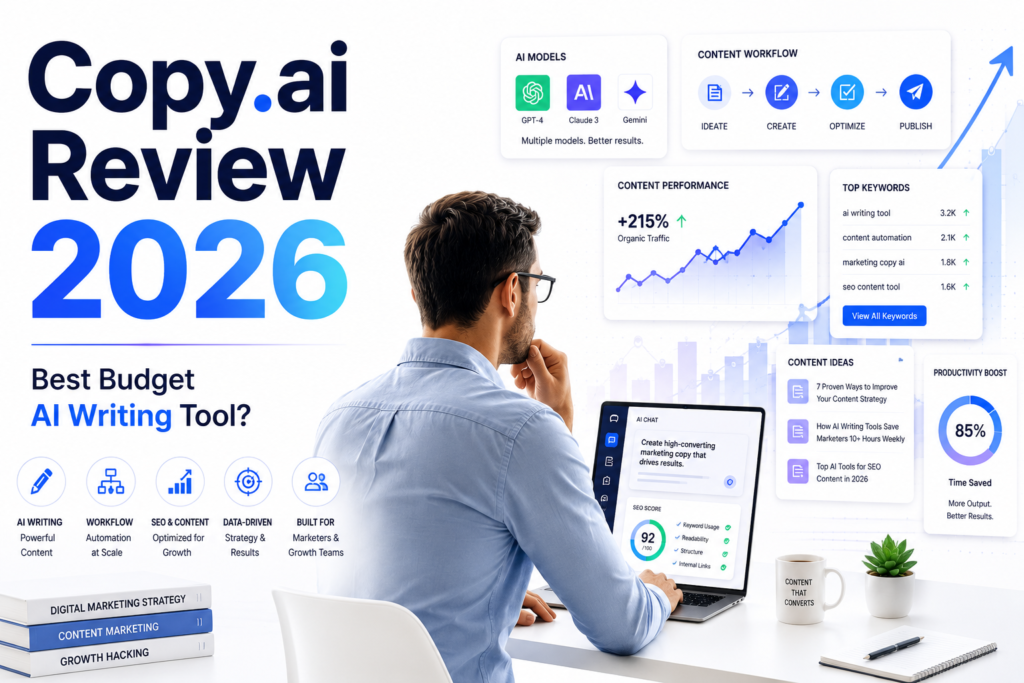
The main workspace is a conversational chat interface that looks and feels like ChatGPT but is pre-loaded with a marketing context layer. The standout differentiator is multi-model access. Within a single session you can switch between GPT-4, Claude 3, and Gemini without separate subscriptions.
In practical terms: different models have genuinely different output tendencies. GPT-4 tends toward structured, predictable marketing copy. Claude 3 tends toward more natural, nuanced tone. Gemini can surprise on creative variation. The ability to compare outputs from multiple models in one interface is genuinely useful and most competing tools do not offer it.
Short-form copy is where this shines brightest. Social captions, email subject lines, ad headlines, product descriptions, cold email openers. One independent 2026 test found that cold outreach templates specifically needed around 30% editing rather than the 80% most users expect from template-based generation. Fast, iterable, usable with moderate editing.
Long-form content is where the tool hits its ceiling. Research-heavy blog posts, case studies, and data-driven content need substantial editing and line-by-line fact-checking. Copy.ai will state a statistic confidently without a source. For brand-controlled factual content like product pages, that is manageable. For editorial content requiring verified accuracy, it requires a serious human review layer.
90-Plus Content Templates
For teams that do not want to build prompts from scratch every time, the template library covers the main marketing formats. AIDA and PAS copywriting frameworks. Email sequences. LinkedIn posts. YouTube scripts. Cold outreach. Product descriptions. Blog outlines. Google and Meta ad copy. And more.
The templates reduce cognitive load and get you to a usable draft faster than engineering a custom prompt for every format. They are strongest for ad copy and social content. Weaker for anything requiring research depth or original editorial voice.
Workflow Automation: Where the Real ROI Lives
This is the feature most individual users overlook and most agency and operations teams undervalue until they have actually built a workflow and run it.
Workflows let you chain multiple AI actions into an automated pipeline that runs without manual intervention at every step. A practical example: you upload a list of 200 target prospects, the workflow researches each company, identifies relevant pain points, drafts a personalized cold email, and pushes it to your CRM or outreach tool. Fully automated.
Another example: you publish a new YouTube video and a workflow automatically produces a blog summary, three LinkedIn posts, and an email newsletter introduction from the same source content. No manual briefing, no switching tools, no coordination overhead.
One 2026 audit of Copy.ai’s workflow capabilities found that account research workflows, specifically the type that scrapes LinkedIn profiles, identifies pain points, and drafts personalized outreach, reduced manual data capture work by up to 80% compared to doing the same task manually across multiple browser tabs.
For agencies and content operations teams, this automation layer can justify a paid plan entirely on its own. The honest caveat: workflows require setup time upfront and deliver the most value when your team already has established content patterns and enough volume to make the automation worthwhile. If you are producing two emails a week, a workflow will not move the needle. If you are producing 200 outreach emails, 40 social posts, and weekly content at scale, the math changes significantly.
Brand Voice Training
Available on paid plans, Brand Voice lets you upload samples of your existing content so the AI learns your tone, vocabulary, sentence patterns, and style markers. In real-world testing, outputs trained on a brand voice noticeably reduce editing time compared to generic prompts.
One digital agency reported a 40% reduction in time spent per social media campaign after implementing Copy.ai with proper brand voice configuration. It is not flawless. You will still edit. But the gap between generic AI-sounding copy and something that approximates your actual brand voice narrows to a workable degree. For agencies managing multiple client voices, this feature can make or break workflow consistency across accounts.
Infobase: The Memory Layer That Reduces Hallucination
Infobase acts as a structured knowledge base for your business. You upload product specs, pricing information, approved messaging, company facts, and key data points. When the AI generates content, it pulls from Infobase instead of guessing or fabricating details.
This directly addresses one of the most common and damaging complaints about AI writing tools in 2026: confident hallucination. The AI will generate an incorrect product specification in a tone that sounds completely authoritative. For brand-controlled content where accuracy is non-negotiable, Infobase meaningfully reduces that risk. Human review remains essential, but the tool moves closer to a reliable first-draft partner rather than a liability.
Multi-Language Support Across 25-Plus Languages
Copy.ai generates content in 25-plus languages, including Spanish, French, German, Portuguese, Italian, Chinese, Japanese, and more. For global marketing teams running campaigns across multiple markets, this removes a layer of translation friction at the first-draft stage. Native-speaker review is still essential for cultural tone and local nuance. But reaching a 90% localized draft in seconds is a real operational gain for internationally distributed teams.
Copy.ai Pricing in 2026: The Breakdown Competitors Avoid
Copy.ai restructured its pricing in 2025, moving away from the simpler old Pro plan at $36/month and toward a tiered structure that reflects its GTM platform repositioning.
Free Plan: 2,000 words per month. Full chat interface. 90-plus templates. No credit card required. This is a genuine free tier, not a stripped trial. For testing quality and exploring the interface before committing, it is one of the more generous free offerings in this category. For any real production volume, you will exhaust it inside a week.
Starter Plan (approximately $49/month, or $36/month billed annually): Unlimited words in chat. Brand Voice training. 25-plus languages. API access. This is the realistic entry point for individual marketers using Copy.ai as a daily writing tool. The annual billing discount saves 25 to 30 percent, so if you have tested the free plan and know you will use it consistently, committing to annual billing is the obvious financial choice.
Advanced Plans (from $249/month): Full Workflow automation. Team collaboration. Higher workflow credit allocations. CRM integrations with HubSpot, Salesforce, and more. This tier is where the GTM platform becomes the actual product. Workflow credits are separate from Chat word limits and are consumed by automated multi-step processes. Complex workflows cost more credits than simple single-output generation.
Enterprise (custom pricing): Governed AI workflows, compliance features, dedicated support, and deeper system integrations. Built for RevOps teams operating at scale.
One important note: Brand Voice, which many individual users would consider a core feature, requires Advanced at $249/month or above on some plan structures. Review the current Copy.ai pricing page before purchasing, as tiers have shifted multiple times through 2025 and 2026.
The pricing verdict in plain terms: At $36/month annually, the Starter plan is reasonable value for someone writing short-form marketing copy every day. At $49/month on a monthly basis without a long-term commitment, it is harder to justify without high volume usage. At $249/month, the ROI depends entirely on whether your team’s workflow automation needs justify the spend relative to time currently lost to manual content production. Run that math with your actual numbers before deciding.
Copy.ai vs. The Real Alternatives in 2026
Copy.ai vs. Jasper: Jasper wins on long-form content quality, deeper native SEO integration through Surfer, and brand governance at enterprise scale. Copy.ai wins on multi-model flexibility, GTM workflow automation for sales teams, and pricing accessibility for smaller operations. If your primary output is SEO-focused blog content, Jasper competes harder. If you run a mixed marketing operation with short-form copy, sales outreach, and automation, Copy.ai’s workflow layer is the actual differentiator.
Copy.ai vs. Writesonic: Writesonic is built for SEO content at scale. Real-time keyword research, SERP intelligence, and direct WordPress publishing are native to the product in ways Copy.ai does not match. For teams running content-heavy organic campaigns, Writesonic has an edge on that specific use case. Copy.ai covers more of the marketing funnel but goes less deep on the pure SEO editorial side.
Copy.ai vs. ChatGPT Plus or Claude: This is the most uncomfortable comparison for any dedicated AI writing tool vendor, so most reviews avoid it. At $20/month, ChatGPT Plus and Claude offer enormous writing versatility, often better long-form output quality, stronger factual reasoning on research-heavy content, and no built-in workflow complexity. What they do not offer is the marketing-specific template library, the Workflow automation layer, the Infobase memory structure, and brand voice training. Copy.ai charges a meaningful premium for that vertical focus and operational infrastructure. Whether the premium delivers value depends on whether you will actually use that infrastructure. Most solo users will not. Most marketing operations teams will.
Copy.ai vs. Rytr: Rytr at $9/month is genuinely hard to argue against for occasional solo copy work. The output quality handles short-form content adequately. Copy.ai’s free plan covers similar ground at zero cost. The gap widens substantially when you need team features, workflow automation, or production scale. For any use case beyond solo or light individual production, Copy.ai’s feature depth outpaces Rytr significantly.
5 Common Mistakes Marketers Make With Copy.ai (And How to Avoid Them)
1. Using it as a finished copy machine instead of a first-draft engine. The most expensive mistake teams make is publishing Copy.ai output without a human editorial pass. AI-generated content that has been reviewed, edited, and enhanced by humans performs 127% better than raw AI output on average. Treat every output as a strong starting draft, not a finished asset.
2. Buying the paid tier before building one workflow. Most teams that cancel Copy.ai subscriptions never built a single automated workflow. They paid for the Starter plan, used it like a slightly fancier ChatGPT, and concluded the premium was not worth it. Before upgrading, identify one repetitive content task your team does weekly and build a workflow for it. If the workflow saves three or more hours, the paid tier earns its place. If it does not, you have your answer before the next billing cycle.
3. Ignoring the Infobase setup. Teams that skip Infobase setup consistently report more hallucination issues and more editing time per output. The 30 to 60 minutes required to populate Infobase with product facts, approved messaging, and key data points pays back in reduced editing overhead from the first week. Do not skip this step.
4. Using generic prompts and blaming the tool. A consistent finding across 2026 reviewer testing is that output quality correlates strongly with prompt specificity. “Write a LinkedIn post about our product” produces generic copy. “Write a LinkedIn post for a Head of Marketing at a Series B SaaS company, addressing the challenge of proving content ROI to a CFO, referencing our workflow automation feature, in a direct and slightly provocative tone” produces something worth editing. The tool is not the ceiling. The prompt is.
5. Applying Copy.ai to long-form research content without a fact-check layer. Copy.ai will generate statistics, cite figures, and reference research with complete confidence and zero verification. For short-form copy where you control all the facts, this is manageable. For any content that includes data points, claims about competitors, or reference to external research, every figure requires independent verification before publishing. One fabricated statistic in a published article costs more in credibility than the time saved generating it.
Expert Insight: The Strategic Question Underneath the Tool Choice
Most marketers approach AI tool selection as a features comparison. It is not. It is a workflow design question.
The data from 2026 research is consistent on this point. Teams operating at what researchers describe as “Level 3” AI content maturity, meaning fully integrated, systematic AI workflows with proper measurement, produce content at 75 to 85 percent lower cost per article than teams using AI in disconnected silos. That is not a marginal efficiency gain. That is a structural competitive advantage that compounds month over month.
A team running Copy.ai with a properly configured Infobase, active brand voice training, and three automated workflows for their highest-volume content tasks will outperform a team using Jasper or Claude with no systematic workflow. The tool quality gap between platforms is narrower than the workflow maturity gap between teams.
Before asking which AI writing tool to buy, ask: what content am I producing repeatedly, at volume, that could be systematized? What does my team’s content operation actually look like versus what it could look like at three times the output with the same headcount? Answer those questions first. Then evaluate which tool’s feature set maps to those answers.
If you are building out that kind of AI content strategy for the first time and want a structured framework, Digehub’s AI Automation services and Content Marketing services cover exactly this kind of operational design work. Not a pitch. Just a relevant pointer if you are in that planning phase.
Current Trends: How Copy.ai Fits Into the 2026 AI Marketing Landscape
Three macro trends shape how Copy.ai fits into your stack in 2026.
The shift from AI assistance to AI agency. In 2025, AI tools primarily helped humans write faster. In 2026, the leading edge of adoption is agentic AI, meaning AI systems that can plan, execute, and optimize multi-step marketing workflows with minimal human intervention at each step. Copy.ai’s Workflow automation is an early-stage version of this capability. It is not fully autonomous, but it is the most accessible entry point into agentic content marketing for most mid-market teams. According to HubSpot’s AI predictions for 2026, by end of year agentic AI systems will handle full marketing campaigns without constant human input at the highest-maturity organizations. Copy.ai sits at the accessible end of that spectrum.
The search visibility shift. Traditional SEO is no longer the only visibility game. AI Overviews now appear on a meaningful percentage of queries. ChatGPT, Claude, Perplexity, and Gemini are answering questions directly rather than routing users to websites. For content teams, this means optimizing for AI citation alongside Google ranking, what practitioners now call GEO (Generative Engine Optimization) and LLMO (Large Language Model Optimization). Copy.ai does not have native GEO or LLMO features, but the content it helps you produce needs to be structured with these channels in mind. If your agency or team needs help building visibility across both traditional and AI search, Digehub’s AI Visibility services are designed specifically for this challenge.
The content quality bifurcation. As AI-generated content floods digital channels in 2026, two categories of content are pulling away from the middle: high-volume, systematically produced AI-assisted content that is properly human-edited and brand-consistent, and genuinely original, experience-driven, data-backed content that AI cannot replicate. Generic AI content published without editorial care is getting squeezed by both. Copy.ai, used well, helps you operate in the first category. The human judgment layer is what keeps you out of the trap in between.
Future Trends: Where Copy.ai and AI Writing Tools Are Heading
The next 18 months will reshape this category significantly. Here is what the evidence points toward.
Deeper agentic capability. Gartner predicts that by 2027, organizations will implement task-specific AI models at usage volumes three times higher than general-purpose LLMs. For tools like Copy.ai, this means increasingly specialized workflow agents for specific marketing tasks, not one generalist chat interface doing everything.
Multi-agent orchestration. The next evolution is not one AI writing tool but multiple specialized agents working in coordination. One agent researches accounts. Another drafts outreach. A third monitors performance and triggers content updates based on engagement signals. Copy.ai’s Workflow architecture is built to accommodate this direction.
AI search as a primary discovery channel. By late 2027, AI search channels are projected by some researchers to drive economic value equal to traditional search. Content teams not optimizing for AI citation today are building on a foundation that is actively eroding. This is the single most underinvested area of content strategy in 2026 for most marketing teams.
Brand authenticity as the differentiator. A countermovement is emerging alongside AI adoption. Gartner predicts that by 2027, 20% of brands in advanced economies will deliberately position their lack of AI as a value proposition, particularly in categories where consumers perceive AI as diluting quality or authenticity. For most brands, the strategic answer is not avoiding AI but making AI-assisted content indistinguishable from high-quality human output. That requires the editorial layer. It always comes back to the editorial layer.
Who Should Use Copy.ai in 2026 (Plain Decision Guide)
Use Copy.ai if you are:
- A marketing or sales operations team producing short-form copy at volume across email, social, and ads
- A digital agency managing multiple client brands who needs brand voice configurations and team collaboration
- A SaaS company building GTM workflows that connect content creation to CRM and outreach automation
- A global team running campaigns across multiple languages who needs first-draft localization
- A marketer or small business owner who wants to test AI writing with a genuinely free no-card-required plan
Skip Copy.ai’s paid tiers if you are:
- A solo blogger or SEO writer who primarily produces long-form research-backed content
- A freelancer doing occasional writing work who will not use workflow automation
- A team that needs technically accurate content where hallucination risk is genuinely costly
- Someone comparing it to ChatGPT Plus at $20/month for general writing tasks without marketing workflow needs
Frequently Asked Questions
Is Copy.ai 2026: Best Budget AI Writing Tool for Marketers?free in 2026? Yes. The free plan gives you 2,000 words per month, access to 90-plus templates, and the full chat interface with no credit card required. It is one of the more generous permanent free tiers in this category.
What does Copy.ai cost in 2026? The Starter plan is $49/month billed monthly, or approximately $36/month billed annually. Advanced workflow plans start at $249/month. Enterprise pricing is custom. Always verify current pricing directly on the Copy.ai website before purchasing.
Has Copy.ai changed significantly in 2026? Yes, significantly. Copy.ai was acquired by Fullcast in October 2025 and repositioned as an AI-native GTM platform called Fullcast Propel. The product now focuses on marketing and sales workflow automation for teams, not simple individual copywriting. Pricing moved up accordingly.
Is Copy.ai good for SEO blog content? Not as a primary SEO content tool. For blog outlines, short sections, and repurposing existing content into new formats, it is functional. For full research-backed long-form articles where accuracy and SEO depth matter, Jasper or Writesonic are stronger choices. Line-by-line fact-checking is always required for any data-heavy content.
How many languages does Copy.ai support? 25-plus languages including Spanish, French, German, Portuguese, Italian, Chinese, Japanese, Korean, and more. Useful for global teams doing first-draft localization across markets.
Is Copy.ai better than ChatGPT for marketers in 2026? For marketing and sales operations teams running workflow automation, multi-step outreach sequences, and high-volume branded content, yes. For individual writers who can build their own prompts and do not need GTM workflow features, ChatGPT Plus or Claude at $20/month offers more flexibility for less money.
What is Copy.ai’s biggest weakness in 2026? Two weaknesses consistently surface in independent testing: inconsistent factual accuracy in research-heavy content, and output quality that can feel generic without detailed prompting and proper brand voice configuration. Both are manageable with the right workflow and editorial process. Neither is a dealbreaker for the right use case.
Is Copy.ai worth it for agencies? Yes, with the right setup. Multi-brand voice configurations, team collaboration features, multi-language support, and workflow automation for recurring content formats make it genuinely valuable for agencies managing multiple client accounts. The Advanced plan economics depend on client content volume and whether automation credits are being actively used.
The Bottom Line
Copy.ai in 2026 is not the tool many people remember, and that is the core risk in this buying decision. The product is genuinely powerful for marketing and sales operations teams that need AI-assisted content at volume inside an automated workflow. It is a poor fit for solo writers, casual users, and anyone who will not use the workflow and integration features that justify the premium over cheaper or more flexible alternatives.
Start with the free plan. Build one workflow for a task your team repeats every week. If that workflow saves three or more hours in the first month, the Starter plan pays for itself immediately. If it does not, you have a clear signal before committing.
The tool is the easy part. The workflow design around the tool is where the competitive advantage actually lives. That is true of Copy.ai and it is true of every AI writing platform in 2026.
Ready to Build an Copy.ai 2026: Best Budget AI Writing Tool for Marketers? Content Strategy That Actually Performs?
Choosing the right tool is one decision. Building the workflow, measurement framework, and editorial process that makes it perform is a different challenge entirely, and one most teams underinvest in.
At Digehub, we help global businesses across the USA, UK, Canada, and Australia design AI content operations that compound in value rather than just produce volume. Our Content Marketing services cover the full strategic build, and our AI Automation services handle the workflow architecture that makes tools like Copy.ai actually deliver on their promise.
If you are also working through how to stay visible in AI search engines alongside Google, our AI Visibility services are built specifically for that challenge, which is becoming one of the most important and most overlooked areas of digital marketing strategy in 2026.
No pressure. If this review gave you what you needed to make your own decision, that is exactly what it was built to do. If you want an external perspective on your AI content setup, we are easy to reach.
Also useful from Digehub: Want to write better-optimized content without paying for an expensive tool first? Try our Free SEO Blog Writing Tool and see what structured AI-assisted writing looks like in practice.
For deeper reading on the strategy side, our SEO Services page covers how we approach organic visibility for global brands, and the AI Visibility Services page addresses the GEO and LLMO optimization layer that most content strategies are still missing entirely.
