
What Is LLMO? Large Language Model Optimization for 2026
LLMO stands for Large Language Model Optimization, which is a practice of structuring a website’s data so that the results of AI search can point to and recommend your brand. In other words, it is a search engine optimization (SEO) technique for AI assistants such as ChatGPT or Gemini.
Introduction: Why LLMO Is Suddenly a Business Priority
LLMO has become a business priority since the traditional search traffic is shifting towards AI conversational answers. Whenever an end-user asks for recommendations from an AI model, the search engines and assistants provide synthesized results. Businesses need to optimize their content for LLMs to avoid getting excluded by search engines and assistants from AI-generated search results, thus losing traffic and opportunities.
Search behavior has changed fundamentally in the last two years than in the previous decade. The typical behavior of typing keywords in a search box and reading ten blue links is now gone. People are asking questions directly to ChatGPT, Gemini or Claude, getting comprehensive answers with a few relevant sources cited underneath.
This poses the obvious and urgent question to any business that is wondering how to get their brand cited or quoted when someone asks an AI for advice.
The answer is Large Language Model Optimization, also known as LLMO – and this guide explains everything a beginner needs to know about it. Previewkart is a research and review company, so having our entities discovered and quoted in AI responses has a direct impact on our traffic and visibility. This is why we are sharing this guide publicly – it compiles our internal practices for LLMO, which anyone with basic content writing skills can implement to elevate their brand in the new AI-driven attention economy.
What Is LLMO?
The Simple Definition
Large Language Model Optimization, or LLMO, is the discipline of structuring, writing and distributing content as well as brand information so that language models (LLMs) can correctly interpret, use and quote it.
Breaking the term down reveals that LLMO consists of two primary elements:
Large Language Model or LLM refers to the language model itself, such as the ones that power ChatGPT, Claude, Gemini, Llama and other similar AI platforms. These are the systems that allow computers to understand and generate human language.
Optimization implies that LLMO is a discipline of making one’s content more easily interpreted and referenced by LLMs.
LLMO is not a singular set of optimization techniques – rather, it is a broad discipline that touches upon content optimization, technical SEO practices, digital PR, and brand entity management. Simply put, LLMO is the art and science of making sure your brand is the one that gets quoted by an AI when a user asks it for advice.
A Real Definition, Not Just Our Own
LLMO is not a term that only Previewkart uses, so we have decided to feature definitions from other credible sources on the topic in this section. This way, readers can understand LLMO better by examining different perspectives:
Conductor defines LLMO as the practice of optimizing content and websites for large language models (LLMs), including chatbots and answer engines.
PowerChord’s LLMO definition states that it is the practice of structuring content, data and websites in a way that makes them more likely to be referenced by large language models.
Search Engine Land’s LLMO definition is similar to the one above, stating that LLMO consists of a set of tactics that can make a brand mentioned or cited more frequently in AI responses.
IONOS provides the most comprehensive LLMO definition, saying that the optimization practice focuses on structuring content in a way that makes it easy for large language models to understand, use and quote.
It is evident from these definitions that LLMO revolves around making one’s content easier for large language models to understand, use (repurpose) and cite. The entire practice boils down to three actions: understanding, using and citing.
LLMO vs. SEO: What’s The Difference?
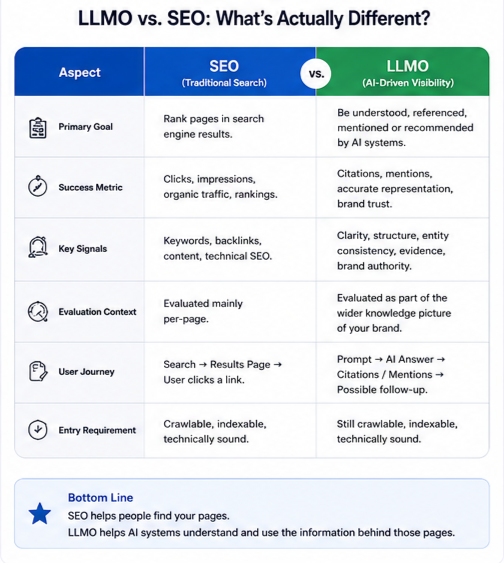
LLMO does not cancel or replace SEO – instead, it builds upon existing SEO practices.
| Traditional SEO | LLMO |
|---|---|
| Optimizes for search engine rankings | Optimizes for how a language model interprets and reuses content |
| Success = clicks and ranking position | Success = citations, mentions, and accurate representation |
| Keywords and backlinks are primary signals | Clarity, structure, and entity consistency are primary signals |
| Content is evaluated per-page | Content is evaluated as part of a wider knowledge picture of your brand |
| Crawling and indexing are the entry ticket | Crawling and indexing are still the entry ticket |
A page still has to be crawlable, indexable, and technically sound before an LLM-powered system can ever use it as a source. LLMO doesn’t skip SEO — it starts from it and adds a second, AI-specific layer on top.
According to IONOS, citation-focused SEO typically prioritizes keywords, backlinks and other ranking factors, while LLMO puts more emphasis on clarity of information, structured data, and machine-readable formats that facilitate the task of language models that parse and repurpose information.
How Does LLMO Work? The Actual Pipeline
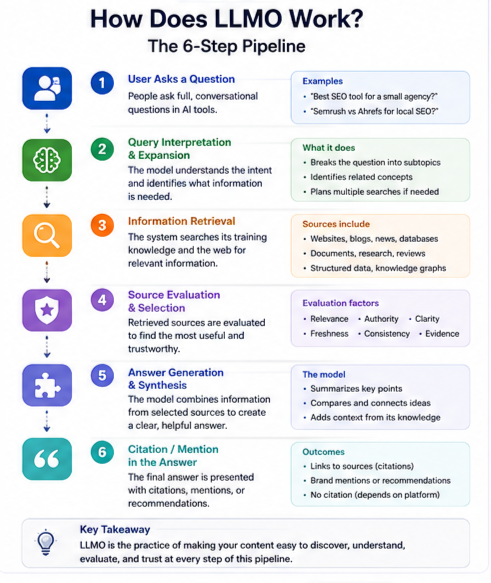
Do not mistake the idea that “LLMs simply read your content and quote it” for the entire LLMO pipeline. In reality, an LLMO has several steps that must be completed for a brand to appear in AI responses:
- The User Asks A Question
The types of questions that are posed to large language models can be varied and diverse. Here are a few examples of questions that can appear in ChatGPT, Gemini, or an AI Overview:
- “What is the best project management software for a 10-person agency?”
- “Which is better for local SEO clients, Semrush or Ahrefs?”
- “What exactly is LLMO and do I need it in 2026?”
- “How much does WordPress hosting typically cost for a small business?”
In many cases, questions addressed to AI models are more complex and diverse than traditional keyword queries, containing multiple sub-questions.
- The System Figures Out What The User Means And Wants
The LLM processes the query and begins figuring out what information the user is looking for. It also conducts additional searches to find related information; this process is known as query fan-out.
- The System Begins Searching For The Necessary Information
Depending on the platform, the search can be conducted across real-time web results, the model’s own database, or both. The information sought by the model depends on the query but generally includes:
Various pieces of information relevant to the query. In particular, the model looks for the most relevant, recent, and trustworthy resources.
Entities relevant to the query, including brands, products, and people.
Entity mentions, including mentions of brands and people across the web.
- The System Evaluates And Synthesizes The Information It Found
This is, in many ways, the most misunderstood step in the entire process. The model does not simply quote one page; it synthesizes the information it found to provide comprehensive answers to the user’s questions. In many cases, an LLM will combine information from multiple sources.
This is why simply ranking #1 in Google is no longer enough to ensure that one’s content gets cited by AI models. Even if a web page ranks first for a query, it can fail to be synthesized by an LLM if there are better, more comprehensive sources available. To summarize, an LLM will use several sources to provide comprehensive answers to complex questions.
- The System Writes The Final Answer
The final response from the LLM can take many forms. In some cases, the model simply quotes multiple sources. In other cases, it produces a detailed list of recommendations.
- Certain Sources Are Cited, Mentioned Or Used To Support The Response
This is the most underestimated aspect of LLMO, which is why we are going to dedicate an entire section to it. When a source is discovered by an LLM, it can be:
- Discovered but ignored
- Visited but not used
- Cited with a link provided
- Actually synthesized and used as a basis for the response
The difference between discovery and actual synthesis determines what the value of mentioning a brand in an AI response is. Many experts feel that simply being mentioned in an AI response is no longer sufficient – researchers are beginning to separate mentions and citations as metrics that have different impacts on visibility. In short, the actual context in which a brand is mentioned determines its value to SEO.
LLMO vs. GEO vs. AEO: What’s The Difference?
There are three optimization practices that are closely linked to LLMO but have different purposes. They are:
- SEO (Search Engine Optimization)
- AEO (Answer Engine Optimization)
- GEO (Generative Engine Optimization)
- LLMO (Large Language Model Optimization)
SEO is the practice of optimizing a website so that it can rank higher in organic search results, which ultimately drives more traffic. It is the traditional discipline that has been around for decades. AEO focuses on optimizing content for answer engines so that it can appear in featured snippets or answer boxes.
Answer engines facilitate direct questions and answers, such as “how much does a mortgage cost in California?” AEO is essentially a subset of SEO.
GEO is the practice of optimizing one’s content for generative search experiences. In short, it is the practice of optimizing for AI Overviews, AI Search, Perplexity, ChatGPT search, etc. Finally, LLMO is optimizing for the language models that run search experiences.
According to PowerChord, AEO and GEO focus on optimizing content for the search results that users see, while LLMO focuses on what happens behind the scenes in language models.
A useful model from ClickPoint: if GEO is the strategic umbrella, LLMO is its editorial component — GEO is the “get visible in AI search” strategy, LLMO is “write and structure things so the model itself understands you correctly.”
| SEO | AEO | GEO | LLMO | |
|---|---|---|---|---|
| Primary target | Search engines | Direct-answer formats | Generative search experiences | The language model’s understanding |
| Main outcome | Ranking, clicks | Featured answer | Citation, inclusion | Accurate reference, brand recall |
| Works without live search? | No | No | No | Often yes — model training/knowledge |
| Keyword research | Important | Important | Important | Useful, not central |
| Entity clarity | Helpful | Helpful | Important | Critical |
The key point: these aren’t four competing disciplines. They overlap heavily, and a serious 2026 content strategy needs all four working together, not one replacing the others.
Why LLMO Matters in 2026
Search Is Becoming a Conversation,
Not a Query
People are entering whole questions, not just keywords. Expectations include context, comparison, and follow-up.
AI Can Be the First (and Only) Layer of Discovery
The old path was search → click → research. The new path is question → AI answer → maybe click.
According to Search Engine Land, AI search visitors convert better than traditional organic search visitors, and LLM traffic is forecast to rival traditional search traffic in value within a couple years.
Whether you get clicked to from an AI answer or not, showing up accurately within the answer itself is becoming a discovery channel in its own right, not an opt-in add-on.
Being Mentioned Isn’t the Same as Being Trusted as the Source
The brand you’re mentioned in an AI answer need not be the same as the one the model provides an answer about, so treat those as separate metrics.
How Do LLMs Decide What Content to Use?
Relevance to the Exact Question Posed
Does the page answer the question presented, not one that the question might be conflated with?
Extractability of Information
Can a model easily extract definitions, comparisons, steps, conclusions, etc., or would it have to guess or infer based on context?
Entity Accuracy
This is LLMO’s equivalent to E-A-T. How accurately is your brand entity represented? According to third-party data from PowerChord, a business that’s accurately described across a range of first-party and third-party content sources (not just its own website) is a stronger entity in the eyes of an AI than one that only appears in one or a few sources.
Example: The more consistently Previewkart is described as a comparison, review, and information platform across our website, third-party mentions, directories, and our About page, the better a match we are for questions about tools, and the more likely an AI is to cite us.
If our website describes us as a review platform, other sites describe us as a blog, and directories list us as a certain type of review site with no mention of comparison, we aren’t going to be a good match for any of these queries, since our entity is conflicting.
Originality and Information Value
The model must find a particular page more informative and reliable than competitors’, so avoid duplication and provide original testing, data, and conclusions.
Authority and Trust
For questions about finance, health, and other high-impact areas, models err on the side of more authoritative sources.
Freshness
Outdated information loses value exponentially.
What Makes Content LLMO-Friendly?
Answer the Question Immediately
While it’s good to introduce your brand and explain why you’re qualified to answer, it’s critical to answer the question right away instead of, say, writing a 5-paragraph essay about your company. Better to lead with the answer to the question, then explain, justify, and give additional context and information.
Use Questions as Headings
Use question-based headings to clearly indicate to the model what the page is about, rather than vague or generic terms like “Pricing”.
Make Information Easy to Extract
Use concise paragraphs, subheadings, tables, bullet points, and definition-style phrasing to make it easy for a model to extract facts from your page. It’s not just about ranking – it’s about saving the model time and effort.
Add Original Data, Testing, First-Party Info, or Commentary
Phrases like “we tested”, “our data shows”, or “in our analysis of 12 Xs” indicate to the model that the information it’s reading is first-party information, rather than a distillation of other sources.
Never say something is tested, compared, analyzed, etc., that you didn’t actually test, compare, analyze, etc. – it makes you vulnerable to accusations of dishonesty if a model cites you for that information and a user follows the link to your page to check it out.
Keep Critical Information in Text
If a model can’t read it, it might as well not be there. Avoid putting crucial information behind a paywall, in a widget, in a video, etc., that a model can’t “see”.
Strengthen Entities Outside of Your Own Site
LLMO isn’t just about optimizing your own site, though that’s a big part of it. Entities across the web, including directories, review sites, and other websites, should consistently describe your brand the same way and say similar things about it.
How to Optimize a Website for LLMO: Step-by-Step Workflow
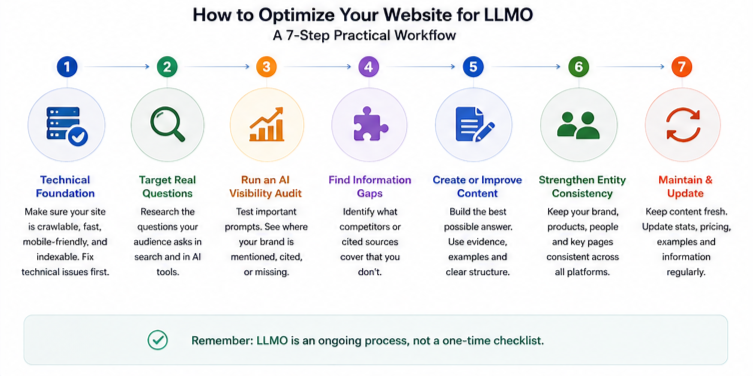
First Step: First, Make Sure All Technical SEO Foundations Are Covered.
LLMO can’t fix issues with crawling, indexability, canonicalization, etc., so that work has to happen first.
Second Step: Identify Which Real Questions You Want to Answer With LLMO.
Do keyword research to identify what questions you want to target.
Third Step: See How Your Competitors Are Being Answered by AI.
Ask the same questions across multiple AI platforms to see how competitors are performing. What brands get mentioned for each question? What sources do they cite? What information is missing entirely? This helps identify gaps you can fill.
Fourth Step: Fill Information Gaps With First-Party Data, Testing, Commentary, or Other Content.
What does your content offer that competitors’ content doesn’t? What does the information gap you identified in Step 3 say you should have that you don’t? Fill those holes with original research, testing, data, commentary, etc., that the model can extract and use.
Fifth Step: Structure Pages to Help Humans and Models Easily Extract Information.
This is where direct answers, subheadings, paragraphs, etc., come in. Content that’s written to help humans can also help models extract information just by virtue of how it’s written.
Sixth Step: Make Sure All Entity Information Is Accurate and Consistent
Across Your Site, Your About Page, and Any Directories You’re Listed In.
Avoid contradicting yourself across different pages on your site or in external listings. If you want to be seen as a review platform, make sure you’re consistently described as such in all your entity-related content.
Seventh Step: Publish and Maintain Your Pages Going Forward. LLMO isn’t a one-time task.
It has to be maintained over time just like any other type of SEO. Updating old content to keep it fresh and relevant helps maintain and improve LLMO as well.
LLMO Techniques: What Actually Helps, and What Doesn’t
What Actually Helps(LLMO Techniques)
Original research, testing, commentary, and data
Direct answers to specific questions
- Consistent, unified descriptions of brand entities across the web
- Technical SEO foundations
- Easy extraction of information like facts, figures, and explanations
Claims Worth Being Skeptical Of(LLMO Myths)
- “Adding this special schema will make me appear in search results”
- There is no universally recognized special schema that all AI platforms recognize and prioritize.
- “Just repeat my keyword phrase 20 times and the AI will love it”
- Relevance and entity information are much more important than keyword density.
- “Just get one backlink and the AI will cite me”
There is no one-size-fits-all tactic for earning citations from AI platforms.
“The AI will always prefer bulleted lists”
While bullet points make information easier to extract, they are not inherently preferred over other formats.
No one tactic can guarantee a citation from a specific AI platform, so beware of anyone claiming otherwise
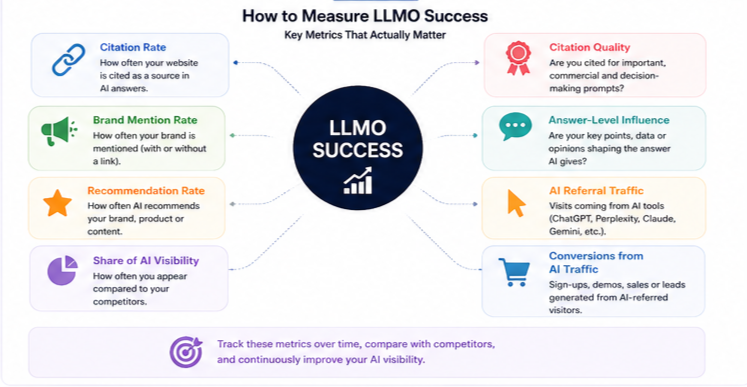
How to Measure LLMO
Do Not Reduce It to “How Many Mentions Do We Have”
Visibility (How Often We Are Seen Across Certain Questions)
Calculate a baseline rate, then, after implementing changes, calculate the rate again to see how it impacted your LLMO. For visibility, measure how often your brand is mentioned across a set of prompts tested (ideally 50-100) and across what platforms.
Citation Rate (What Percentage of Our Mentions Are Actual Citations of Our Content)
It’s also helpful to calculate a citation rate, or, for mentions, what percentage of those mentions actually cite your content in their answers. For a more accurate measurement, use the same set of prompts every time you test a change to your LLMO strategy instead of using completely random prompts.
Mention Rate Compared to Similar Brands(to Understand Market Position)
Are you performing better or worse than similar brands for the same set of prompts?
Answer-Level Influence (Does Our Content Actually Alter the Words Used in an AI Answer, or Just Get Listed as a Source?)
These should be treated as separate metrics – if a brand gets cited in an answer, that’s one thing, but if it actually influences the text of the answer itself, that’s an entirely different level of impact.
Traffic and Conversions(to Understand Business Impact)
Where trackable, measure traffic and conversions from the sources that drive users to your website as a result of an AI answer, in addition to traditional SEO traffic channels.
How to Measure LLMO Performance in Practice
Build Your Prompt Set. Begin With 50–100 of the Most Commercially Relevant Questions Your Buyers Are Asking
Test Across Multiple AI Platforms to See How You Performin Them All(to Understand Total Market Reach)
Log Informationin a Simple Table, Such as Prompt, Platform Tested On, Whether Your Brand Was Mentioned, Whether It Was Cited, Whether Competitors Were Mentioned, and What Source the AI Listed(This Lets You Break Down the Data in Different Ways)
Continue Testing Regularlyn Since Answers Can Vary Significantly From Run to Runand Provide Insight Into How Your Content Performed at a Particular Point in Time
Establish a Baseline Before Optimizing Anything,and Then Re-Test After You Make Changes to See How LLMO Efforts Have Impacted Performance
Common LLMO Mistakes
- Thinking of LLMO as a Replacement for SEORather Than a Complement to It
- Creating Thin, Generic Content With Little Unique Value,Rather Than Building a Content Asset That Provides Information, Research, or Analysis That Other Sites Don’t Offer(Remember That LLMO Can Be Seen as an Extension of SEO, Not a Separate System, So Thin “SEO Pages” Will See Similar Results to Thin LLMO Pages in Terms of Ranking Power)
- Writing Content for the AI Rather Than for the Human ReaderWho Will See the Answer and Take Action Based on It
- Making Up First-Party Information, Data, Testing, Commentary, or Experience That You Didn’t Actually Do
- Using One Prompt to Define Your Entire LLMO Strategyand Thinking That One Test Represents Reality When It’s Really Just Noise
- Thinking That All AI Platforms Behave the Same WayThey Most Definitely Do Not
- Thinking That One Specific Tactic Will Guarantee a Citation From a Particular AI Platform,No Tactic Can Truly Guarantee That
LLMO for Different Types of Businesses
SaaS Businesses: Product comparison, pricing transparency, integration guidance, original benchmarking data
Agencies: Methodology documentation, real case studies, industry specialization, not generic “we offer services” pages
E-commerce: Product specs, comparisons, consistent merchant information across review sites
Local Businesses: Consistent service, product, location, and hours information across all directories and sites
Publishers/Review Sites(Like Us): First-party testing, comparisons, and methodology documentation, since these are exactly what AI platforms are shown to prefer
Does LLMO Replace SEO?
No, and anyone who tells you otherwise is oversimplifying the situation
SEO is the foundation, and LLMO is an important additional layer that helps get discovered and understood by searchers who use AI-powered search and discovery tools.
Final Takeaway: LLMO Is About Becoming a Trustworthy Source, Not Gaming the Algorithm
LLMO Is Not About Teaching ChatGPT, Gemini, or Claude to Name Your Brand
LLMO is not about tricking ChatGPT, Gemini, or Claude into naming your brand. It is about creating such an entity that a language model would want to quote as a reliable source of information.
This entity should have accurate, original, well-structured, and properly cited content and have a strong brand presence on the web.
SEO will help you get your content in front of searchers, but original research is what will make you trustworthy. LLMO is about building such a presence that a language model would want to quote as a reliable source of information. In 2026, this is the kind of brand that will be able to get quoted in the search results.
Frequently Asked Questions
Does LLMO influence what a model learns during training, or only what it retrieves at query time?
Both, but differently. Retrieval-based systems (AI Overviews, ChatGPT with browsing, Perplexity) pull from a live or recent web index at the moment of the query — this is where structure, freshness, and technical SEO matter most. A model’s baseline “knowledge” of your brand, however, comes from training data and is far slower to shift; it depends on how consistently and widely your brand is described across the web over time, not on a single optimized page.
Can a page rank #1 in Google and still get zero citations in an AI Overview or ChatGPT answer?
Yes, routinely. Ranking reflects one algorithm’s relevance signals; citation reflects whether the generative system judged that specific page as the clearest, most directly useful source for synthesizing its answer. The two systems evaluate content differently, so strong SEO rank is necessary but not sufficient for LLMO visibility.
How does entity disambiguation affect LLMO, especially for brands with generic or common names?
If a brand name overlaps with unrelated terms, people, or other companies, a language model has to resolve which entity is being referenced before it can cite anything with confidence. Brands in this position need stronger, more explicit entity signals — consistent descriptions, structured data, and third-party references that clearly tie the name to the correct category and context — or they risk being filtered out simply due to ambiguity, not quality.
Is there a meaningful difference between being cited with a link versus being mentioned without one?
Yes, and they should be tracked separately. A citation with a link is measurable, attributable, and can drive referral traffic. A mention without a link still shapes how the AI describes your brand to the user but produces no traceable traffic. Both matter for brand perception; only one shows up in analytics.
Do different AI platforms weight the same LLMO factors differently, and how should that change strategy?
Yes. Platforms vary in how much they rely on live retrieval versus internal training knowledge, how many sources they synthesize per answer, and how conservative they are about citing lesser-known domains. A single-platform optimization strategy is incomplete — testing your visibility across multiple systems, not just one, is necessary to know where the gaps actually are.
How does LLMO interact with paid or sponsored content — does a paid placement carry the same weight as an organic mention?
Generally no. Systems built to synthesize trustworthy answers tend to treat sponsored or clearly promotional content with more skepticism than independent, editorially neutral coverage. A paid mention on a low-authority site is unlikely to carry the same entity-reinforcement value as an organic mention on a recognized industry publication.
Can negative or inaccurate information about a brand get absorbed into a model’s outputs, and how would you correct that?
Yes — if inaccurate claims about a brand are repeated across enough sources, a model can reflect that inaccuracy in its answers, the same way it reflects accurate information. Correcting it isn’t a single-page fix; it requires publishing accurate, well-sourced information consistently enough, across enough credible surfaces, to outweigh the inaccurate signal over time.
Does structured data (schema markup) actually influence LLM citation behavior, or is its role overstated?
Its role is often overstated in isolation. Structured data helps machines parse facts unambiguously — prices, ratings, FAQs — which supports extractability. But no major AI platform has confirmed that schema alone determines inclusion in generated answers; it’s a supporting signal, not a ranking lever on its own.
How should a business measure ROI from LLMO when most AI platforms don’t expose full referral data?
Combine what’s measurable with what’s directional. Trackable elements include referral traffic tagged from known AI-platform domains, branded search lift in Google Search Console, and manual prompt-testing logs recorded over time. Because full referral transparency doesn’t exist across every platform, ROI measurement today is necessarily a mix of hard analytics and consistent manual tracking — not a single dashboard number.
Is there a risk of over-optimizing content specifically for AI extraction at the expense of human readability?
Yes — this is one of the more common execution mistakes. Content stripped down purely for machine-parsing (fragmented bullet points, unnatural repetition, thin explanations) often reads worse to actual visitors, which hurts engagement, trust, and conversion. The content that performs best for LLMO is written for a human first and happens to be structured clearly enough that a model can extract it too — not the reverse.
