
Mangools Review 2026: Is KWFinder the Easiest Keyword Tool?
Quick Answer
Still today, KWFinder sits among the simplest ways to explore keywords through 2026. Though many tools complicate the process, this one keeps steps clear. Its layout feels familiar almost right away. Features guide you without demanding a tutorial. Even newcomers spot trends fast. Over time, small details help more than flashy extras ever could.

Bloggers, affiliate marketers, small businesses, content creators, and those new to SEO find a quick route from raw keyword thoughts to real chances here. Because the layout feels clear, keyword challenges are rated simply, yet deep long-tail options still emerge easily – learning this beats wrestling with tools like Ahrefs or Semrush.
Just because something feels simple doesn’t guarantee it’s right.
When it comes to enterprise SEO, something better might already exist. For deep technical audits, options out there go further. Large-scale backlink insights? Other tools handle that differently. When AI shapes content strategy, different paths open up. Reporting at agency level doesn’t have to mean sticking with this one.
What really matters isn’t how simple KWFinder might seem.
Is it really possible that keeping things basic will reach what you aim for in search rankings.
This Mangools review from 2026 gives you what it’s really about.
Marketers Rethinking SEO Tools in 2026
SEO has changed dramatically.
Years back, getting noticed online mostly meant picking terms people searched often then crafting pages tuned just right. Not long ago, visibility hinged on spotting phrases with steady queries plus shaping content around them carefully. Earlier still, climbing up relied heavily on selecting words that pulled traffic while designing site sections to match closely.
Today, marketers must think about:
- Google AI Overviews
- ChatGPT recommendations
- Perplexity citations
- Gemini answers
- Entity-based search
- Topical authority
- AI visibility
Surprising more than a few companies lately – there’s an odd trend popping up.
These days, getting hold of information isn’t what slows down SEO work.
It is finding clarity.
Loads of data come from tools such as Ahrefs or Semrush. Useful stuff, sure. Yet too much detail might freeze your next move instead. Still, it’s there if needed.
This is precisely what keeps pulling people toward Mangools.
Instead of flooding people with endless reports, this zeroes in on showing marketers where they can actually climb in rankings. A clearer path emerges when noise gets cut out. What stands out is how little effort it takes to spot chances that matter. Not every opening needs attention – just the ones within reach guide next steps.
Some companies find strength in keeping things basic. Their edge often comes from what they leave out, not what they add. Simplicity shapes how they stand apart. What seems minor can quietly shift outcomes. A lean approach sometimes speaks louder than complexity.
What Is Mangools?
Mangools is an SEO software suite designed to simplify search engine optimization.
Among these features sits a set of five essential tools built into the Mangools system. By 2026, Mangools began paying closer attention to how AI affects search visibility — matching a wider move across the field.
Five Essential Tools
- KWFinder — Keyword research and opportunity discovery
- SERPChecker — Spot gaps by analyzing search results
- SERPWatcher — Keyword rank tracking
- LinkMiner — Backlink research
- SiteProfiler — Website authority and competitor metrics
AI Evolution in Mangools
As artificial intelligence reshapes search tools, Mangools evolved its tracking methods in step. Visibility monitoring now adapts to generative search, ensuring brands don’t miss shifts beyond traditional ranking metrics.
Simplicity First
Far from the usual corporate SEO tools, Mangools puts ease of use first. While others stack features, it strips things down. Not cluttered with layers, just straightforward access.
Where most demand a steep learning curve, Mangools moves out of the way. Complexity takes a back seat here — simplicity leads instead. Still today, that spot holds major power.
KWFinder Review 2026 Inside the Mangools System
For most folks, there’s just a single motive behind grabbing Mangools.
KWFinder.
Still sitting at the top, it’s likely the most powerful piece across everything offered. What holds it together isn’t just name recognition – it’s performance that outpaces the rest.
What KWFinder aims to do sits clear at its core
Start by showing people terms they might actually show up for in search results.
That sounds simple.
Most SEO tools complicate things more than they need to.
Instead of following the crowd, KWFinder goes its own way.
A word gets typed into the box. Then it waits, sitting there like a seed before soil.
The tool immediately provides:
- Search volume
- Keyword difficulty
- CPC data
- Trend information
- SERP analysis
- Competitor metrics
- Related keywords
- Autocomplete suggestions
- Question-based keywords
A person new to SEO can still move through it smoothly. This happens because the steps fit together like pieces of a puzzle found in an old drawer.
Is KWFinder Actually the Simplest Keyword Tool?
Yes, that’s the conclusion I reach once looking at the platform and measuring it next to key rivals.
Hardly a walk in the park.
The easiest.
Just because something seems strong doesn’t make it the strongest.
That’s how it bridges study with doing, cutting across delays. A shortcut forms when insight meets move. Gets things going fast – no lag between knowing and stepping. Distance shrinks once thought turns into step. Moves straight from findings to motion.
Jumping between screens piles up when tools scatter data across too many tabs. Reports stack high but answers stay hidden behind layers of menus. Filtering takes forever just to spot one clear takeaway.
Friction fades when KWFinder steps in.
What grabs attention here is how it highlights only the key numbers worth watching
- Search volume
- Keyword difficulty
- Search trends
- SERP competitiveness
Minutes pass before most people get what these numbers mean.
Most folks in SEO don’t see how big a deal this really is.
Value shows up once someone picks it up and tries. When nobody touches it, a thing just sits there doing nothing.
KWFinder Features That Remain Notable in 2026
Long-Tail Keyword Discovery
Still stands out as a key strength in KWFinder’s toolkit.
Most high-performing search traffic still comes from longer, specific phrases. Though often overlooked, these detailed queries bring visitors already looking for exact matches. Their precision makes them quietly powerful in drawing focused audiences. Rarely flashy, yet consistently effective at turning visits into results.
Examples:
- best CRM for small accounting firms
- AI SEO tools made for SaaS startups
- local SEO services for dentists
Most of these lookups include things like
- Lower competition
- Higher purchase intent
- Better conversion rates
Finding those chances fast is where KWFinder really shines.
Keyword Difficulty Analysis
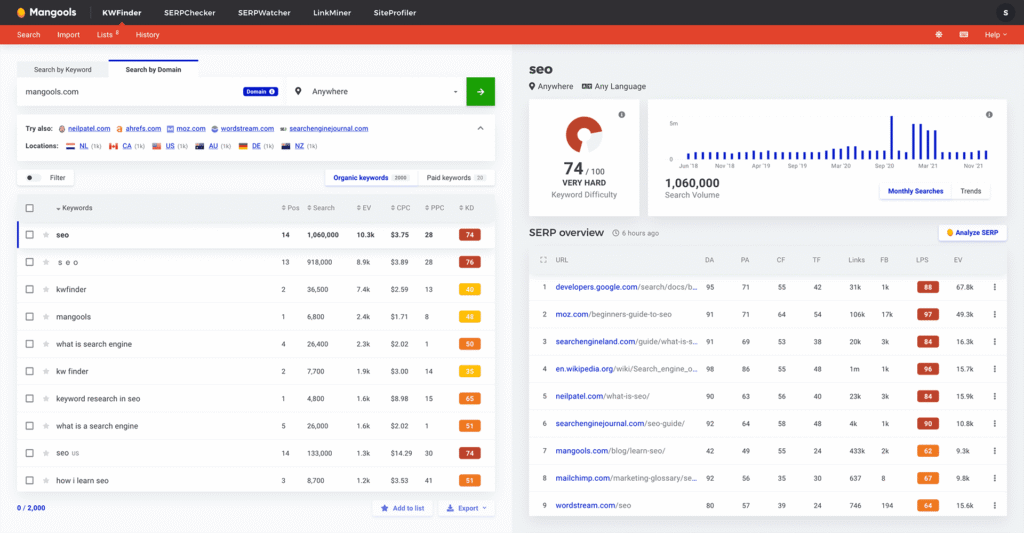
Still matters more than most tools admit, keyword difficulty shapes how sites climb search results.
With color-coded signals, Mangools shows how tough keywords are to rank for. A clear layout makes the info simple to grasp at a glance. Instead of numbers alone, it uses shapes and shades to guide your eye. Complexity becomes obvious without needing explanations.
Each detail fits neatly into an intuitive design. What might seem messy turns clean through smart spacing. Visual cues replace jargon so anyone can follow along.
This one matters most when you are just starting out.
Right away, folks get clear direction instead of trying to figure out if a keyword makes sense.
SERP Analysis
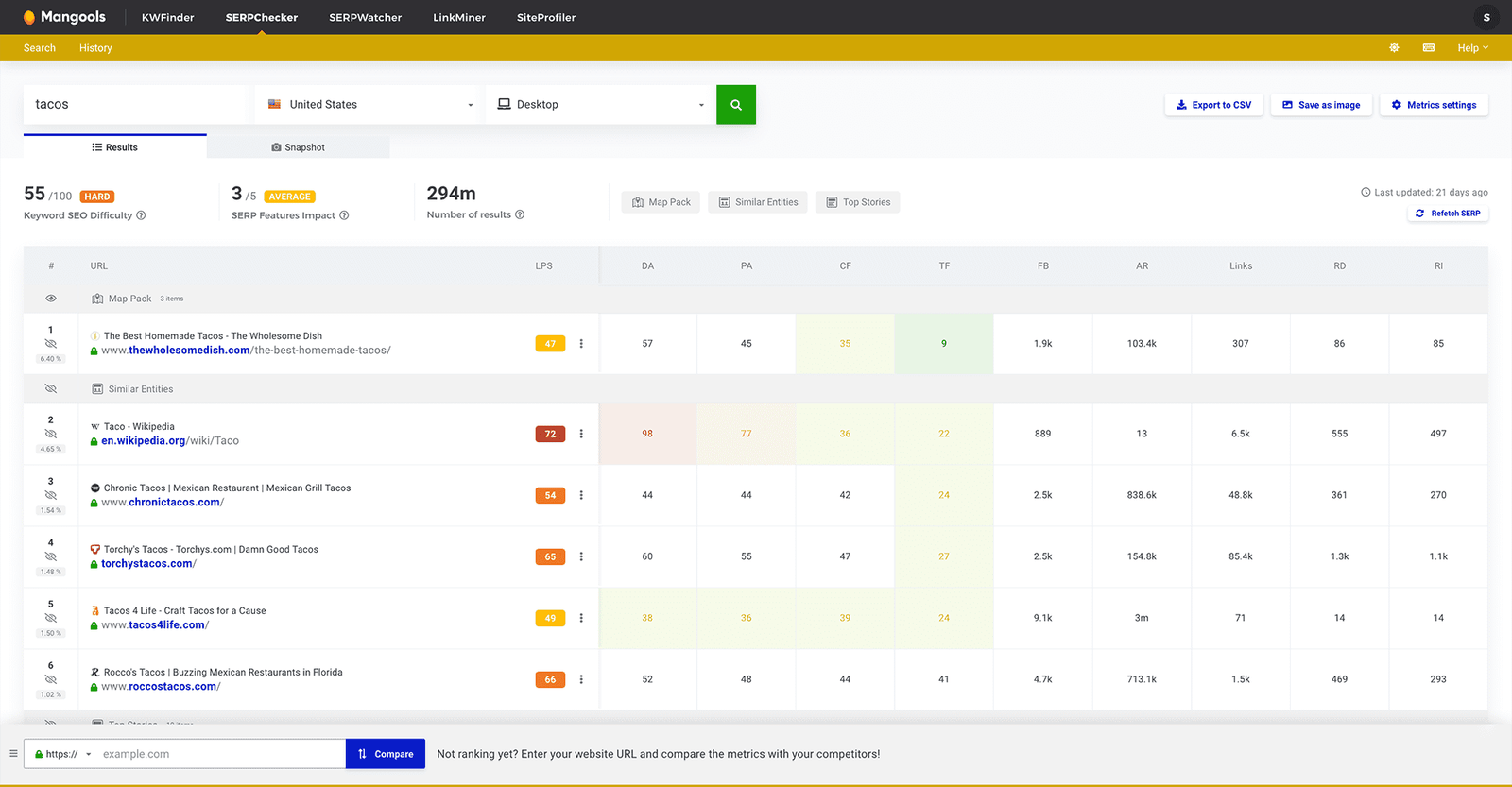
Most SEO software gives you keywords then ends there.
KWFinder goes further.
Users can instantly analyze:
- Domain authority
- Backlinks
- Citation flow
- Trust flow
- Ranking URLs
Marketers can check if there are real chances to rank higher.
Local Keyword Research
Out there among tools that dig into search data, KWFinder stands out when companies focus on one place at a time. For those aiming right at certain towns or nations, its local keyword insights hit harder than most.
This works well when you need it for:
- Local businesses
- Agencies
- Service providers
- Multi-location brands
How accurate is KWFinder keyword difficulty score?
Here, most opinions never dig deep.
Let’s go deeper.
Keyword difficulty scores are estimates.
A single truth remains: guessing how hard it is to rank stays messy. Perfect forecasts? They don’t exist in any tool made so far.
What powers Google’s search? Hundreds of ranking clues shape the results you see.
Some tools made by others can’t reach every one. Not even close.
Still, KWFinder works better than expected.
Many Users Find KWFinder Difficulty Scores Reliable
Most times the numbers stay on the lower side.
That matters.
Tools sometimes miss how tough the race really is, pushing people toward words they can’t win. Not every shortcut works when others are already far ahead.
Most times KWFinder plays it safe.
As a result:
- Mistakes happen less often when you’re just starting out
- Content strategies become more realistic
- Ranking expectations improve
Questioning the Reliability of Difficulty Scores
Keyword difficulty scores can be useful, but they cannot fully measure the bigger picture. Numbers alone miss the deeper signals that shape search outcomes.
What Keyword Difficulty Cannot Measure
- Search intent alignment
- Content quality
- Brand authority
- Topical authority
- User experience
- AI Overview impact
Even when a keyword shows low difficulty, tough competition might hide behind strong existing pages. Great content at the top can make ranking hard, regardless of the number.
A small score doesn’t always mean an easy win. Sometimes, what looks simple becomes steep because others did it so well already.
Practical Guidance
Use keyword difficulty as a guide. Leave the last call up to human judgment — context, expertise, and experience matter more than any single score.
Find Long Tail Keywords Using KWFinder
Some reviews talk about how things work.
Most skip showing real steps people take. Some do cover how things really move.
Here is a practical process.
Begin With a Core Word
Example:
email marketing software
Generate keyword suggestions
Right away, KWFinder tosses up countless connected phrases. A flood of suggestions appears without delay.
Switch to Question Keywords
Check out terms such as:
- what is the best email marketing software
- which email platform is easiest to use
- how much does email marketing software cost
Hidden chances show up here more than you might think. Sometimes the strongest leads come through these openings.
Filter by difficulty
A practical approach:
- Below thirty five sits the keyword challenge level
- More than fifty times people look it up
- Relevant business intent
Analyze Search Results
Open SERPChecker.
Look for:
- Forums
- Reddit discussions
- Quora pages
- Small niche websites
Weak competitors often indicate opportunity.
Build Topic Clusters
One topic might lead somewhere else entirely when you follow its questions. Branching out helps cover what people actually ask. A single term rarely tells the whole story. Exploring nearby ideas fills gaps naturally. Curiosity often moves sideways, not straight ahead.
Because of this, search engines notice the site more easily. Topics feel clearer to both readers and machines.
Mangools vs Semrush vs Ahrefs vs SE Ranking
Mangools vs Semrush vs Ahrefs vs SE Ranking
Side-by-side feature comparison across the biggest SEO platforms
| Feature | Mangools | Semrush | Ahrefs | SE Ranking |
|---|---|---|---|---|
| Ease of Use | Excellent | Moderate | Moderate | Good |
| Keyword Research | Very Good | Excellent | Excellent | Very Good |
| Long-Tail Discovery | Excellent | Very Good | Very Good | Very Good |
| Backlink Database | Basic | Excellent | Excellent | Good |
| Technical SEO | Limited | Excellent | Very Good | Very Good |
| AI Features | Growing | Strong | Growing | Strong |
| Reporting | Basic | Advanced | Advanced | Advanced |
| Agency Features | Limited | Excellent | Excellent | Very Good |
| Beginner Friendly | Excellent | Moderate | Moderate | Good |
| Affordability | Excellent | Low | Low | Good |
Color guide: Dark Green = Excellent · Green = Very Good/Strong · Purple = Good/Growing · Amber = Moderate/Basic · Red = Limited/Low
Who Should Use Mangools?
Who Is Mangools Best For?
Mangools handles this need just right.
Who Should Skip Mangools?
Who Should Avoid Mangools?
Common mistakes people make using kwfinder
Focusing Only on Search Volume
Traffic potential matters.
Intent matters more.
Ignoring SERP Analysis
Only when you check the rivals does a keyword reveal its true face.
Always review actual search results.
Targeting Hard Keywords Before Readiness
Some companies chase high-traffic keywords even without strong credibility yet. Starting too fast often leads to weak results down the line.
Because of this, outcomes take longer to appear.
One Keyword Used on Each Page
Modern SEO rewards topic coverage.
Build content clusters.
The Effect of AI Search on Finding Keywords
SEO in 2026 looks very different.
Search is increasingly influenced by:
- Google AI Overviews
- ChatGPT recommendations
- Gemini responses
- Perplexity citations
Now things shift in how you handle keyword research. The method gets a new direction entirely.
Now it’s not only about how often people search a word. What matters shifts beyond sheer numbers these days.
The best keywords often have:
- Clear intent
- Strong topical relevance
- Question-based structure
- Entity relationships
Finding keywords today? Tools help spot them. What works now? Software points the way. Still stuck on search terms? These helpers break through.
Yet what you plan weighs heavier.
For companies aiming to show up everywhere – from regular searches to newer AI tools – shifting attention toward AI-friendly content makes sense. Not just one or the other, but both matter now.
Start strong when tech meets visibility – Digehub shapes how SEO, content, or AI access work together on one clear path. While effort pours into AI search, their services quietly connect each piece without fuss. One move at a time, they build what shows up where it matters.
Soft Strategic Insight
Some companies spend big on SEO tools yet still can’t make content that shows up online.
Most times, it’s not the program slowing things down.
The strategy is.
Keyword research only creates value when paired with:
- Strong content
- Proper site architecture
- Technical optimization
- Topical authority
Out here, having a clear plan for search engine visibility matters way more than the software you use. What counts isn’t the gadget on your screen but how smartly you organize each move ahead of time. Tools fade fast – strategy sticks around when things get messy.
A steady rhythm in creating pages beats chasing shiny apps every week. It’s less about what clicks and more about who shows up later. Real traction builds slowly through choices made daily, not one-time tricks.
When companies struggle to move forward, they might pair keyword research with expert SEO help along with content promotion just to speed things up.
Keyword Research After 2026
Several trends are becoming clear.
AI visibility becomes more important
Just showing up high on Google isn’t sufficient.
Finding space inside AI replies matters more now for companies. How they show up shapes what people see next.
Topical Authority Beats Single Keywords
Winning content ecosystems will outperform isolated pages.
Intent Matters More Than Volume
Most clicks happen when people search for something very precise.
Automation keeps growing
Out there, machines shape how teams dig up insights, build messages, leave traces on results. A shift hums beneath the surface – different moves now guide old routines.
Those who adopt such methods stand to save time and effort. Efficiency finds its edge in updated routines.
KWFinder Ease of Use Final Answer?
Looking at how things work now – platform details, what others offer, where the field is headed, plus real-world SEO steps – the conclusion shows itself plainly.
Yes.
KWFinder remains the easiest keyword research tool available in 2026.
Just not about how many tools it includes.
It isn’t about size at all. What matters shows up elsewhere entirely. Database volume means little here. Other things weigh more heavily now. Numbers alone don’t win anything.
It isn’t about holding control in enterprise SEO.
Victory comes from making a core piece of SEO feel effortless.
Finding opportunities you can actually rank for.
Besides bloggers, freelance writers find Mangools a solid SEO choice. Affiliate promoters get good value too. Consultants rely on it regularly. Local shops benefit just as much. Growing software firms count on its tools daily. Even so, some wait before jumping in.
When a company wants more than just finding keywords, using software such as Mangools along with expert planning often leads to stronger outcomes. Sometimes it’s not about having tools – it’s how they work together that lifts performance.
Search rankings rise when websites speak clearly to both people and machines. Digehub shapes words, systems, and signals so companies show up where answers are sought. Visibility grows not by shouting, but by fitting naturally into questions. Machines notice consistency; audiences trust clarity. Over time, smart structuring pulls attention without force. Growth follows paths built on relevance, not noise.
For those aiming at the US, Britain, Canada, or Australia – or even broader regions – the target stays unchanged.
Find opportunities.
Create better content.
Build authority.
Wherever folks look, show up. Be seen where searches happen. Pop into view when someone seeks.
Frequently Asked Questions
Keyword research tools are unlikely to disappear, but their purpose is changing. The future of SEO is shifting from keyword targeting to intent modeling, entity relationships, topical authority, and AI visibility. Tools like KWFinder will remain relevant because businesses still need data about what people search for. However, marketers who rely solely on keyword metrics without considering AI search behavior, content quality, and authority signals will struggle to compete in the next generation of search.
Keyword research tools should serve as strategic intelligence platforms rather than keyword generators. The most successful SEO campaigns use tools like KWFinder to understand audience needs, uncover search patterns, identify topical gaps, and map customer journeys. In modern SEO, understanding intent, context, and audience behavior is often more valuable than targeting individual keywords.
KWFinder performs particularly well at uncovering long-tail opportunities that larger competitors often overlook. However, in industries such as SaaS, legal services, finance, healthcare, and insurance, truly low-competition keywords are increasingly rare. Experienced marketers often use KWFinder to identify micro-niches, underserved audience segments, and problem-focused searches rather than searching for universally easy keywords.
Indirectly, yes. KWFinder helps identify the questions, entities, and topics users search for. These insights can be used to create authoritative content that is more likely to be cited by AI systems. However, optimization for AI search requires additional strategies including entity optimization, structured content creation, schema implementation, topical authority development, and citation-worthy expertise that go beyond traditional keyword research.
Advanced keyword evaluation requires analyzing multiple factors simultaneously:
- Commercial intent
- SERP composition
- Brand dominance
- AI Overview presence
- Click-through opportunity
- Conversion potential
- Content depth requirements
- Topical authority alignment
In many cases, a lower-volume keyword with strong commercial intent can generate more revenue than a high-volume informational keyword.
KWFinder can support international keyword research through country-specific databases and localized search data. However, large-scale multinational SEO campaigns often require deeper market intelligence, competitive analysis, and technical SEO capabilities than Mangools provides. For businesses targeting multiple regions simultaneously, KWFinder works best as a keyword discovery tool rather than a complete international SEO solution.
The most common mistake is relying too heavily on quantitative metrics while ignoring qualitative SERP analysis. Many experienced marketers focus on keyword difficulty, search volume, and CPC without evaluating search intent, content quality, brand dominance, or AI Overview presence. Another frequent error is targeting individual keywords rather than creating interconnected content ecosystems that establish topical authority.
KWFinder is highly effective for discovering keyword opportunities, but topical authority requires a broader workflow. Enterprise platforms like Semrush and Ahrefs offer more advanced content gap analysis, topic clustering, and competitive intelligence capabilities. However, experienced SEO professionals can still build strong topical authority using KWFinder by combining related keyword discovery, SERP analysis, and strategic content planning around core subject areas.
Yes, but with limitations. Search volume and keyword difficulty remain valuable indicators of user demand, yet AI-powered search experiences have changed how traffic is distributed. Many informational queries now receive answers directly within AI-generated responses. Smart marketers use KWFinder not only to identify keywords but also to uncover entities, question-based searches, and topic clusters that increase visibility across Google AI Overviews, ChatGPT, Gemini, and Perplexity.
KWFinder’s keyword difficulty score is a useful directional metric, but it should never be treated as a direct ranking prediction. The score primarily evaluates the strength of pages currently ranking in the SERP based on authority-related signals. However, actual ranking difficulty also depends on search intent alignment, topical authority, content quality, user engagement signals, brand trust, and increasingly AI Overview eligibility. Experienced SEOs use KWFinder’s difficulty score as a filtering mechanism, then manually analyze SERPs before making final targeting decisions.
