
What Is Answer Engine Optimization (AEO) in 2026?
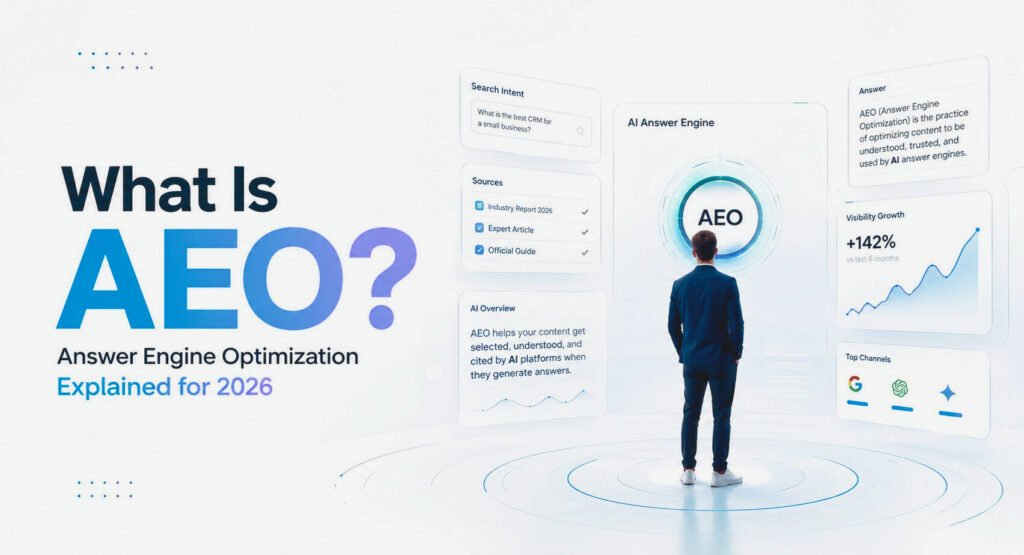
Answer Engine Optimization (AEO). That’s the new cool-sounding term every SEO geek wants to know. It refers to optimizing content so that AI engines such as ChatGPT, Perplexity, and Google AI Overviews can easily digest and quote as direct answers. Compared to traditional SEO practices, AEO is about factual information, schema markup, and brevity to appear as the top answer.
This article unpacks that definition – why and how AEO works, its relationship to SEO and GEO, what makes content AEO-friendly, and the myths around it.
Every claim is backed by a specific source, and every conclusion is tempered with caveats – because this guide will not make unsupported claims about AEO’s ability to drive traffic or citations from AI, since no credible source is willing to make that claim either.
What Is AEO, In Practice?
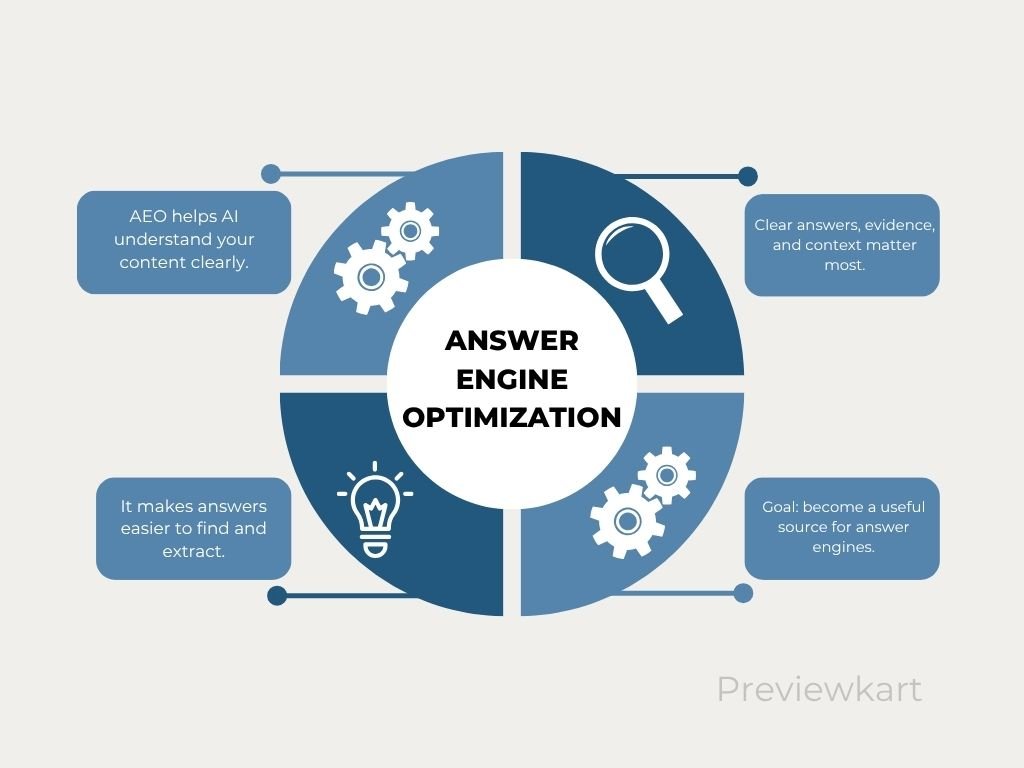
In short, it refers to optimizing your content to be easily understood and extracted for value by both humans and AI – not buried or hidden in a way that requires extra effort to parse or extract.
A Practical Example
If I search “what is the best CRM for a 5 person sales team” in ChatGPT instead of Google, traditional SEO would be about optimizing a page to appear in the list of blue links for that query.
AEO, meanwhile, is about whether the content on that page is presented in a way that makes it easy for an AI evaluating that query to extract the most relevant and well-supported answer – and cite your page – based on the information and arguments presented.
Where the Term “AEO” Came From
The term itself is not new – Rand Fishkin (SparkToro, ex-Moz) has stated that he coined the phrase “answer engine optimization” in 2017, to describe the shift in search from a linking economy to an answering economy, and how brands needed to evolve their SEO practices to participate in this new system (Search Engine Land).
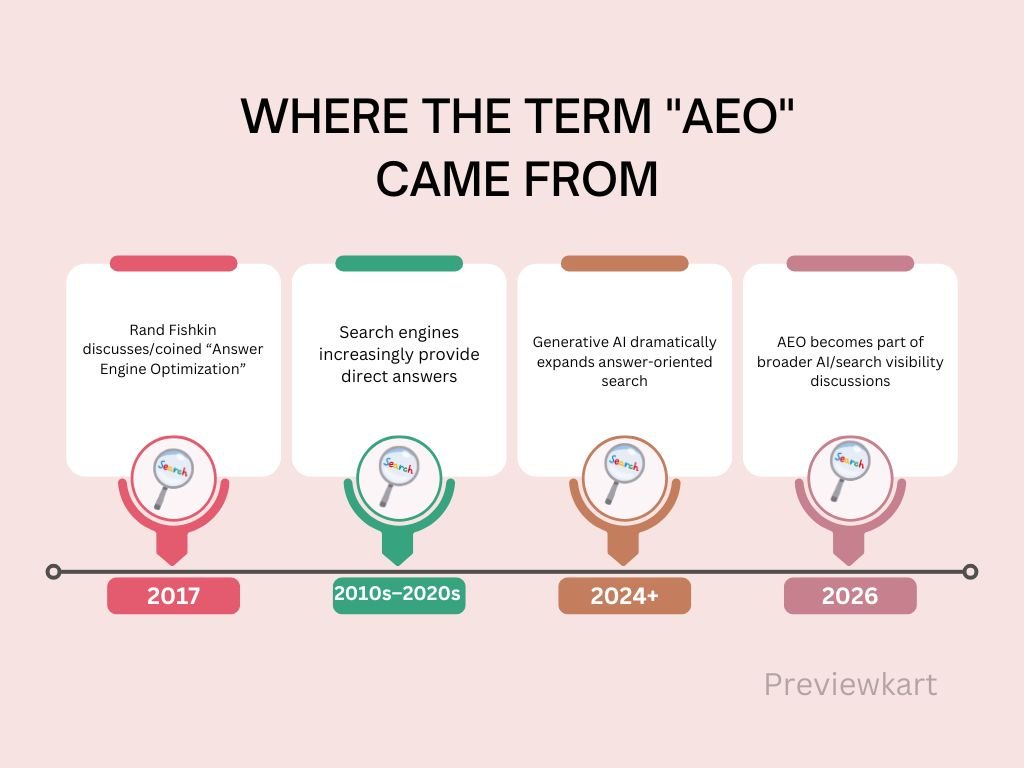
Two implications of this origin story are worth mentioning – first, that AEO is not a new concept that appeared in 2024 to sell a new product, but a practice that has existed for several years. Second, that AEO is not “just SEO”, but a response to a fundamental change in how search results are produced – one that has since accelerated with the arrival of generative AI.
What AEO Is Not
It is important to note what AEO is not, at this point – it is not a guarantee that any particular AI will cite your content, not a replacement for SEO, and not a simple technical tweak like adding a bit of schema markup. It is a mindset that informs your content creation and presentation so that it has maximum value and is most easily extracted and consumed by both humans and AI.
Why Does AEO Matter?
There are three primary reasons why AEO has become such a hot topic in recent months:
A significant proportion of searches now do not lead to a click. SparkToro’s zero-click research (led by Rand Fishkin) has consistently shown that roughly half or more of Google searches in the US do not result in a click to any organic result – with one report suggesting that 58–68% of searches in 2023 were zero-click (Devenup, ClickForest).
This trend predates the arrival of AI, but these technologies have accelerated the trend.
Answer engines are a major force now. Google’s AI Overviews, for instance, are now Google’s largest AI answer surface, available across more than 200 countries and 40 languages, while AI Mode has surpassed a billion users (Affiliate Summit). In short, most brands with any visibility online are now potentially exposed to these tools, whether they want to be or not.
The reasons people search haven’t changed – but the place where they find answers has. People still need information to make decisions – but more and more, those decisions are being informed not by clicking to a website, but by reading a summary provided by an AI.
What this means for the reader: you don’t have to throw your content strategy out the window. You have to understand that a significant chunk of your audience’s research is happening behind an intermediary – an “answer engine” that reads and digests content for them – and said intermediary has certain preferences about how content should be formatted.
What Is an Answer Engine?
A search engine created by an AI that answers questions directly. Search engines like Perplexity and ChatGPT scour the web for information and present it in a helpful summary rather than a list of sites to click through.
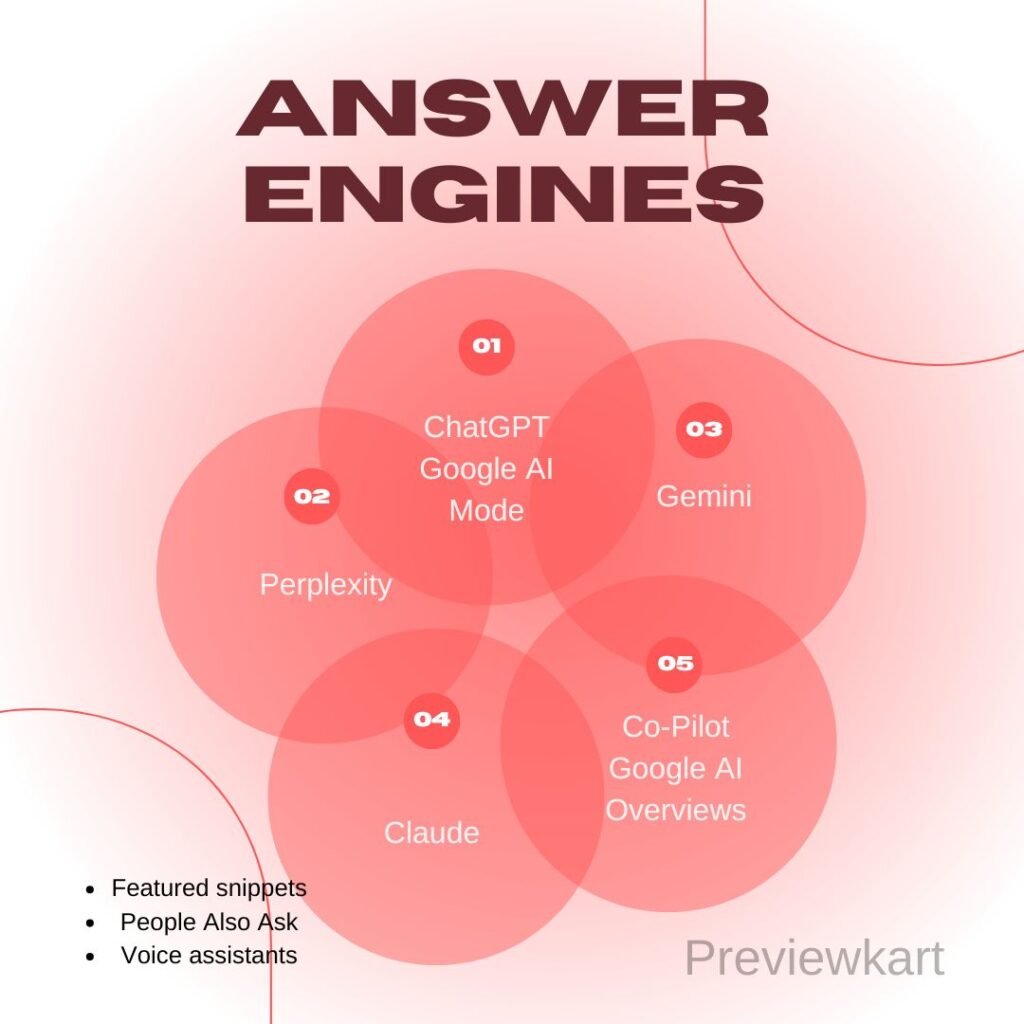
Short definition: any system that returns a synthesized result to a query instead of a set of links. This includes:
- Google’s own AI Overview / AI Mode
- ChatGPT, Gemini, Claude, Copilot, and other chatbots
- AI-native search engines like Perplexity
- Featured snippets, “People Also Ask,” voice assistants – the precursors to modern answer engines
Lily Ray sums it up best: “Search engines are becoming answer engines that provide synthesized and generated responses, rather than focusing on the list of links to follow” (Affiliate Summit)
Not All Answer Engines Are Created Equal
It’s crucial to stress that all these various engines have different behaviors. Some favor first-party research, others rely mostly on third-party content aggregation and summarization.
Some cite sources, others conceal them. Google’s AI Overviews are essentially web searches with synthesis, while Copilot is trained on a mix of public and private data (the latter being unavailable to competitors).
One tool might favor brevity while another prioritizes comprehensive resource listing. As a result, tactics that work well for one engine might have little impact on another, which is why AEO is a philosophy that informs your approach to each engine rather than a set of universal guidelines that apply to all.
How Does AEO Work?
You need some basic working knowledge of answer engine mechanics in order to optimize for them. Most systems follow a similar four-stage process:
- Query understanding / retrieval
- Evaluation / filtering
- Synthesis
- Citation formatting (if applicable)
- Query Understanding / Retrieval
- Query understanding / retrieval
Any given search request is processed by breaking it down into related concepts and performing a set of retrievals (often referred to as “query fan-out” in Google’s case). In other words, the search engine tries to understand what you’re asking, and then looks up relevant existing web content to serve as a basis for the response.
- Evaluation / Filtering
The retrieved sources are assessed for credibility, relevance, depth, and presentation quality. If a given source appears spammy or untrustworthy, it will be excluded from consideration.
- Synthesis
Using the information from the filtered sources, the answer engine constructs a response. The response may take a variety of formats: extracting specific text excerpts, comparing and contrasting different sources, providing instruction, or any combination thereof.
- Citation Formatting (If Applicable)
Some answer engines prominently cite sources used to construct a response, while others make them appear inline within the body text, and some conceal them entirely. The presence and presentation of citations affect how end users perceive the response, as well as the potential impact on your brand’s reputation.
Why “I Don’t Rank for That Phrase” Is Not a Good Excuse
Danny Sullivan (Google’s Search Liaison) and John Mueller have repeatedly addressed the issue of “I don’t rank for that phrase” in the context of conversational search queries. The short answer is that Google’s answer engines perform multiple subqueries when presented with a complex request.
In effect, Google’s system performs several searches with related phrases in order to understand the query and build a response, which means that a page not explicitly targeting a given short-tail keyword may still be eligible for inclusion in an answer box.
In fact, Danny cites a specific example where a single complex search request was effectively several separate searches joined together (“search engine land”).
What this means: AEO is not about working around search rankings – it’s about understanding that engines like Google will analyze your page’s content, identify relevant concepts, and use them to construct an answer.
To optimize for AEO, you need to facilitate this process by ensuring your content uses targeted terms in locations that can easily be parsed, extracted, and presented to the end user.
AEO vs SEO: What’s the Difference?
SEO optimizes content to rank web pages on search engine results pages, driving traffic via click-throughs. AEO optimizes content for AI models to extract, synthesize, and cite as direct answers. SEO targets keywords and backlink authority, while AEO focuses on structured data, clear entity relationships, and immediate concise resolution.
Anchoring this entire post is the frequently asked question: how is AEO different from SEO? The short answer is that it isn’t. SEO underpins everything we do in AEO, including optimizing for answer engines.
Danny Sullivan has discussed at length with clients and members of the search marketing community that AEO is part of the same continuum as traditional SEO, which is why he’s repeatedly referred to the concept as “GEO,” or Google Enhanced Optimization.
Lily Ray has echoed this point from the opposite end of the industry: she has argued that AEO can largely be seen as an extension of traditional SEO, rather than an entirely separate discipline.
SEO best practices continue to apply to AEO, particularly in the realms of technical optimization and page structure – if your website’s fundamentals are weak, it doesn’t matter how well you optimize for answer engines, you will still struggle to perform as a whole. AEO tactics build upon the same pillars as traditional SEO would, merely applying some of its techniques in new ways.
More specifically, most answer engines utilize a process referred to as retrieval-augmented generation when constructing responses: the engine queries the existing live web to identify relevant existing resources, and then uses those resources to create a response, as opposed to relying on its own knowledge database.
This is why optimizing for traditional search rankings continues to be relevant to AEO: if your page is not going to appear in the search results for a given query, it cannot show up in an answer box.
SEO vs. AEO at a Glance
| Segments | SEO | AEO |
|---|---|---|
| Primary goal | Rank in search engine results pages | Be understood, trusted, and potentially used as a source in generated answers |
| Success signal | Rankings, organic traffic, click-through rate | Presence/citation in AI answers, brand mentions across AI platforms, accurate representation |
| Core unit of optimization | Pages and keywords | Clear, well-scoped answers and evidence |
| Output the user sees | A list of links to evaluate | A synthesized answer, sometimes with source links |
| Underlying requirement | Technical accessibility, relevance, authority | Everything SEO requires, plus clarity and extractability of specific answers |
Neither column can be skipped: SEO determines whether your content is technically accessible and ranks at all, and AEO determines whether that same content is structured clearly enough to be extracted once it’s found. In most organizations, the same content teams and technical infrastructure govern both.
AEO vs SEO vs GEO: Why Does Terminology Vary?
Why the Terminology Is Still Unsettled
If you’ve seen “GEO” (Generative Engine Optimization) used interchangeably with AEO, you’re not alone: the practice still lacks a unified vocabulary. According to Wikipedia’s entry on the topic, GEO falls under the umbrella of “optimizing content to be discoverable by AI engines,” with AEO being one of its “related terms.” (Wikipedia)
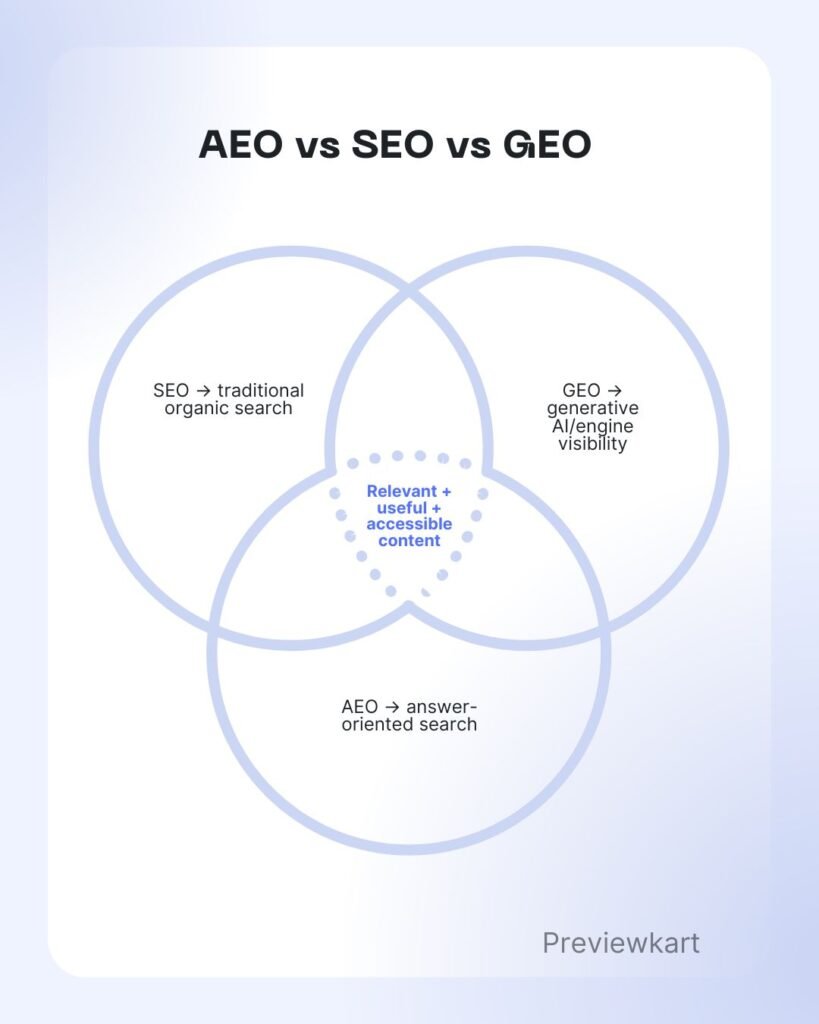
Meanwhile, some practitioners make a distinction between AEO – which targets more traditional extractable answers – and GEO, which targets the newer generative models like ChatGPT and Perplexity. In other corners, the view is that there is no meaningful distinction between the two, and that they’re both variations of AEO. (Profound)
The Findability-Specialist View
Aleyda Solís, owner of international SEO agency Orainti, prefers to think of the evolution from SEO to AEO as an expansion of the same role into a “findability specialist” who can navigate an increasingly fragmented search landscape.
Solís’ research for ClickForest goes into detail about how Google and other traditional search engines continue to dominate discovery for most queries – but also shows how AI-driven search results are rising, threatening to overtake human search results in some areas.
Additionally, Solís’ research underlines a critical nuance that many AEO guides overlook: AI language models are currently trained on predominantly English data, and may offer varying levels of performance in other languages – a crucial consideration for international SEOs. (First Page Sage)
SEO vs. AEO vs. GEO at a Glance
The “Coined / popularized” column below makes use of two particular discoveries: one is that GEO was first mentioned in a 2024 research paper about generative engine optimization by Aggarwal et al., while Andreessen Horowitz appears to have been the one to popularize the term with their May 2025 research publication. (Profound)(Digital Applied)
| Segments | SEO | AEO | GEO |
|---|---|---|---|
| Coined / popularized | 1990s–2000s | Term used by Rand Fishkin from 2017 | Widely popularized after a 2024 academic paper and 2025 industry adoption |
| Typical focus | Organic search rankings | Direct, extractable answers (search + AI) | Generative AI platforms specifically |
| Overlaps with | Both | Both | AEO, heavily |
| Industry consensus on definition | Mature, stable | Still forming | Still forming |
What this means : don’t get hung up on choosing the right acronym. The people who make AEO tend to use whichever terms their team prefers, as long as they’re fulfilling that job description: clear answers with credible evidence, presented technically accessible ways. The work itself is ahead of the terminology.
What Makes Content AEO-Friendly?
Content that performs well for answer engines tends to have a certain structure that also happens to be useful for people trying to read and understand it: Question → Answer → Evidence → Context.
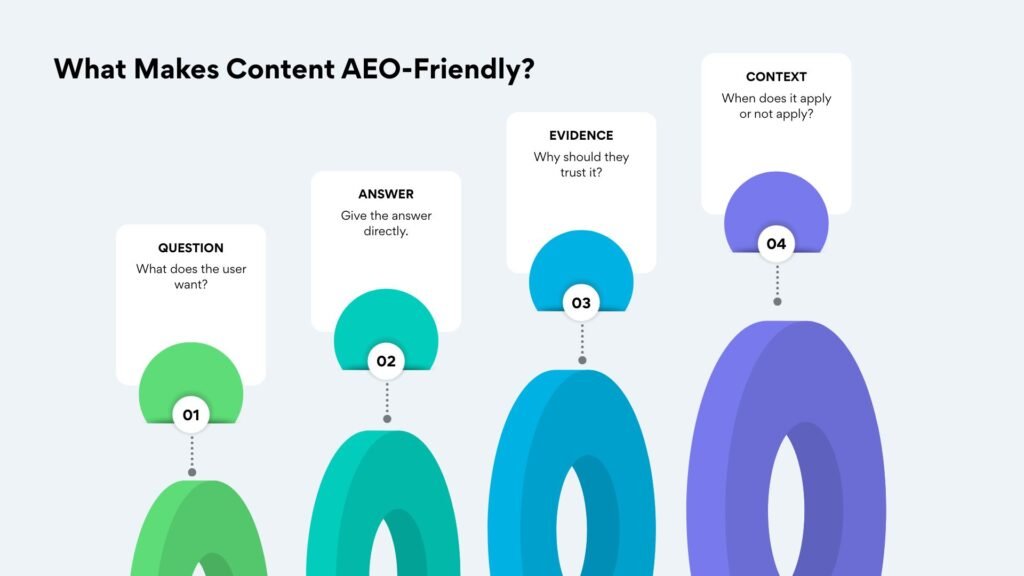
The Question, Answer, Evidence, Context Pattern
- Question: What is the reader trying to find an answer to?
- Answer: What is the page’s position on this question? This should be stated clearly and concisely, ideally right at the beginning of the relevant section.
- Evidence: What evidence supports this position? This could take the form of documented research, third-party testimonials, a worked example, or something similar.
- Context: What exceptions or caveats are there to the evidence presented? This is where nuance belongs.
A Before-and-After Example
To illustrate the difference, here’s a comparison of weaker and stronger writing when it comes to answering the same question.
“There are several reasons companies may consider AEO”
vs.
“Companies tend to consider AEO for three reasons: increased presence in answer-oriented search results, increased likelihood of information being cited or used, and adapting to different phrasings of questions as they appear conversationally.”
The stronger example makes the answer explicit rather than forcing the reader or summarizing program to deduce it from the context.
Applying This to Comparison and Recommendation Content
This same principle applies to recommendation and comparison content, which answer engines will analyze to determine whether the information is relevant to their users.
A weak comparison article (e.g., “Ahrefs vs. Semrush”) will list off features of both products without qualification. A strong comparison will explicitly state which tools fit which budgets, needs, or use cases directly, rather than expecting the reader to infer from a laundry list of similarities and differences.
This helps both the search engine’s algorithm and the user by providing specific, easily accessible evidence relevant to a particular application.
Why First-Hand Evidence Outperforms Generic Claims
The most effective type of evidence for most answer engines is first-hand information. This means that if you’re using a tool to generate SEO-friendly content, test it firsthand and document the process. “This tool is powerful and intuitive to use” is a weaker statement than “We tested this tool and found it to produce [X] result when used with [Y] technique.”
While the latter type of evidence is less valuable if an answer engine has other information contradicting it, it provides much more value to readers trying to determine whether a given recommendation is right for them. In general, first-party documentation should be prioritized whenever possible, regardless of context.
Structured Data and AEO: What It Actually Does
Schema markup is a form of structured data that tells search engines what type of information appears on a given page.
By labeling each piece of information and its relationship to other content, structured markup makes it easier to determine what a page is about. This can include designating a work’s publication date, pricing info for a product page, or anything else that identifies the content and its intended purpose.
What Google Says About Schema and AI Search
It’s crucial to be precise here, as this is one of the most common misstatements in the AEO space. Danny Sullivan has addressed this myth before, emphasizing that it’s not that adding structured data equals an instant win for AI search, but rather that it contributes to a better understanding and presentation of information, similar to its role in standard Search (Search Engine Land).
What Schema Can and Can’t Do
In brief:
- What structured data/markup can do: improve the accuracy of the page structure/content type interpretation
- What it can’t do: secure a mention in an AI answer, citation, or ranking advantage
- What it needs to do to do any of the above: accurately represent the content visible on the page. Schema that describes content that isn’t present or not visible to the eye is misleading, at best
Schema is one of the many technical elements of AEO but not the be-all and end-all of it
Myths About AEO
To truly understand something, one must recognize and be aware of potential misconceptions about it. With that in mind, here are the most common myths about AEO:
- “AEO guarantees citations in AI.” It doesn’t, and no one who knows what they’re talking about claims it does. None of the methods described, from schema to FAQ pages, have that level of guarantee, as visibility ultimately depends on the query, the platform, and the competition for it neither of which one can control
- “All AI platforms are the same.” They are not; Google AI Overviews, ChatGPT, Gemini, and Perplexity all have different approaches to retrieving, analyzing, presenting information as detailed further up, and what works for one might have little to no effect on the others.
“Getting cited means getting recommended.” These are all different results. According to Lily Ray’s study of 100 B2B software queries in Google AI Overviews, self-promotional “best of” listicles were frequently mentioned as sources in AI answers but were not cited directly in the recommendations themselves, while brands that had more mentions in third-party publications were more likely to be recommended overall(Search Engine Land).
- “Schema markup is the cornerstone of AEO.” It is, rather, one of the supporting technical elements, and Danny Sullivan has even remarked on the point that simply adding structured data to a page does not immediately make it rank better in AI search results. Proper schema adds to the page’s general discoverability and visibility in organic search, but it does not replace genuinely useful, well-researched content
- “AEO means SEO is obsolete.” It does not, and that’s an incorrect perspective on the two concepts’ relationship, as AEO is actually an extension of traditional SEO and shares many of its fundamental principles
- “Optimizing for AI means optimizing for the algorithm, not the user.” Content that is optimized for extractability but fails to provide any tangible value is arguably worse than standard SEO fare, as it is unappealing and easily identifiable as such to an actual person while still managing to appear in AI recommendations.
- “AI search works the same everywhere.” As Aleyda Solís’ study demonstrated, AI search engines trained primarily on English-language content could produce different results for users who accessed them in other languages, which could have different implications for representation and discoverability depending on the region and the audience one seeks to reach
The Future of AEO
The terminology around AEO and similar concepts is likely to change and update multiple times as the practices around it continue to evolve. With that in mind, it’s important to note that no one, including the authors of this article, has a definite, ironclad statement about what the future of answer engines will look like or what specific optimizations will eventually be necessary.
One perspective to consider, suggested by Rand Fishkin, is that of evolution; namely, that AEO is part of a broader cycle that includes traditional SEO methods and will eventually lead into other concepts down the road.
The first stage, AEO 2017, occurred when Google transitioned from link-based ranking to answer-oriented search. AEO 2024, according to Fishkin, is “AI-assistive engine optimization,” which emphasizes the shift towards AI assistants that can not only answer questions but also recommend, compare, and ultimately choose between options, rather than merely retrieving information.
Finally, the next stage, which he refers to as “assistive agent optimization,” is about autonomous agents that pick things for the user instead of merely recommending them, essentially making search obsolete as an activity (Search Engine Land)
This is not a future anyone can claim to know with certainty, but it is a possible one. In it, the concepts of SEO are still relevant but are applied more broadly, as optimization for autonomous AI agents must happen on the foundational level, with the very presentation of the content itself, as there’s no other way for an autonomous agent to parse it and understand what it is about
Conclusion
AEO boils down to creating discoverable, easily readable, structured, credible, and relevant information that can be extracted and utilized by answer-oriented search engines in both traditional and emerging AI-powered platforms, which ultimately makes it a natural evolution for SEO rather than a separate concept
It is not mutually exclusive with other forms of optimization, nor does it overshadow them; rather, it serves as an additional channel, with visibility in both traditional search results and AI Overviews being the ultimate aim for any page that uses such methods
As a practice, it touches on all existing areas of SEO but is more concerned with their fundamental principles, as well as the application of specific AEO concepts like direct answers, evidence, and context. It should be seen as an update to general SEO practices that reflects the changes in search behavior and the increasing presence of answer-oriented platforms in people’s daily lives
As such, it helps to break it down into several points: the fundamentals of AEO can be seen as a response to Google’s shift from link-based to answer-based search from 2017, not a 2024-specific innovation;
answer engines analyze and evaluate information before presenting or recommending it which means that conventional keyword optimization techniques will only get one part of the visibility equation;
AEO is, similarly to SEO, an evolving practice, and the similarities it shares with GEO are more of a semantic difference than anything else;
finally, AEO concepts like direct answers help to achieve visibility in AI Overviews but are not a guarantee, and no optimization practices should be used in bad faith since content that is optimized for machine readability but fails to appear in actual search results is, ultimately, wasted.
Frequently Asked Questions
If I rank #1 on Google, am I guaranteed to appear in AI Overviews for the same query?
No. Danny Sullivan and John Mueller of Google have explained that AI Overviews use query fan-out — a single query can be broken into several related sub-searches internally, with results synthesized across all of them.
That means a page influencing an AI Overview doesn’t have to rank #1, or even rank at all, for the literal keyword typed by the user. Conversely, ranking #1 for that exact keyword doesn’t guarantee inclusion, since the system may be pulling from one of the fanned-out sub-queries instead. Rank and AI-answer inclusion are correlated but not equivalent.
Can a brand have strong AEO without strong SEO?
Not in any durable sense. Most AI answer systems — including Google AI Overviews — rely on retrieval-augmented generation: they search the live web first, then generate a response grounded in what they retrieve.
If a page isn’t technically accessible, indexed, or competitive enough to be retrieved in that first step, it has no chance of being part of the answer, regardless of how well the content itself is written. Lily Ray has made this point directly: AEO functions as an extension of SEO, not a parallel track that can succeed independently of it.
Does adding schema markup actually improve citation odds, even marginally?
This is genuinely unresolved, and it’s worth being precise rather than optimistic. Danny Sullivan has stated that adding structured data does not mean automatically winning in AI search — schema supports how systems parse and understand a page, similar to its role in traditional Search, but Google has not published data quantifying any citation-rate improvement from schema alone.
Treat schema as good technical hygiene that removes ambiguity for machines, not as a measurable citation lever. Anyone citing a specific percentage improvement from schema alone is not working from public, verifiable data.
If different AI platforms give conflicting answers about my industry, which one should I trust as the benchmark?
None of them, universally. Google AI Overviews are grounded in live web search and typically show source links. ChatGPT can answer from training data alone or from live browsing, depending on the mode, which changes what it can retrieve. Perplexity is built specifically around citing sources for nearly every claim.
Because their retrieval and evaluation methods genuinely differ, conflicting answers across platforms usually reflect different retrieval processes, not an error in one of them. The practical approach is to track your visibility per platform separately rather than treating any single one as the definitive signal.
Is “citation share” a standardized metric I can benchmark against competitors or industry averages?
No — this is a common point of confusion. “Citation share” and similar terms (e.g., “AI visibility score”) are measurement frameworks built by individual tools and agencies, not audited, industry-standard metrics like domain authority attempts to be. Different vendors calculate them using different methodologies and different prompt sets.
A citation-share number is useful for tracking your own trend over time within one tool, but it is not reliably comparable across tools or treated as an objective external benchmark.
Why would an AI system cite my content as a source but still recommend a competitor?
This is one of the more counterintuitive findings in current AEO research. Lily Ray’s analysis of 100 B2B software queries in Google AI Overviews found that self-promotional “best of” listicles were frequently cited as sources but excluded from the actual recommendation in most cases — while brands with stronger independent, third-party mentions and link profiles were more likely to be the one actually recommended.
The likely mechanism: a system can pull factual details or category context from a page without treating that page’s own self-promotional framing as a credible basis for a recommendation. Being cited and being recommended are measured and earned differently.
Does E-E-A-T (Experience, Expertise, Authoritativeness, Trust) factor into whether AI systems use a page?
E-E-A-T is a documented part of how Google evaluates content quality for Search generally, and Lily Ray’s work treats it as foundational to AI-search performance as well — arguing that AEO extends rather than replaces SEO precisely because signals like demonstrated expertise and credibility still matter to what gets surfaced and trusted.
What isn’t publicly confirmed is a precise, quantified mechanism by which E-E-A-T signals feed into AI Overviews or other platforms’ generation step specifically. Treat it as a well-supported directional factor, not a documented scoring formula.
Should a multinational brand run the same AEO approach across every market and language?
No, and this is an easy point to overlook. Aleyda Solís’s research highlights that AI systems trained predominantly on English-language data can behave inconsistently across other languages and markets — meaning retrieval quality, source availability, and even answer accuracy can vary by language in ways that don’t show up if you’re only testing in English.
A single global AEO strategy risks silently underperforming in non-English markets; testing your actual prompt set per target language is necessary, not optional, for any brand operating internationally.
Will AI agents that book, buy, and act on a user’s behalf make current AEO practices obsolete?
Rand Fishkin frames this as a coming phase rather than a present reality — describing a progression from AEO (2017) to what he calls AI-assistive engine optimization (systems that recommend and compare, not just answer) to an emerging phase he terms assistive agent optimization, where autonomous agents act on a user’s behalf. This is a reasonable forward-looking lens from a credible source, not a confirmed roadmap — nobody, including Fishkin, has published a fixed timeline for it.
What’s more defensible is the underlying principle: clear, well-evidenced, structurally sound content that a system can confidently act on is unlikely to become less valuable as agents get more capable, even if the specific tactics evolve.
If I can only fix one thing to improve AEO performance, what should it be?
There isn’t a single universal answer, because it depends on which step in the process is currently the weakest link for a given page: retrieval (is the page indexed and technically accessible at all), evaluation (is the content credible and well-sourced), or synthesis (is the answer stated clearly enough to extract). For most organizations already investing in SEO, the highest-leverage gap is usually at the evaluation and extraction level — content that buries its conclusion instead of stating it directly, or that makes claims without backing evidence.
Auditing your highest-intent pages against the Question → Answer → Evidence → Context pattern is a reasonable starting diagnostic, but it should follow, not replace, confirming the technical and indexing basics are already solid.
