
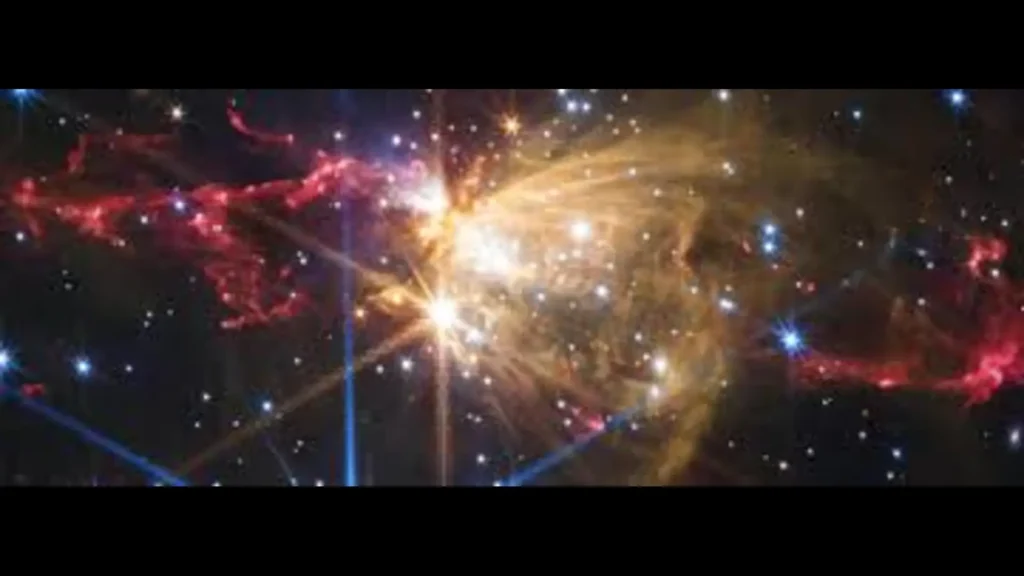
The James Webb Space Telescope (JWST) has once again amazed astronomers with a breathtaking discovery. In its latest observation, Webb captured a rare protostar firing twin jets nearly eight light-years long in the glowing Sharpless 2-284 nebula, located at the edge of the Milky Way.
This discovery isn’t just visually stunning—it could rewrite how scientists understand the birth of massive stars. Unlike chaotic star formation theories, these jets suggest that even the largest stars may grow through a steady, organized process.
At about 15,000 light-years from Earth, this massive protostar—estimated to be ten times the mass of the Sun—acts like a cosmic blowtorch, carving through surrounding gas and dust at unimaginable speeds.
What Makes This Protostar So Special?
NASA describes the discovery as “a double-bladed dueling lightsaber in space.” Here’s why it’s unique:
- Twin Jets: Each jet extends nearly eight light-years, making them among the largest ever observed.
- Perfect Symmetry: The nearly 180° alignment suggests a stable star-forming disk, rather than random chaos.
- Rare Observation: Jets of this magnitude are seldom seen in the star-formation process.
According to lead researcher Yu Cheng, the spectacle is “one of the most spectacular and rare star-forming events ever captured.”
How Does a Protostar Form?
A protostar is the earliest stage of a star’s life, forming when clouds of gas collapse under gravity. As material spirals into the star:
- The protostar heats up.
- Particles in the disk funnel onto the star.
- Some material is ejected in powerful jets of gas and plasma.
In this case, Webb’s infrared imaging allowed astronomers to pierce through cosmic dust and reveal the structure with unprecedented clarity.
Scientific Significance: Steady Growth vs Chaos
The discovery challenges the long-standing debate about how massive stars form:
- Old Theory: Massive stars form chaotically, with violent gas clouds colliding and merging.
- New Evidence from Webb: The symmetry of the jets suggests that even the largest stars may grow steadily through organized disks of gas.
This insight could help scientists recreate early-universe conditions, offering a clearer view of how the first stars in the cosmos emerged.
Comparison: James Webb vs Hubble Discoveries
| Feature | Hubble Space Telescope | James Webb Space Telescope |
|---|---|---|
| Main Strength | Visible and ultraviolet imaging | Infrared imaging, deeper penetration |
| Star Formation Capture | Limited by dust interference | Reveals protostars hidden in nebulae |
| Jet Observations | Shorter, less defined | Extended, sharp twin jets |
👉 While Hubble gave us snapshots of nebulae, James Webb provides clarity that peels back the cosmic curtain.
Pros and Cons of Webb’s Discovery
Pros:
- Confirms stable star-formation models.
- Provides the clearest image of symmetric jets.
- Offers data on the earliest phases of massive star birth.
Cons:
- Limited to infrared observation (can’t capture all wavelengths).
- Interpretations depend on models that still need refinement.
- Data analysis takes time before full confirmation.
Why It Matters for Astronomy
- Understanding Massive Stars: These stars influence the chemical evolution of galaxies.
- Better Models of the Universe: Helps refine how stars and planetary systems evolve.
- Public Engagement: Stunning images inspire the next generation of scientists and space enthusiasts.
For everyday readers, this is more than science—it’s a reminder of how human curiosity and advanced technology can uncover the hidden stories of our galaxy.
Related Space Discoveries You Should Read
- NASA’s Perseverance Rover and Signs of Life on Mars (external)
- Hubble Uncovers Young Blue Straggler Systems (external)
- James Webb Detects Carbon Dioxide in Interstellar Object (internal)
- Latest Space and Science News on PreviewKart (internal)
FAQs: James Webb Protostar Discovery
1. What is a protostar?
A protostar is a young, forming star that hasn’t yet started nuclear fusion. It gathers material from a surrounding disk while ejecting jets of gas.
2. How far is this protostar from Earth?
It lies approximately 15,000 light-years away in the Sharpless 2-284 nebula.
3. Why are the twin jets important?
Their symmetry suggests that massive stars form through steady disks, not chaotic processes, changing how astronomers model star formation.
4. How is Webb different from Hubble in star formation studies?
Webb’s infrared vision cuts through dust clouds, allowing astronomers to see structures Hubble couldn’t.
5. Can this discovery affect our understanding of the early universe?
Yes. Observing such protostars helps recreate the conditions of early star formation, offering insights into how the first galaxies evolved.