
Future of Smart Homes 2026: How AI-Powered Living Will Change The Way We Live Forever
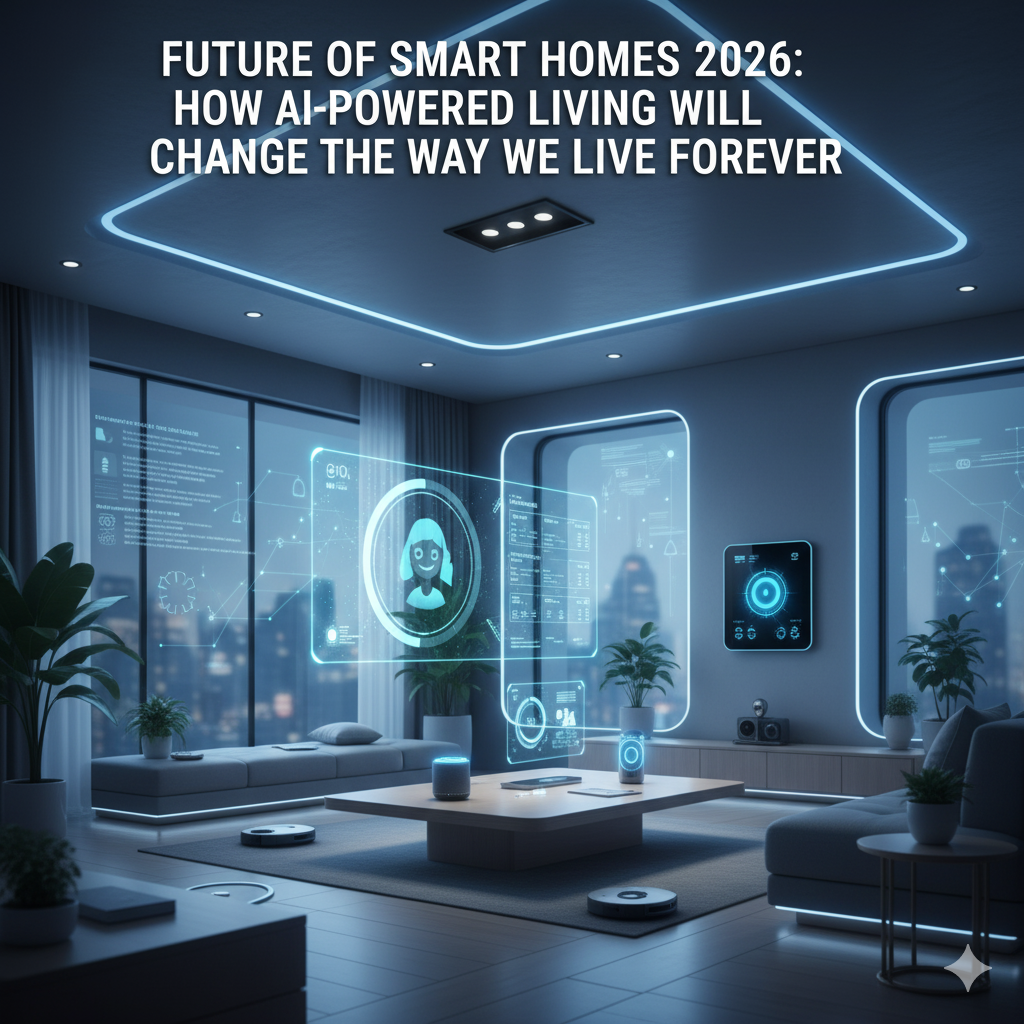
Imagine coming back home after a long day and your lights already dim to your mood, the thermostat is perfectly adjusted, and your voice-assistant greets you with a personalized update on your day. Sounds like sci-fi, right? But this is exactly the kind of experience that AI-powered smart homes promise in 2026.
With the rise of smart home devices, home automation, AI in home systems, and connected gadgets like Alexa, Google Home, and other IoT devices, our homes are slowly transforming into intelligent spaces. In this guide, we’ll look at how AI is changing the game, compare traditional and AI-powered smart homes, explore pros and cons, and answer the most common questions.
We’ll naturally use keywords like “AI smart home devices,” “2026 smart home automation,” “IoT smart lighting,” “AI gadgets home,” and “AI in home security” while keeping it easy to read and humanized.
What’s Driving the Smart Home Revolution?
The rise of IoT and connected devices
The backbone of today’s smart homes is IoT — devices connected to the internet and to each other. In 2024, there were around 17 billion connected devices worldwide (source). As sensors and internet connectivity get cheaper, more homes adopt smart lighting, thermostats, locks, and cameras.
AI enters home automation
Earlier, smart homes needed you to program schedules manually. Now AI can learn your habits, routines, and preferences. For instance, your home could detect when you arrive and switch on heating, lights, or music automatically (source).
Why 2026 is a milestone
Experts predict that by 2026, smart homes will be more affordable, interoperable, and widely adopted. AI-powered home security, predictive energy management, and voice-assistants that understand context are expected to become mainstream (source).
Smart Home Devices to Expect in 2026
Smart lighting, thermostats & energy management
- AI-controlled lights adjust brightness and color based on activity or circadian rhythm.
- Smart thermostats use predictive analytics to save up to 15% on energy bills (source).
- Integration with solar panels and home batteries helps homes become more sustainable.
AI home security, voice assistants & gadgets
- Alexa and Google Home will recognize individual voices, detect context, and act proactively.
- Security cameras may anticipate threats and act before incidents occur (source).
- AI gadgets like smart fridges, ovens, and washers respond to voice or routines automatically.
Interoperability & ecosystems
With standards like Matter maturing, devices from different brands will finally work seamlessly together (source). This is a major shift from today’s siloed ecosystems.
Comparing Traditional vs AI-Powered Smart Homes
| Feature | Traditional Smart Home | AI-Powered Smart Home 2026 |
|---|---|---|
| Automation method | Pre-set schedules | Predictive AI & context-aware actions |
| Interaction | App or voice command | Ambient sensors, proactive AI |
| Energy control | Manual | AI-driven optimization |
| Security | Reactive alerts | Preemptive detection and smart responses |
| Ecosystem | Brand-locked | Interoperable & unified |
Key difference: AI-powered homes act before you even think about it, instead of waiting for commands.
Pros and Cons of AI-Powered Smart Homes
Pros
- Convenience: Home adapts to you automatically.
- Energy savings: AI predicts and optimizes usage.
- Better security: Predictive alerts reduce false alarms.
- Accessibility: Great for elderly or differently-abled users (source).
Cons
- Privacy concerns: More data collection increases risks.
- Interoperability issues: Some devices might still not work together.
- Higher cost: Advanced systems can be expensive.
- Reliability risks: Over-automation may cause glitches (source).
Unique Insights: What 2026 Will Bring
- Emotional intelligence in homes: Detect stress or mood via voice and adjust lighting or music.
- Wellness-focused homes: Air quality, sleep optimization, fall detection.
- Grid-interactive homes: Sell back energy or shift loads based on pricing peaks.
- Edge AI: More decision-making happens locally to reduce latency.
- Lifecycle automation: Homes predict maintenance or device replacements.
How to Prepare Your Home
- Start with one area: smart lights or thermostat.
- Choose interoperable, Matter-certified devices.
- Secure your IoT network with strong passwords and updates.
- Focus on use-cases, not gadgets.
- Plan for future expansion with hubs that can handle multiple devices.
Avoid mixing too many ecosystems and chasing every gadget hype. Prioritize utility and compatibility.
FAQs
Q1: What is an AI smart home?
An AI smart home uses connected devices plus artificial intelligence to learn patterns, adapt to user behavior, and automate actions.
Q2: Are smart lighting and automation worth it in 2026?
Yes. AI makes lighting smarter, energy-efficient, and even wellness-friendly. The value is best when devices are integrated into an ecosystem.
Q3: How does AI in home security differ?
Traditional systems react. AI security predicts abnormal activity and can take actions before incidents happen (source).
Q4: Is it safe to rely on AI home automation?
Yes, if devices follow strong security protocols, like edge processing, encryption, and firmware updates.
Q5: Best smart home devices for future-proofing?
- Matter-compatible
- Edge AI processing
- Integrates with Alexa, Google Home, or SmartThings
- Focused on energy, security, or wellness