
Blue Origin’s New Glenn Rocket: Pioneering Mars Exploration with NASA’s ESCAPADE Mission
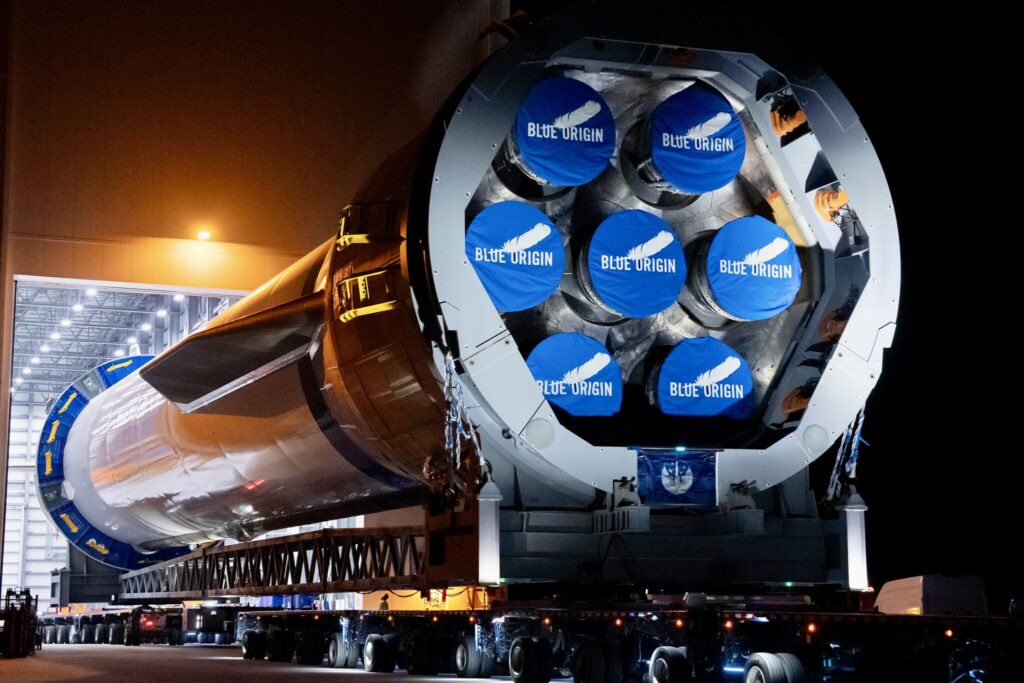
In the exciting world of space exploration, Blue Origin’s New Glenn rocket is slowly making its mark as a strong contender, challenging even SpaceX in some ways. Scheduled for its second flight, New Glenn will carry NASA’s ESCAPADE (Escape and Plasma Acceleration and Dynamics Explorers) mission to Mars. This mission is not just a demonstration of reusable technology but also a big step in interplanetary science. Blue Origin’s partnership with NASA shows how private companies are becoming more important in space research.
What Is the New Glenn Rocket?
Named after astronaut John Glenn, the New Glenn is a heavy-lift rocket developed by Blue Origin. Its main highlight is reusability. The rocket has a two-stage configuration:
- First Stage: Powered by seven BE-4 engines using liquid oxygen and liquefied natural gas (LNG). This stage is designed to land vertically for future reuse (blueorigin.com).
- Second Stage: Features two BE-3U engines using liquid oxygen and liquid hydrogen. It provides the thrust needed to push payloads into orbit (blueorigin.com).
Standing about 98 meters tall, New Glenn can carry up to 45,000 kg to low Earth orbit (LEO) and 13,600 kg to geostationary transfer orbit (GTO) (rocketlaunch.org).
ESCAPADE Mission: Exploring Mars in Detail
The ESCAPADE mission has two identical spacecraft, named Blue and Gold, built by Rocket Lab. These probes will study Mars’ magnetosphere and how solar wind interacts with its atmosphere. Launching from Cape Canaveral later this year, ESCAPADE aims to give scientists more details about how Mars is losing its atmosphere to space (nasa.gov).
New Glenn vs. SpaceX Starship: Quick Comparison
| Feature | New Glenn | SpaceX Starship |
|---|---|---|
| Height | 98 meters | 120 meters |
| First Stage Engines | 7 × BE-4 (LNG/LOX) | 33 × Raptor (Methalox) |
| Second Stage Engines | 2 × BE-3U (LH2/LOX) | 6 × Raptor Vacuum |
| Payload to LEO | 45,000 kg | 100,000 kg |
| Reusability | Yes, first stage | Yes, both stages |
| Primary Use | Govt & commercial launches | Orbital, lunar, Mars missions |
Starship might carry more payload, but New Glenn’s reusable first stage and operational progress makes it a strong competitor.
Pros and Cons of New Glenn
Pros:
- Reusable First Stage: Can land vertically and used again, reducing costs.
- Efficient Engines: BE-4 and BE-3U provide high performance.
- NASA Collaboration: ESCAPADE mission builds credibility and experience.
Cons:
- Delayed Development: Launches took longer than originally planned.
- Strong Competition: SpaceX is still ahead in commercial launches.
FAQs
1. When is New Glenn’s next launch?
The next flight is planned for late October or November 2025 with NASA’s ESCAPADE mission (orbitaltoday.com).
2. How much payload can it carry?
Up to 45,000 kg to low Earth orbit and 13,600 kg to geostationary orbit (rocketlaunch.org).
3. Is New Glenn reusable like Falcon 9?
Yes, the first stage is reusable, similar to SpaceX’s rockets, which helps in lowering launch costs.
4. What missions is it designed for?
New Glenn is for satellite launches, cargo missions, and interplanetary tasks like ESCAPADE.
5. How does it compare with SpaceX Starship?
Starship has bigger payload capacity, but New Glenn’s reusable first stage and current readiness make it competitive.