OpenAI’s ChatGPT Turns Three: Key Milestones, Growth, and What’s Next
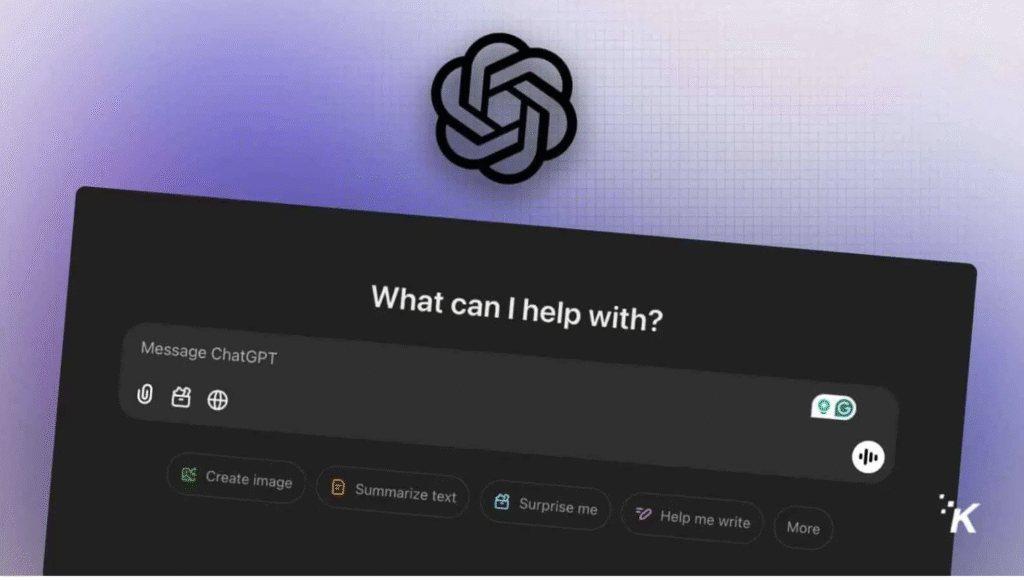
Image credits to KnowTechie
It has now been three years since OpenAI launched ChatGPT in late 2022. What began as a simple conversational model has become a core layer of the digital world, transforming how people work, learn, code, shop, and communicate. Today, ChatGPT stands as one of the most influential technologies of the decade, powering new use cases from multimodal search to autonomous AI agents.
More than a chatbot, ChatGPT has become an ecosystem that touches education, business, entertainment, healthcare, and enterprise automation. As of late 2025, it is used by hundreds of millions around the world each week and is integrated into workflows across almost every major industry.
This article explores how ChatGPT evolved, how it reshaped the AI market, its impact on users and companies, and what to expect in the coming years.
The Evolution of ChatGPT
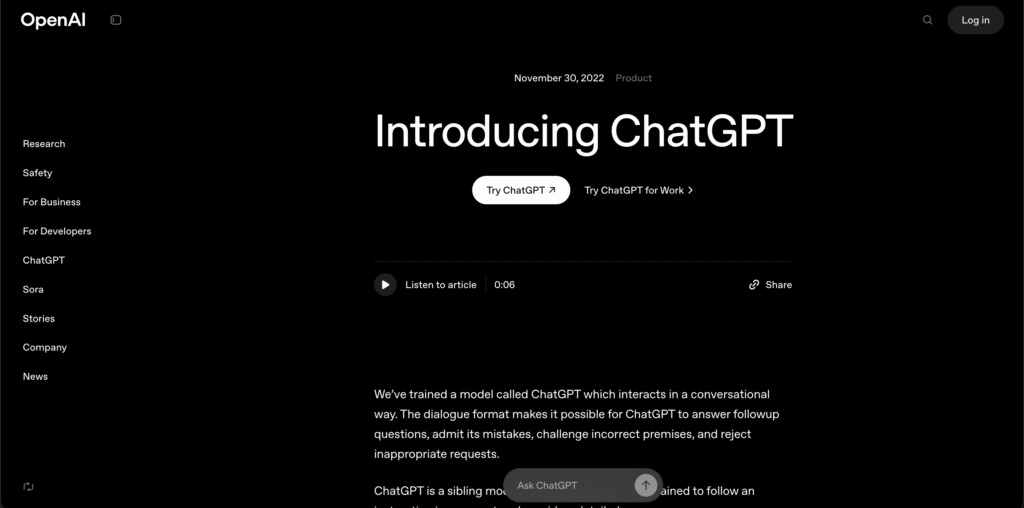
The original ChatGPT launched as a public experiment with a simple goal: make advanced language models accessible to everyone. It was designed to answer questions, help with homework, and generate creative content. No one expected it to become one of the fastest-growing digital services in history.
The real transformation began when the model shifted from GPT-3.5 to GPT-4. Suddenly, ChatGPT could perform more complex analysis, write professional documents, and generate production-grade code. From that point on, ChatGPT stopped being a novelty tool and became an everyday companion for students, analysts, software engineers, marketers, researchers, clinicians, and content creators.
The arrival of GPT-4o marked the breakthrough into true multimodality. Users could speak to it like a voice assistant, upload images, analyze files, and interact in real time. This blurred the line between traditional search engines, productivity tools, and digital assistants.
From there, OpenAI introduced reasoning-focused models that could think through steps instead of guessing quickly. These models were designed to solve math problems, plan strategies, and break down complicated reasoning tasks. The company continued pushing further into agentic AI, creating systems that could take actions on behalf of users such as booking tickets, browsing websites, or summarizing research from external pages.
The goal has shifted from answering questions to getting things done.
The Rise of ChatGPT Agentic AI
The last year has been defined by one major shift: chatbots are evolving into AI agents. Traditional language models respond to prompts, but agents act independently.
Agentic AI can:
- Browse the web
- Fill out forms
- Schedule appointments
- Compile research
- Execute multistep tasks
- Interact with external tools and APIs
This represents a fundamental change in the role of AI. Instead of being a passive advisor, ChatGPT becomes an active digital worker. Businesses are using it to automate onboarding, handle customer service, run marketing funnels, manage knowledge bases, and perform data extraction tasks that used to require large teams.
Developers use it to write unit tests, generate documentation, refactor legacy code, and review pull requests. Designers use it for layout planning and asset generation. Teachers use it to create lesson plans and personalized study guides. For millions of users, ChatGPT is no longer a companion. It is a productivity engine.
ChatGPT Adoption and Market Impact
ChatGPT has penetrated markets in a way few technologies ever have. Its reach is broader than smartphones, streaming platforms, or social networks at the same point in their lifecycle.
Students use it to analyze essays, generate flashcards, and simulate exam questions. Freelancers rely on it for portfolios, contracts, resumes, and client communication. Software teams use it as a coding companion and debugging assistant. Companies integrate it into internal workflows to reduce repetitive labor and accelerate decision making.
Businesses large and small have adopted ChatGPT to:
- Automate administrative tasks
- Draft proposals, reports, and documentation
- Process customer support tickets
- Work with spreadsheets and databases
- Generate images and audio content
- Analyze legal documents and contracts
- Translate and localize communication
- Perform market and competitor research
Entire job categories now expect AI literacy as a requirement. Artificial intelligence has become the equivalent of spreadsheet software in the 90s: not an optional skill but a core competency.
The Competitive Landscape
OpenAI is no longer alone. The race to build the smartest general-purpose AI has created a multi-billion-dollar competition across the world.
Anthropic’s Claude has become a favorite among engineers, researchers, and enterprise developers thanks to its stable reasoning and massive context windows. Meta’s Llama has become the backbone of the open-source ecosystem, powering thousands of independent apps and custom deployments. Google’s Gemini sits deep inside Gmail, Docs, Drive, and Android, giving it massive reach among everyday users.
Each competitor has carved out a unique niche, but OpenAI still maintains a brand halo thanks to its consumer focus and the cultural phenomenon it built around ChatGPT. The company that introduced the world to practical LLMs continues to shape public expectations of what AI should feel like: fast, intuitive, and human-like.
The Push Toward Safety and Regulation
As the influence of generative AI grows, the debate around safety, copyright, and ethics has intensified. Governments across Europe, North America, and Asia are enforcing policies that require transparency in training data, risk classification, and watermarking of generated content. Content creators are pushing back against models trained on their work. News organizations have raised questions about the reuse of their archives in training. Artists continue to call for stronger protections around style replication.
OpenAI has implemented more conservative safeguards to limit election interference, misinformation, deepfake content, and dangerous instructions. Multimodal models that generate video or synthetic voices come with strict restrictions and identification layers. The conversation has shifted from capacity to responsibility. The real challenge is not whether the models can generate realistic audio or images, but how society should manage them.
The Future: AI as an Operating System
The next stage of AI is not about larger models, it is about integration. ChatGPT is positioned to become a personal operating system that understands your calendar, tasks, preferences, and habits. Instead of typing prompts, you will delegate goals. Rather than asking how to format a document, you will request the finished output.
Over the coming years, we will likely see:
- Personalized AI companions embedded into phones, laptops, and wearables
- Digital agents that negotiate prices, book travel, and manage subscriptions
- Local models that run offline and protect privacy
- Hybrid workflows where AI oversees human teams
- New hardware built specifically for AI interaction
The shift is no longer theoretical. AI is becoming embedded into every layer of digital life. ChatGPT will be one of the central pillars of that transformation.
Final Thoughts
What began as a research experiment has reshaped how billions of people interact with technology. The original question was whether a machine could write a poem or help with homework. Today the question is how much of our work and decision making we will delegate to intelligent systems.
ChatGPT’s first three years were about discovery and adoption. The next three years will be about responsibility, integration, and autonomy. We are entering a period where digital assistants will not just answer questions but perform tasks and make suggestions. The line between tool and teammate is getting thinner.
Artificial intelligence is no longer futuristic. It is woven into the way we learn, build, communicate, and solve problems. And the platform that made the world care about generative AI may soon become the platform that runs it.
FAQs — ChatGPT Three Years After Launch
1. What is ChatGPT and why did it become so popular?
ChatGPT is a conversational AI developed by OpenAI. It became popular because it can understand natural language, generate high-quality content, answer questions, assist with coding, and support professional work without requiring technical skills.
2. How many people use ChatGPT today?
ChatGPT has hundreds of millions of weekly active users globally. It is used by students, professionals, freelancers, businesses, and developers for everyday tasks and productivity.
3. How has ChatGPT evolved since it launched in 2022?
It started as a text-only chatbot based on GPT-3.5, then expanded to GPT-4, GPT-4o, and later GPT-5. ChatGPT now supports voice, vision, file analysis, coding assistance, and agent-based task automation.
4. What does “agentic AI” mean?
Agentic AI refers to models that do tasks instead of simply generating answers. These AI agents can browse websites, fill forms, plan schedules, summarize data, or perform multi-step actions with minimal user supervision.
5. Is ChatGPT safe to use?
ChatGPT includes strong guardrails, content filtering, and built-in safety policies. It avoids harmful instructions, refuses unethical tasks, and uses watermarking for sensitive media. Safety continues to evolve with regulations.
6. What industries are using ChatGPT the most?
Education, software development, customer support, marketing, healthcare administration, legal research, data entry, product design, and enterprise automation all use ChatGPT heavily.
7. How is ChatGPT different from Google Search?
Search engines show links and ads.
ChatGPT gives direct answers, generates content, analyzes files, and performs tasks. Search tells you where information is; ChatGPT helps you use it.
8. What are competitors to ChatGPT?
Major competitors include Anthropic Claude, Google Gemini, and Meta Llama. Each offers different strengths in coding, open-source flexibility, document reasoning, or ecosystem integration.
9. Will AI replace human jobs?
AI will automate repetitive, low-value tasks, but it also creates new roles and increases productivity. People who adapt, use AI tools, and learn automation skills will benefit the most.
10. What can we expect from ChatGPT in the future?
Future versions will function as true AI personal assistants. They will manage schedules, execute work tasks, personalize learning, interact across devices, and integrate into apps and operating systems seamlessly.