Apple and Google Partner to Create an AI-Powered Siri: What It Means for iPhone Users
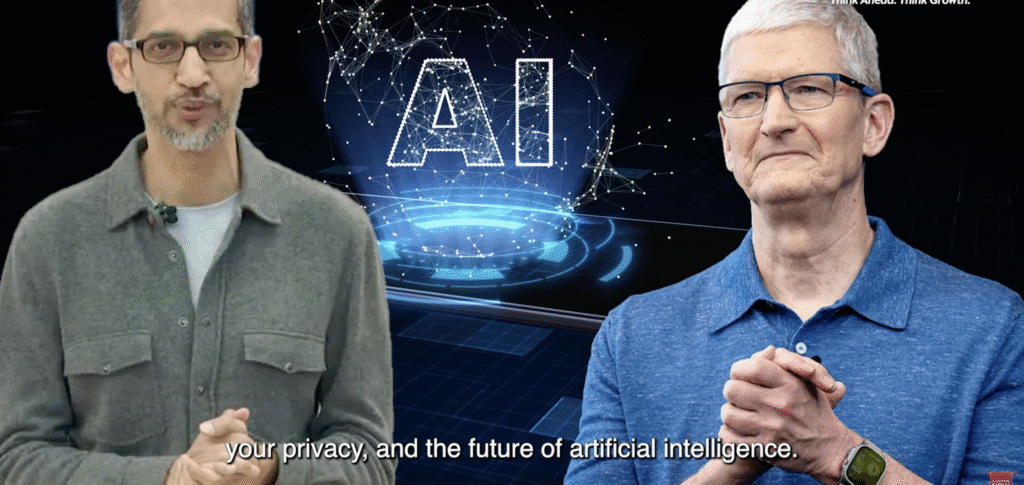
Image credits to Mint
The tech world’s most unexpected partnership is reportedly underway. Apple and Google AI-powered Siri is finalizing a major agreement to use Google’s Gemini AI as the intelligence layer behind a completely new version of Siri. Unlike previous integrations where Siri simply forwards queries to ChatGPT, this is a full backend transformation of Siri’s core intelligence model.
This move could be the biggest strategy shift in Apple’s AI history.
TLDR — Why Apple and Google’s Gemini Deal Matters
- Apple is integrating Google’s Gemini AI into Siri, replacing its outdated intelligence and enabling real context-driven conversations.
- User privacy remains protected, because the AI runs on Apple’s Private Cloud Compute, not Google servers.
- New Siri will handle multi-step commands, summaries, and real-world tasks across multiple apps automatically.
- The deal is a temporary bridge, while Apple develops its own trillion-parameter model to replace Gemini in the future.
- Apple and Google Partner to Create an AI-Powered Siri: What It Means for iPhone Users
- Timeline of the Apple–Google AI Partnership
- The Tech: What Powers the New Siri
- Privacy and Control: Why Google Never Sees Your Data
- What the Gemini-Powered Siri Can Actually Do
- Why Apple Went to Google
- Competitive Positioning
- How This Changes Siri Forever
- Why This Is a Turning Point in Smartphone History
- How It Might Roll Out to Users
- Is This the End of Apple’s AI Independence?
- Conclusion
- FAQs — Apple x Google AI Partnership and the New Siri
- Timeline of the Apple–Google AI Partnership
Timeline of the Apple–Google AI Partnership
Rumors of Apple tapping external AI providers gained traction after the launch of Apple Intelligence. Apple kept its options open, even while working publicly with OpenAI.
The breakthrough came when multiple internal reports confirmed that Apple plans to license Google Gemini to power Siri’s cloud reasoning engine. The goal is to deliver a version of Siri that understands context, plans multi-step tasks, and synthesizes information the way modern LLMs do.
This upgraded Siri is reportedly targeted for a Spring 2026 release, aligning with iOS updates and potential AI-focused hardware announcements.
The Tech: What Powers the New Siri
This partnership is not the same as the optional Siri access to ChatGPT. It is Gemini acting as the brain for Siri itself.
Key differences:
- Gemini becomes the reasoning engine, not a third-party assistant.
- Siri front-end remains Apple, but the thinking happens on Apple servers using Google’s models.
- The project is designed as a white-label integration, meaning users will never see Google branding on Siri.
The model powering Siri is believed to be a large Gemini variant, capable of deep reasoning, contextual memory, and multi-application workflows.
Apple Intelligence models handle local tasks and small contextual jobs.
Gemini handles the complex heavy lifting, like understanding, planning, summarizing, and chaining actions across apps.
Privacy and Control: Why Google Never Sees Your Data
The most important part of this deal is how Apple protects personal data.
Instead of sending data to Google Cloud, Gemini runs on Apple’s Private Cloud Compute — Apple-controlled server clusters built for confidential processing.
Your Siri inputs never leave Apple’s ecosystem, and Google cannot use that data for training, advertising, or analytics.
In practice, this delivers the best of both worlds:
- Google’s model quality
- Apple’s privacy and device integration
What the Gemini-Powered Siri Can Actually Do
Apple’s current Siri is reactive. It executes commands but lacks reasoning, planning, and contextual awareness.
The Gemini version aims to behave like a true AI assistant.
Context Memory
Siri will understand continuity across time.
Example:
“Send the notes from yesterday’s project meeting to my design team.”
Multi-App Automation
Instead of single commands, Siri will perform multi-step tasks.
Example:
“Book dinner near the theatre at 7 PM, add it to my calendar, and text the reservation to John.”
Smart Summarization
Long emails, documents, messages, PDFs, or browsing sessions can be converted into actionable summaries.
The new Siri becomes a full productivity engine rather than a voice remote.
Why Apple Went to Google
Many question why Apple, a company that prefers in-house solutions, would pay to outsource intelligence. The answer is simple: time to market.
Apple’s internal Ajax models have improved but still lag against Gemini in:
- reasoning
- summarization quality
- code understanding
- planning
- multimodal analysis
Google offered a performance advantage and the ability to white-label the model.
This is something OpenAI did not prioritize, and Anthropic was reportedly too expensive.
Apple sees Gemini as a temporary bridge while it builds its own ultra-large model.
Competitive Positioning
OpenAI
Still used for:
- creative writing
- casual conversation
- general knowledge queries
But not as the core brain for iOS automation.
Samsung
Already uses Gemini deeply inside Galaxy AI, offering on-device features and cloud processing.
With Gemini powering Siri, Apple immediately neutralizes Android’s largest perceived AI advantage.
How This Changes Siri Forever
The current Siri suffers from:
- shallow task execution
- weak memory
- zero reasoning
- inability to chain actions
Gemini integration changes it into a cognitive assistant.
Imagine:
- reading your emails
- analyzing your purchase history
- planning your logistics
- booking services
- summarizing documents
- organizing work tasks
- cross-app automation
- multimodal understanding of media
All with one sentence.
Apple is not “replacing” Siri.
It is replacing Siri’s brain.
Why This Is a Turning Point in Smartphone History
This partnership is a strategic weapon for both companies.
For Apple
- Instantly competes with GPT and Galaxy AI
- Buys time to build their own trillion-parameter model
- Offers a dramatic Siri improvement without admitting weakness
For Google
- Becomes the brain of hundreds of millions of iPhones
- Gains ecosystem dominance beyond Android and Pixel
- Establishes Gemini as the standard cognitive model
This is Microsoft–OpenAI levels of strategic importance.
How It Might Roll Out to Users
Based on internal reports and leaks, the launch will be staged:
- iOS Siri upgrade first
- iPad and macOS follow
- support for cloud workflows
- limited beta regions
- phased feature unlocks
Hardware might also play a role. Apple has been experimenting with:
- smart home displays
- AirPods AI features
- health-oriented wearables
The new Siri could be the anchor for Apple’s next ecosystem wave.
Is This the End of Apple’s AI Independence?
Absolutely not.
Insiders describe Gemini as a temporary stopgap.
Apple is aggressively:
- training internal models over a trillion parameters
- building in-house inference compute
- optimizing Private Cloud Compute to run huge models cheaply
The goal:
Replace Google once Apple’s own brain is ready.
Until then, Gemini becomes the nervous system that finally makes Siri usable.
Read Tim Cook as Apple CEO: How Long Will He Stay and Who Will Replace Him?
Conclusion
The Apple–Google partnership is one of the most significant AI deals in tech history.
It is not a chatbot integration, and it is not marketing fluff.
It is an architectural decision to rebuild Siri into a true AI assistant.
Apple keeps total control of user data.
Google supplies world-class intelligence.
Users finally get the Siri they deserved ten years ago.
The new Siri:
- reasons
- remembers
- plans
- automates
- summarizes
- acts across apps
If Apple delivers as reported, the iPhone will leap forward.
One trillion parameters at a time.
FAQs — Apple x Google AI Partnership and the New Siri
1. What exactly is the partnership between Apple and Google?
Apple is reportedly licensing a custom version of Google’s Gemini AI to power the next-generation Siri. The model will run on Apple’s servers, not Google Cloud, ensuring user data remains private.
2. Will Google see or store user Siri data?
No. Gemini runs on Apple’s Private Cloud Compute, which means the AI model performs inference on Apple-owned infrastructure. Google never receives Siri requests or personal data.
3. How is this different from Siri using ChatGPT?
The ChatGPT integration is optional and request-based.
The Gemini integration is core-level. It powers Siri’s reasoning, context, planning, and automation. It becomes the brain of Siri itself.
4. Will the new Siri be branded as “Google powered”?
No. This is a white-label deal. Users will only see Siri and Apple Intelligence branding. The Google backend will be invisible to the average user.
5. Which Siri features will improve the most?
Siri will gain:
- Context memory
- Multi-app automation
- Long-document summarization
- Task planning and reasoning
- Conversational context awareness Think: “Do what I asked yesterday” or “Plan dinner and send invites.”
6. Will the new Siri work offline?
Routine actions will still happen on-device.
Deep reasoning, planning, and summarization will run on Apple Private Cloud Compute for better performance and privacy.
7. Why didn’t Apple just rely on its own AI models?
Apple’s internal Ajax models are strong for local tasks but still trail behind frontier AI like Gemini for multi-step reasoning and cognitive automation.
Gemini is a bridge strategy while Apple finishes its own trillion-parameter model.
8. How does this affect OpenAI’s role on iOS?
OpenAI stays as a creative assistant, mainly for:
- long chats
- storytelling
- ideation
- general information Gemini powers Siri’s intelligence, not the “Ask ChatGPT” feature.
9. Will Android users benefit from this deal?
Indirectly. The partnership:
- increases Gemini’s importance
- accelerates Google AI investment
- sets a benchmark for assistants on all platforms But exclusive Siri features stay Apple-only.
10. When will users actually get the upgraded Siri?
Current internal targets point to a Spring 2026 rollout, likely tied to a major iOS update and phased regional deployment. Apple has not officially confirmed the launch timeline yet.