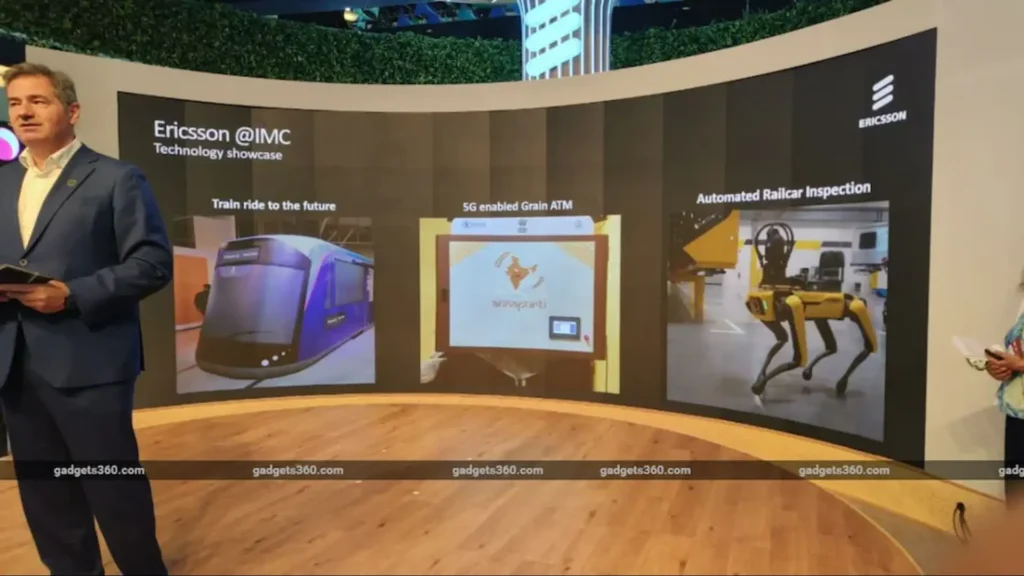
At the India Mobile Congress (IMC) 2025 in New Delhi, Ericsson turned heads with an AI-powered robotic dog built to inspect driverless railcars. The event, held between October 8 and 11 at Yashobhoomi, showcased India’s growing ecosystem of 5G and AI-led innovations.
This smart robot isn’t just a tech showpiece — it’s designed to redefine how rail safety and automation work. Let’s dive into how this innovation could change the future of smart mobility and connectivity.
Ericsson’s Smart Move: Bringing AI to Railways
Ericsson’s robotic dog looks futuristic but serves a deeply practical purpose. It’s equipped with advanced sensors and high-definition cameras that help detect mechanical and system-level faults in automated railcars.
By streaming real-time data through a private 5G network, the robot sends information to AI-powered systems that analyze it for potential issues. This ensures faster maintenance and improved rail safety.
Key Features of Ericsson’s Robotic Dog:
- AI-driven mechanical fault detection
- 5G-based real-time data transmission
- Fully autonomous mobility and obstacle navigation
- Designed for driverless and automated railcars
This marks a big step toward safer, self-managed rail systems in India — and it’s one of the most practical examples of AI-powered robotics in transport so far.
More Than Just a Robot: Ericsson’s 5G Innovations at IMC 2025
Ericsson’s booth at IMC 2025 didn’t just feature the robotic dog. The company also highlighted several real-world use cases where AI and 5G converge to improve lives across different sectors.
1. Annapurti: India’s 5G-Enabled Grain ATM
Ericsson also showcased Annapurti, a Made in India 5G-powered grain ATM developed in partnership with the World Food Programme.
It dispenses 25–30 kg of grains in just 30 seconds using Aadhaar-based biometric verification, ensuring fair and transparent food distribution.
This solution is already live in Bhopal, Lucknow, Varanasi, Shillong, and Gorakhpur, and will expand to 23 more cities by 2026.
2. Fixed Wireless Access (FWA) Expansion
Ericsson announced that its Fixed Wireless Access (FWA) technology now serves 8.4 million users across India, with around 40% penetration in rural regions.
The company claims the service delivers fiber-like speed wirelessly, showing the potential of 5G as a reliable broadband alternative.
3. StethoECG: Healthcare Meets Connectivity
Another interesting innovation was StethoECG, a portable wireless digital stethoscope embedded with an ECG system. Developed with IIT Madras, it uses a 5G SIM for remote heart monitoring and analysis. This device can reach rural and under-resourced regions where access to cardiac care is limited.
How This Impacts India’s AI and 5G Ecosystem
India’s tech landscape is evolving fast, and Ericsson’s 5G applications play a big part in that transformation. By combining AI, robotics, and edge computing, the company is addressing real-world challenges — from food security to healthcare and transportation.
Unique Insights:
- The AI robotic dog can potentially reduce rail inspection downtime by up to 60%.
- Annapurti could revolutionize India’s public distribution system.
- The collaboration between global firms and Indian institutions like IIT Madras shows strong local innovation momentum.
Such partnerships are crucial as India aims to lead in AI-driven automation under the Digital India initiative.
Comparison: Ericsson vs. Global AI Robotics Trends
| Feature | Ericsson AI Robotic Dog | Boston Dynamics’ Spot | Unitree Go2 |
|---|---|---|---|
| Purpose | Railcar inspection | General inspection | Research & entertainment |
| Network | Private 5G-enabled | Wi-Fi/LTE | Wi-Fi/Bluetooth |
| Region | India | Global | China |
| Intelligence Level | AI-based real-time defect analysis | Remote-controlled | Semi-autonomous |
| Commercial Focus | Industrial automation | Multi-industry | Consumer/Research |
While Boston Dynamics’ Spot remains more famous globally, Ericsson’s robot shows a stronger integration with 5G networks, making it ideal for industrial-grade automation in India’s rapidly growing infrastructure sector.
Pros and Cons of Ericsson’s AI Robotic Dog
Pros:
- Enhances safety in driverless transport
- Real-time AI data analysis
- Works seamlessly with 5G private networks
- Reduces maintenance costs
Cons:
- High deployment cost initially
- Needs trained operators and system integration
- Still in early-stage rollout phase
Final Thoughts
Ericsson’s presence at IMC 2025 shows how AI and 5G are shaping the next era of connected technologies in India. The AI-powered robotic dog is more than just a cool demo — it’s a sign of where industrial automation is headed.
With tools like Annapurti and StethoECG, Ericsson is also showing that connectivity can be inclusive, efficient, and meaningful for society.
For more updates on AI innovations and 5G advancements, explore PreviewKart’s Tech section and stay ahead in the world of smart innovation.
FAQs
1. What is the purpose of Ericsson’s AI-powered robotic dog?
It’s designed to inspect automated railcars for defects using AI and real-time 5G connectivity, improving safety and efficiency.
2. Where was the AI robot showcased?
It was displayed at the India Mobile Congress (IMC) 2025, held in New Delhi between October 8–11.
3. What is Annapurti by Ericsson?
Annapurti is a 5G-enabled grain ATM developed with the World Food Programme for automated and transparent food distribution in India.
4. How is Ericsson contributing to India’s 5G growth?
With over 8.4 million FWA users and several AI-driven projects, Ericsson is expanding 5G infrastructure, especially in rural areas.
5. Which other innovations did Ericsson showcase at IMC 2025?
Besides the robotic dog, Ericsson presented Annapurti and StethoECG — both powered by 5G and AI to serve essential public needs.